

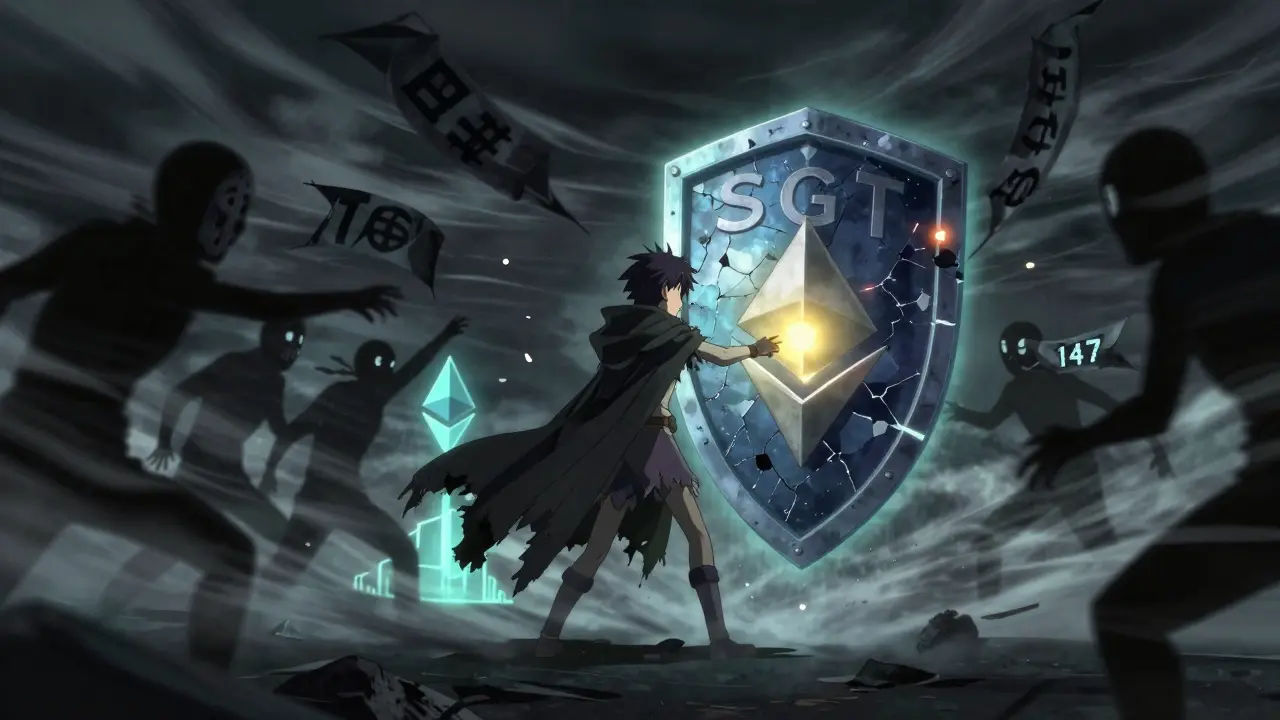
The name Shill Guard Token (SGT) sounds like it should be a shield against scammy crypto promotions - the kind of hype you see on social media where someone pushes a coin with no substance, just to cash out. But in reality, SGT doesn’t guard against anything. It’s a token with no clear purpose, no team, no roadmap, and almost no one using it.
Launched in 2023 on the Ethereum blockchain, SGT is an ERC-20 token with the contract address 0xa0e7626287bd02cbe3531c65148261bf0c0ed98b. That’s all the official information you’ll find. There’s no whitepaper. No GitHub repo. No team members listed anywhere. No Discord or Telegram. Just a token name that tries to sound helpful while offering zero real functionality.
As of October 2025, SGT trades at around $0.001273. That’s down more than 91% from its all-time high of $0.014652. The daily trading volume? Just $2,500. For comparison, Bitcoin moves over $25 billion every day. SGT’s volume is so low that even a $100 trade could swing the price by 20-30% due to lack of buyers and sellers. That’s not a market - it’s a playground for manipulators.
Here’s the odd part: LiveCoinWatch lists SGT’s market cap as $0.0 - even though it claims there’s a circulating supply. That’s a red flag. A real token with tokens in circulation must have a market cap. If it says $0.0, either the data is broken, or the token’s supply is fake. Either way, it’s not trustworthy.
Some sites like CoinCodex say the RSI is at 68.43, meaning it’s "approaching overbought." They even predict it’ll jump 228% to $0.004278 by mid-2025. But here’s the truth: those predictions are based on math, not facts. With only 12 tweets in 90 days and zero Reddit threads, there’s no real demand. No community. No reason for the price to rise. Those forecasts are just noise.
And what about the "shill guard" part? The name suggests it blocks fake promotions or flags scammy influencers. But there’s zero technical explanation of how it does that. No smart contract logic. No API. No integration with any platform. It’s just a name. No different from a coin called "Crypto Tax Helper" that doesn’t file taxes.
Compare this to real anti-fraud tokens like CertiK (CTK). CertiK has a team, audits, partnerships, and over $15 million in daily volume. It’s used by exchanges and projects to verify security. SGT? It’s not listed on any major exchange. You can’t buy it on Binance or Coinbase. You have to manually enter its contract address into a decentralized exchange like Uniswap. That’s not user-friendly - it’s risky. You could easily paste the wrong address and lose your money to a fake token.
Even the wallet holders are few. Etherscan shows only 147 unique addresses holding SGT. That’s fewer than a small Discord server. Bitcoin has over 46 million active addresses. Even obscure tokens with real use cases have thousands. SGT has less than 200. That’s not a project - it’s a ghost.
And the timing? SGT appeared right when a wave of "anti-shill" tokens hit the market in early 2023. Chainalysis flagged that period as a spike in scam tokens with names like "AntiShill," "NoFOMO," or "TruthCoin." Most of them vanished within months. SGT fits that pattern perfectly: catchy name, zero transparency, no development, low volume.
The U.S. SEC warned in October 2025 about tokens using "vague protective claims" to trick investors. That’s exactly what SGT does. It uses language that sounds responsible - "guard," "shield," "protection" - to lure people into buying something that does nothing. No regulator, no analyst, no reputable news site like CoinDesk or Cointelegraph has ever covered SGT. That’s not an accident.
If you’re thinking of buying SGT, ask yourself: Why would anyone build a token to fight shilling if they can’t even explain how it works? Why is there no developer activity for over two years? Why does it have less trading volume than a single tweet thread?
The answer is simple: it doesn’t have a purpose. It’s not a tool. It’s not a solution. It’s a speculative gamble wrapped in a misleading name. And with 98.7% of similar micro-cap tokens going to zero within a year, according to Messari’s 2024 study, the odds are stacked against you.
There’s no harm in knowing about SGT. But there’s huge risk in investing in it. If you’re looking for crypto that actually does something - whether it’s DeFi, privacy, or security - there are hundreds of better options. SGT is just noise.
Is Shill Guard Token (SGT) a real cryptocurrency project?
No, SGT is not a legitimate cryptocurrency project. It lacks a whitepaper, development team, GitHub activity, or official community channels. Its only claim to fame is a name that suggests it fights crypto scams - but it provides no technical mechanism to do so. Most reputable sources, including CoinGecko and CoinMarketCap, don’t categorize it meaningfully, and no major media outlet has covered it.
Can I buy Shill Guard Token on Binance or Coinbase?
No, SGT is not listed on Binance, Coinbase, or any other major centralized exchange. The only way to buy it is through decentralized exchanges like Uniswap or PancakeSwap by manually entering its contract address. This process is risky because it leaves you vulnerable to fake tokens - a common scam tactic. Legitimate projects are listed on exchanges after meeting security and liquidity standards.
Why is SGT’s market cap listed as $0.0?
The $0.0 market cap shown by LiveCoinWatch is a red flag. It suggests either a data error or a broken tokenomics structure. Market cap is calculated by multiplying price by circulating supply. If supply exists but market cap is zero, it means the data doesn’t add up - which is typical for tokens with fake or unverified supplies. Real projects always have a calculable and consistent market cap.
Does SGT actually prevent shilling in crypto?
No. Despite its name, SGT has no functionality to detect, block, or report shilling. There is no smart contract feature, API, or integration that supports this claim. The name is purely marketing. Real anti-shilling tools, like CertiK’s audit system or blockchain analytics platforms, have documented features and partnerships. SGT has none.
Is SGT a scam or a honeypot?
While there’s no proof of malicious code, SGT matches the pattern of a honeypot scam: a token with a persuasive name, no development, low liquidity, and minimal holders. CertiK’s Q3 2025 report found that over 80% of tokens with "protective" names in 2023 were later found to have code that blocked sells or locked liquidity. SGT shows zero contract changes since launch, and no one can sell large amounts without crashing the price - a classic sign of a trap.
Should I invest in SGT?
No. With a 91% price drop from its peak, $2,500 daily volume, no team, no roadmap, and no community, SGT has no fundamental value. It’s a micro-cap token with extreme volatility and zero utility. The risk of losing your entire investment is very high. Even if you believe in the idea of fighting shilling, there are far better, transparent projects to support - SGT is not one of them.





Comments (16)
blake blackner
February 10, 2026 AT 09:26 AMbro this token is a joke 😂 literally named like it's gonna save us from shills but it's just a ghost coin with 147 wallets... i've seen more activity in a meme subreddit thread. if you're buying this you're not investing, you're donating to a crypto ghost story.
Andrea Atzori
February 10, 2026 AT 20:35 PMThis is a chilling example of how emotional language can be weaponized in finance. The very notion of a 'Shill Guard' preys on our desire for safety-yet delivers zero structural integrity. It is not merely a failed project; it is a psychological trap, dressed in semantic armor. We must educate, not speculate.
Joe Osowski
February 12, 2026 AT 10:35 AMUSA is full of people who think a cool name = a real product. This SGT nonsense? Pure garbage. No team. No code. No future. And you know what? I'm sick of these micro-cap scams trying to look like they're doing something noble. America doesn't need more crypto snake oil.
Gaurav Mathur
February 12, 2026 AT 21:52 PMSGT is a honeypot. Contract has no sell function. Liquidity locked. Only 147 wallets. All signs point to rug. No need for whitepaper when the code does the talking. Trust no one. Check the contract. Always.
Jeremy Lim
February 14, 2026 AT 15:04 PMI mean... I read the whole thing. And I'm just... wow. 😳 The market cap at $0.0? That's not a glitch. That's a funeral bell. And the RSI prediction? Ha. I'm out. No more crypto dreams for me.
kelvin joseph-kanyin
February 15, 2026 AT 06:47 AMYOOOOO THIS IS WHY WE NEED EDUCATION IN CRYPTO 😤 SGT ISN'T A PROJECT IT'S A MIND TRICK. PEOPLE ARE STILL BUYING THIS? BRO. GO LOOK AT CERTIK. REAL STUFF. REAL TEAMS. REAL AUDITS. STOP CHASING NAMES AND START CHASING CODE. 🚀
Elizabeth Choe
February 17, 2026 AT 00:17 AMI love how the name 'Shill Guard' sounds like a superhero, but the reality? It's a ghost haunting a blockchain with no purpose. 🕯️ It's heartbreaking, honestly. People put their money into vibes, not value. And that's how you lose everything. Don't be that person.
Grace Mugambi
February 17, 2026 AT 08:03 AMIt's fascinating how language shapes perception. We're wired to trust words like 'guard,' 'shield,' 'protection.' But when those words are divorced from function, they become mirrors-not shields. SGT reflects our hunger for safety in a space designed to exploit it. The real question isn't about the token... it's about us.
Crystal McCoun
February 17, 2026 AT 09:01 AMI'm so glad someone finally broke this down. The market cap being $0.0? That's not an error-that's a neon sign saying 'DANGER.' And the 147 wallets? That's less than a high school class. If you're holding this, you're not an investor-you're a statistic. Please, please, please do your homework before you click 'buy.'
Elijah Young
February 18, 2026 AT 22:45 PMI've seen this pattern before. A name that sounds responsible. Zero transparency. Low volume. No team. It's not a scam because the code is malicious-it's a scam because the whole premise is manufactured. People don't get scammed by code. They get scammed by hope.
Beth Trittschuh
February 20, 2026 AT 05:19 AMI wonder... if SGT had been called 'Crypto Whisperer' or 'Chain Whisper' instead of 'Shill Guard'... would anyone have even noticed? The name is the entire product. And that's the tragedy. We've turned crypto into a branding contest. 🤔
Donna Patters
February 20, 2026 AT 16:43 PMThis is precisely the type of financial frivolity that erodes institutional credibility. A token with no utility, no governance, no oversight-yet marketed with moralistic language-is not innovation. It is fraud dressed as philosophy.
Michelle Cochran
February 22, 2026 AT 15:46 PMI feel bad for the people who bought this. Not because they're dumb-but because they believed in a lie that sounded like truth. 'Shill Guard'? What a cruel joke. The real shill was the name itself. And now they're left holding digital confetti.
Peggi shabaaz
February 22, 2026 AT 22:56 PMhonestly i just scroll past these tokens now. too much noise. if it doesnt have a team pic or a github commit in 6 months, its not real. sgt? nah. i dont even click the link anymore. peace out
Sanchita Nahar
February 24, 2026 AT 10:24 AMthis is why crypto is dying. people buy names not tech. sgt is dead. move on.
Ben Pintilie
February 25, 2026 AT 19:13 PMlol i saw this on a tweet and thought 'this is a joke'... then i checked the chart... and it's still alive?? 😵💫 i'm out. nope. not buying.