

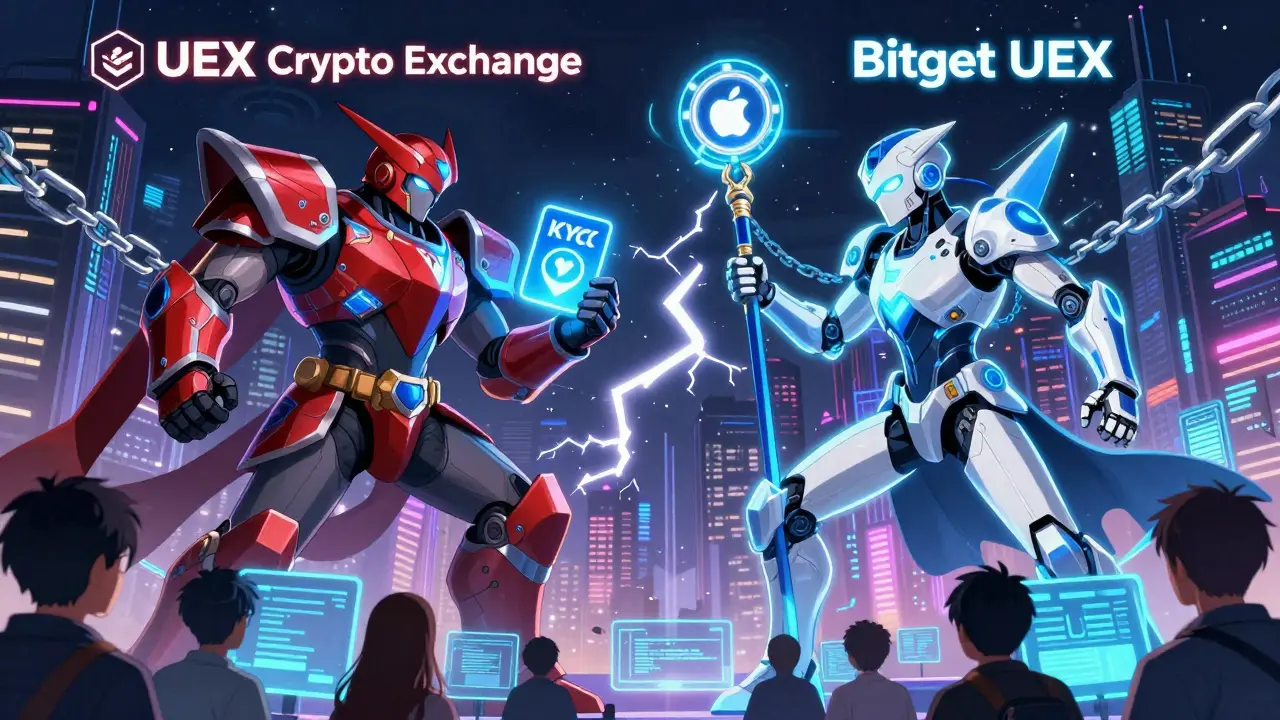
When you search for UEX crypto exchange, you’re not getting one answer-you’re getting two completely different platforms under the same name. That’s not a coincidence. It’s confusion by design. One is a U.S.-regulated crypto exchange built for compliance. The other is Bitget’s ambitious rebrand of their entire platform as a "Universal Exchange." If you’re trying to decide where to trade, this mix-up could cost you time, money, or worse-your assets.
What Is the Real UEX Crypto Exchange?
The standalone UEX Crypto Exchange is a U.S.-registered Money Service Business (MSB), meaning it’s legally required to follow federal anti-money laundering and customer identification rules. That’s not just a badge-it’s a barrier. Most scam platforms avoid KYC like the plague. UEX requires it. Every user must verify their identity with government-issued ID, proof of address, and sometimes even a selfie holding their document. It’s slow. It’s annoying. But it’s also the first sign you’re dealing with a serious operation. This isn’t a offshore shell company hiding in a tax haven. UEX operates under the watch of U.S. financial regulators. That means if something goes wrong, you have legal recourse. You can file complaints. You can demand accountability. That’s more than you can say for 90% of the crypto exchanges out there. Their security setup is straightforward and solid. Over 95% of user funds are held in cold storage-offline wallets that can’t be hacked remotely. Accessing those funds requires multiple digital signatures, meaning no single employee can move money without approval from at least two others. All data is encrypted end-to-end. Fraud detection tools scan every transaction in real time. And they don’t just say they’re secure-they hire third-party auditors to test their systems every quarter. TechBullion called it "exactly what we’d expect from a reputable exchange." That’s not marketing fluff. That’s industry-standard best practice.Then There’s Bitget’s "Universal Exchange" (Also Called UEX)
Don’t let the name fool you. Bitget’s "Universal Exchange" (UEX) isn’t a separate platform. It’s a rebranding of their entire ecosystem, launched in early 2025 to mark their seventh anniversary. This isn’t about compliance. It’s about expansion. Bitget’s UEX aims to merge Wall Street with crypto. You can now trade not just Bitcoin and Ethereum, but tokenized versions of Apple, Nvidia, Tesla, and other major stocks. They partnered with xStocks and Ondo Finance to turn real-world equities into blockchain-based assets. You don’t own the stock-you own a digital token that mirrors its price. Same with ETFs. You can even trade futures on these assets using crypto as collateral. They’ve also added support for four major blockchains: Ethereum, BSC, Base, and Solana. That means you can move assets across networks without jumping between platforms. Their AI tool, GetAgent, gives real-time trading signals and can automate simple strategies. CEO Gracy Chen said it bluntly: "Crypto doesn’t need to compete with Wall Street-it can integrate with it." Security here is different. Instead of just cold storage, Bitget uses a hybrid custody model-some funds offline, some in hot wallets with real-time monitoring. Their biggest selling point? A User Protection Fund worth over $700 million. That’s money set aside to cover losses if something goes wrong. And they prove it every month with Proof of Reserves (PoR) reports using Merkle Tree verification. In September 2025, their reserve ratio hit 186%. That means for every $1 users have deposited, Bitget holds $1.86 in assets. That’s not just safe-it’s unusually strong.So Which One Should You Use?
If you live in the U.S. and want to trade crypto without worrying about legal gray zones, the standalone UEX Crypto Exchange is your best bet. It’s regulated, transparent, and built for users who care about safety over anonymity. If you’ve been burned by unregulated exchanges before, this one gives you peace of mind. But if you hate paperwork and want instant access, UEX might feel too slow. If you’re outside the U.S., or you’re tired of trading just crypto, Bitget’s UEX is the wilder, more powerful option. You can trade stocks, ETFs, and crypto all in one place. You get AI tools, higher liquidity, and a massive safety fund. But you’re also trusting a global platform with complex regulations and less direct oversight from U.S. authorities. It’s more feature-rich, but also more complex. Here’s the bottom line: If you’re looking for a simple, compliant crypto exchange, go with the U.S.-based UEX. If you want to trade crypto and stocks together, and you’re comfortable with a global platform, Bitget’s UEX is the only game in town.
What You Won’t Find on Either Platform
Neither UEX offers anonymous trading. No KYC? No access. That’s a dealbreaker for privacy purists, but it’s also what keeps them out of the scam zone. Neither supports direct bank deposits via ACH or wire transfer. You’ll need to deposit crypto from another wallet or use a third-party fiat on-ramp like MoonPay or Ramp. Neither has a mobile app that’s widely reviewed. Both have apps, but user feedback is sparse. If you’re used to trading on Binance or Coinbase with polished interfaces, you’ll notice UEX’s app feels more utilitarian. Bitget’s app is slicker but packed with features that can overwhelm beginners. You won’t find high-yield staking on UEX. They focus on trading, not lending. Bitget does offer staking and savings products, but those come with higher risk-and less transparency about where the yields come from.Who Is This For?
Use the standalone UEX Crypto Exchange if:- You’re a U.S. resident and want a fully regulated platform
- You value legal protection over anonymity
- You trade Bitcoin, Ethereum, and major altcoins only
- You want clear, documented security practices
- You want to trade tokenized stocks and ETFs alongside crypto
- You’re comfortable with global platforms and complex features
- You want AI-driven trading tools
- You care about Proof of Reserves and a $700M safety fund

What’s Next?
The standalone UEX Crypto Exchange isn’t going anywhere. It’s quietly growing its user base among compliance-minded traders. It won’t add exotic assets or AI bots. It doesn’t need to. It’s doing one thing well: being a safe, legal place to trade crypto in the U.S. Bitget’s UEX, on the other hand, is racing ahead. They’re adding new assets, new partnerships, and new features every month. But with that speed comes risk. Will regulators in Europe or Asia crack down on their tokenized stocks? Will their hybrid custody model survive a major market crash? We don’t know yet. But right now, they’re the only exchange offering this kind of convergence between traditional finance and crypto.Frequently Asked Questions
Is UEX Crypto Exchange safe?
Yes, the standalone UEX Crypto Exchange is safe for U.S. users. It’s registered with FinCEN as a Money Service Business, uses cold storage with multi-signature access, and undergoes regular third-party security audits. Its compliance with U.S. regulations makes it far less risky than unregulated exchanges.
Is Bitget’s Universal Exchange the same as UEX Crypto Exchange?
No. They are completely different platforms. The UEX Crypto Exchange is a U.S.-based, regulated crypto-only exchange. Bitget’s Universal Exchange (UEX) is a global platform that combines crypto with tokenized stocks and ETFs. The shared name is misleading-many users confuse them, but they have no affiliation.
Can I trade stocks on UEX Crypto Exchange?
No. The standalone UEX Crypto Exchange only supports cryptocurrencies like Bitcoin, Ethereum, and other major altcoins. If you want to trade Apple or Tesla stock as crypto assets, you need to use Bitget’s Universal Exchange platform.
Does UEX have a mobile app?
Yes, both platforms have mobile apps, but user reviews are limited. The standalone UEX app is functional but basic, focused on trading and KYC. Bitget’s app is more feature-rich with AI tools and stock trading, but it can be overwhelming for beginners. Neither app has a large volume of verified user feedback yet.
Which one has better security: UEX or Bitget UEX?
Both have strong security, but they approach it differently. UEX Crypto Exchange relies on cold storage and regulatory compliance. Bitget’s Universal Exchange adds a $700M User Protection Fund and monthly Proof of Reserves reports. If you want transparency and asset backing, Bitget wins. If you want simplicity and U.S. legal protection, UEX is better.
Is KYC required on UEX?
Yes, KYC is mandatory on both platforms. The standalone UEX Crypto Exchange requires full identity verification to comply with U.S. law. Bitget’s Universal Exchange also requires KYC globally, though requirements may vary by region. There are no anonymous trading options on either platform.






Comments (22)
michael cuevas
December 8, 2025 AT 18:30 PMSo let me get this straight... one UEX makes you jump through hoops so the government doesn't lock you up, the other lets you trade Tesla as a crypto token and calls it innovation? Sounds like the difference between a library and a carnival. I'll take the library. At least the books don't vanish when the lights go out.
Also why does everyone act like KYC is the devil? If you're not doing anything sketchy, why hide?
Annette LeRoux
December 9, 2025 AT 00:07 AMThis is actually kind of beautiful in a chaotic way 🤔
One platform is like a quiet monk who follows every rule, wears sandals, and meditates on security.
The other is a tech bro in a Tesla wearing a suit made of blockchain fibers, screaming "I AM THE FUTURE" while trading Apple shares as NFTs.
We're living in the weird future everyone predicted. And honestly? I'm not sure which one I want to be friends with. 😅
Manish Yadav
December 10, 2025 AT 08:19 AMThis is why America is going to hell. You people care more about paperwork than making money. Why do you need ID to trade crypto? Crypto is for freedom! You want to be safe? Then don't touch it. Stop being weak.
Vincent Cameron
December 10, 2025 AT 10:47 AMIt's not about which exchange is better. It's about what kind of person you are. Are you the kind who seeks order in chaos? Then UEX is your temple. Or are you the kind who believes reality is just a suggestion? Then Bitget is your playground.
We don't choose platforms. We choose identities. And right now, the internet is just a mirror.
Doreen Ochodo
December 11, 2025 AT 21:58 PMIf you're in the US and you care about your money, pick the regulated one. Simple. No drama. No guesswork. You don't need fancy AI bots to be safe. Just follow the rules. You got this 💪
Yzak victor
December 13, 2025 AT 09:00 AMHonestly I think both are kinda cool in their own way. One’s like your responsible older sibling who always pays bills on time. The other’s like the cousin who throws wild parties but somehow always has snacks and a backup generator.
Depends what you’re in the mood for. I use both. No shame.
Holly Cute
December 13, 2025 AT 17:03 PMLet’s be real - the ‘standalone’ UEX is just a regulatory puppet. They’re not safe, they’re just compliant. Meanwhile Bitget’s $700M fund? That’s not protection - it’s a liability hedge. They’re betting you won’t cash out before they go under.
And don’t get me started on tokenized stocks. You don’t own Apple. You own a promissory note written by a guy in Singapore who doesn’t even know what a balance sheet is. This isn’t innovation. It’s financial cosplay.
Chris Mitchell
December 15, 2025 AT 16:47 PMKYC isn’t the enemy. Anonymity is the problem. If you can’t prove you’re human, you shouldn’t be trading. End of story.
nicholas forbes
December 16, 2025 AT 06:46 AMI get why people are confused. I spent three hours last week trying to figure out which UEX was which. I just wanted to buy some ETH. Now I feel like I need a law degree.
Maybe they should just pick a name. Or at least add a disclaimer. This is why people lose money.
Regina Jestrow
December 17, 2025 AT 12:07 PMWait… so if I trade tokenized Tesla on Bitget, do I get free Supercharger credits? 😅 I’m just kidding… mostly. But seriously, how do they even price these? Is it based on Tesla’s real stock? Or is it just a wild guess? I need to know before I risk my rent money.
Martin Hansen
December 19, 2025 AT 00:09 AMIf you’re using UEX because you ‘want safety,’ you’re already behind. Real traders don’t care about compliance. They care about leverage, liquidity, and speed. This whole article reads like a SEC brochure written by someone who thinks ‘blockchain’ is a type of yoga.
Bitget’s the only platform that understands the future. The rest are just museum exhibits.
Lore Vanvliet
December 19, 2025 AT 21:04 PMUSA thinks it owns crypto now? 😂 You think KYC makes you safe? That’s what China says too. You’re not protecting users - you’re turning them into data points for the surveillance state. Bitget is freedom. UEX is a prison with a better UI.
Frank Cronin
December 21, 2025 AT 13:22 PMLet me guess - you wrote this article because you got paid by UEX’s PR firm. Or maybe you’re just a boring accountant who thinks ‘cold storage’ is a romantic term.
Bitget’s got real innovation. UEX? It’s a spreadsheet with a logo. Congrats, you made crypto as exciting as filing your taxes.
miriam gionfriddo
December 23, 2025 AT 03:03 AMI just tried to sign up for UEX and my ID got rejected because my driver’s license had a smudge. Now I’m stuck in a 3-day verification loop. Meanwhile Bitget let me trade 50 ETH in 2 minutes. Who’s really safe here? The one with the form or the one with the money?
Nicole Parker
December 24, 2025 AT 02:57 AMI think this whole situation is kind of poetic. One platform is built on rules - the other on possibilities. One says ‘no’ to risk. The other says ‘what if?’
Maybe we don’t need to pick one. Maybe we need to accept that crypto is no longer just one thing. It’s two worlds colliding. And honestly? I’m not sure which one I’m more afraid of - the bureaucracy or the chaos.
But I’m glad someone’s documenting it. We’re all just trying to figure it out as we go.
Kenneth Ljungström
December 25, 2025 AT 03:19 AMI use both. UEX for my long-term HODLing, Bitget for my daily trades. It’s like having a savings account and a checking account. One’s for peace of mind. The other’s for fun.
And yes, I know the names are confusing. But hey, at least they didn’t call one ‘UEX Pro’ and the other ‘UEX Lite.’ That would’ve been a nightmare.
Cristal Consulting
December 26, 2025 AT 02:56 AMIf you’re in the US and you’re not using the regulated one, you’re playing Russian roulette with your crypto. Stop being cool. Be smart. 💯
Tom Van bergen
December 26, 2025 AT 12:16 PMThe whole ‘rebrand’ thing is just corporate gaslighting. You don’t get to rename your platform and pretend it’s a different entity. That’s not innovation, that’s fraud. And the fact that people are falling for it just proves how gullible the crypto crowd is
Sandra Lee Beagan
December 26, 2025 AT 20:55 PMAs a Canadian, I’ve been watching this with amusement. We don’t have a U.S.-regulated UEX, but we do have the same confusion with Binance and Binance.US. It’s like every exchange thinks ‘branding’ means ‘copy the name and hope no one notices.’
My advice? Always check the domain. UEX.com ≠ bitget.com. And if you’re not sure? Use a third-party verification tool. Don’t trust the logo.
Ben VanDyk
December 28, 2025 AT 17:58 PMThis post is 90% fluff. You could’ve said ‘there are two UEXs, one is regulated, one isn’t’ in 3 sentences. You turned a simple warning into a 2000-word manifesto. Lazy.
Nina Meretoile
December 30, 2025 AT 10:20 AMI love how crypto keeps evolving into something no one expected. One side is like a bank that finally got its act together. The other is like a sci-fi movie where stocks are NFTs and AI trades for you.
Neither is perfect. But both are real. And honestly? I’m kind of proud of us for building this mess. 🌱
Barb Pooley
December 30, 2025 AT 16:37 PMI don’t trust either of them. The ‘regulated’ one is just a front for the government. The ‘global’ one is a front for hedge funds. They’re both controlled by the same people. This is all a distraction. They want you to think you’re choosing - but you’re just picking which cage to sit in.