


AI Blockchain Comparison Tool
How NeuroWeb Stands Out
Most AI blockchains focus on training AI models or renting GPU power. NeuroWeb creates a decentralized knowledge graph that verifies real-world information. This tool compares NeuroWeb's approach with other leading AI blockchains.
Comparison Tool
Comparison Details
Select a blockchain from the dropdown above to see detailed comparison
NeuroWeb (NEURO) isn’t another meme coin or copycat crypto. It’s a blockchain built for something far more specific - and far more useful - than speculation: verifiable knowledge. If you’ve ever wondered how to prove that a drug shipment came from a certified lab, or that a piece of art has a legitimate provenance, or that a product’s supply chain is truly ethical, NeuroWeb is trying to solve that. It’s not about trading fast or getting rich quick. It’s about building a decentralized system where knowledge itself becomes a trusted, valuable asset.
What Exactly Is NeuroWeb?
NeuroWeb is a Layer 1 blockchain that runs on the Polkadot network. It used to be called the OriginTrail Parachain. In December 2023, the community voted to rebrand it as NeuroWeb, signaling a shift from being just a technical component to becoming its own ecosystem. Its core mission? To create what’s called the Decentralized Knowledge Graph (DKG). Think of it like Wikipedia, but locked down with blockchain security and incentivized by cryptocurrency.
Unlike Bitcoin, which tracks money, or Ethereum, which runs smart contracts, NeuroWeb tracks information. Who created it? When? Where did it come from? Is it still valid? These are the questions NeuroWeb answers using something called Graph Contracts - custom code that links real-world data (like a product’s origin or a medical record) to its digital proof on the blockchain.
How Does NEURO Work?
The NEURO token is the fuel of this system. It’s not just a currency - it’s a reward mechanism. When someone adds verified, useful knowledge to the DKG - like uploading a batch of supply chain documents or validating a product’s manufacturing history - they earn NEURO. This process is called knowledge mining.
It’s not like Bitcoin mining, where you need powerful computers to solve math puzzles. Knowledge mining rewards accuracy, relevance, and trustworthiness. A pharmaceutical company might pay to have its drug traceability data added to the graph. A researcher might submit peer-reviewed findings. A logistics firm might verify shipment routes. Each verified contribution gets rewarded in NEURO.
The token has a max supply of 1 billion. As of December 2025, about 548 million NEURO are in circulation. The token is built to be compatible with Ethereum’s Virtual Machine (EVM), meaning developers can use familiar tools like MetaMask and Solidity to build apps on NeuroWeb - even though it runs on Polkadot. This gives it flexibility without sacrificing security.
Why Does This Matter?
Most blockchains are either for finance (DeFi) or for digital ownership (NFTs). NeuroWeb is different. It’s for truth.
Imagine you’re buying a luxury handbag. You scan a QR code. The blockchain shows you: where the leather was sourced, which factory stitched it, the inspection reports, the shipping logs, and even the carbon footprint of each step. All of it verified, unchangeable, and owned by no single company. That’s the kind of system NeuroWeb enables.
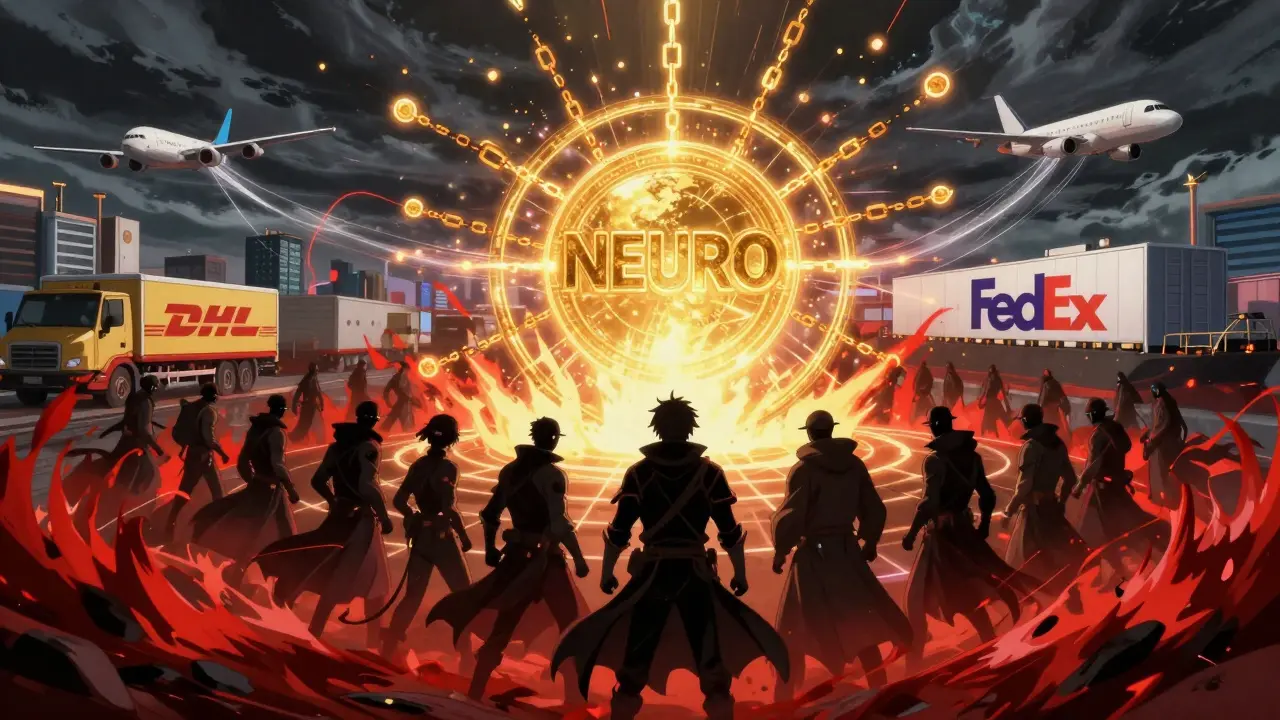
Right now, it’s mostly used in supply chains. Companies like DHL, Maersk, and FedEx are testing it to cut down on fraud, delays, and fake documentation. In one case, a pharmaceutical company reduced documentation fraud by 40% after switching to NeuroWeb’s system. That’s not a small win - it’s life-saving.
But it’s not just for logistics. The same tech can track art ownership, verify academic research, confirm food safety records, or even track carbon credits in real time. The DKG doesn’t care what the data is - only that it’s accurate and linked properly.

How Does It Compare to Other AI Blockchains?
There are other crypto projects claiming to be "AI blockchains," but most are focused on training AI models or renting GPU power. NeuroWeb doesn’t train AI. It gives AI something better: trustworthy data.
- Bittensor (TAO) rewards AI nodes for contributing computing power to train models. NeuroWeb rewards humans and systems for contributing verified facts.
- Fetch.ai (FET) builds autonomous agents that trade and negotiate. NeuroWeb builds the factual foundation those agents could use.
- The Graph (GRT) indexes blockchain data for apps. NeuroWeb creates the original, verified data that gets indexed.
NeuroWeb’s edge? It’s not trying to be everything. It’s focused on one hard problem: making knowledge provable. That’s why it’s backed by OriginTrail, which has been running its knowledge graph since 2017. That’s over 8 years of real-world testing - longer than most crypto projects have been alive.
Market Performance and Liquidity Issues
Don’t expect NEURO to go parabolic anytime soon. As of December 2025, it trades at around $0.01152. That’s down over 94% from its all-time high of $0.2545 in January 2024. The market cap sits at roughly $7.75 million, and the fully diluted valuation is $14.12 million.
The biggest problem? Liquidity. NEURO trades almost entirely on Gate.io and MEXC. You won’t find it on Binance, Coinbase, or Kraken. Trading volume averages just $120,000 per day. That means if you try to buy or sell more than a few thousand dollars’ worth, you’ll likely get crushed by slippage.
Users on Reddit and Trustpilot complain about this constantly. One investor lost 60% of their position in two weeks during a market dip - not because the project failed, but because there weren’t enough buyers to absorb the sell-off. It’s a classic case of a strong tech idea stuck in a weak market.
Who’s Using It? Real-World Adoption
Despite its low market profile, NeuroWeb has real enterprise traction. According to OriginTrail’s 2025 Impact Report, it’s integrated into 47 enterprise supply chain deployments worldwide. That’s not thousands - but it’s not zero either. And these aren’t startups. These are global logistics and pharma giants.
Enterprise users don’t care about price charts. They care about compliance, audit trails, and fraud reduction. NeuroWeb delivers that. In one case, a European food distributor cut product recall response time from 14 days to under 48 hours because they could instantly trace contaminated batches back to their source.
The project’s roadmap includes major upgrades. In Q2 2026, NeuroWeb 2.0 will launch, adding zero-knowledge proofs for private verification and cross-chain syncing with other knowledge graphs. New partnerships with DHL, Maersk, and FedEx are already live. These aren’t PR stunts - they’re real integrations.
Is NeuroWeb a Good Investment?
If you’re looking for a quick flip, the answer is no. NEURO is too illiquid, too volatile, and too niche.
If you’re looking for a long-term bet on the future of verifiable data - especially in supply chains, healthcare, and compliance - then it’s worth watching. The decentralized knowledge graph market is projected to grow to $1.2 billion by 2030. NeuroWeb is one of the few projects actually building it.
Its biggest risk? Being too dependent on OriginTrail. If enterprise adoption stalls, NEURO’s utility shrinks. Its biggest strength? It’s not trying to replace Bitcoin or Ethereum. It’s trying to replace spreadsheets and paper trails with something better.
How to Get Involved
Right now, the main ways to interact with NeuroWeb are:
- Buy NEURO on Gate.io or MEXC (if you’re okay with low liquidity).
- Develop on it - the project has open-source code on GitHub, active developers, and a developer academy that’s trained over 1,200 people.
- Use it - if you’re in supply chain, logistics, or compliance, you can request a demo of the OriginTrail DKG integration.
There’s no staking, no yield farming, no DeFi protocols - yet. That’s intentional. The team is focused on building the foundation before adding financial layers.
Final Thoughts
NeuroWeb (NEURO) isn’t for traders. It’s for builders, enterprises, and anyone who believes that data should be trustworthy - not just convenient. It’s slow. It’s quiet. It doesn’t trend on Twitter. But in boardrooms and shipping docks around the world, it’s quietly changing how we verify what’s real.
If you care about transparency in supply chains, authenticity in art, or accountability in healthcare - NeuroWeb is one of the few crypto projects actually making that happen. The coin might be cheap now. But the idea behind it? That could be worth far more in 5 years.
Is NeuroWeb (NEURO) a good investment in 2025?
NeuroWeb isn’t a typical crypto investment. Its value is tied to real-world enterprise adoption, not speculation. If you’re looking for quick gains, avoid it - low liquidity and high volatility make trading risky. But if you believe in verified knowledge as a future asset class, and you’re willing to hold long-term, it’s one of the few projects with actual utility beyond trading.
Where can I buy NEURO coin?
As of December 2025, NEURO is only available on two exchanges: Gate.io and MEXC. It’s not listed on Binance, Coinbase, or Kraken. The NEURO/USDT trading pair accounts for nearly all of its volume. Be aware that liquidity is low, so large trades will cause significant price swings.
What makes NeuroWeb different from other AI blockchains?
Most AI blockchains focus on training models or renting computing power. NeuroWeb does something different: it verifies real-world knowledge. Instead of training AI, it gives AI clean, trustworthy data. Its core innovation is the Decentralized Knowledge Graph - a blockchain-backed database of verified facts used in supply chains, healthcare, and logistics.
Does NeuroWeb have real users?
Yes. Over 47 enterprise clients - including DHL, Maersk, and FedEx - are using NeuroWeb’s technology for supply chain verification. These aren’t pilot programs; they’re live deployments reducing fraud, speeding up audits, and cutting documentation errors. The project’s strength is in enterprise adoption, not retail popularity.
Can developers build on NeuroWeb?
Absolutely. NeuroWeb is EVM-compatible, so developers can use Ethereum tools like MetaMask, Hardhat, and Solidity. The project has active GitHub repositories with regular updates, and the NeuroWeb Academy has trained over 1,200 developers since 2024. Documentation is solid, though complex integrations still require deep technical knowledge.
Is NeuroWeb regulated?
NeuroWeb has been audited for GDPR compliance by PwC, making it one of the few crypto projects that legally handles personal and enterprise data in Europe. While the SEC hasn’t formally classified NEURO, its utility-based model - where tokens reward knowledge contributions, not investment returns - helps it avoid being labeled a security. This regulatory clarity is a major advantage over other AI crypto projects.







Comments (15)
Sammy Tam
December 15, 2025 AT 16:56 PMNeuroWeb is one of those projects that doesn’t scream for attention but quietly changes how the world works. I’ve seen supply chain folks use it at my job - no more guessing if a shipment was tampered with. Just scan, verify, move on. It’s boring tech that saves millions.
Dionne Wilkinson
December 15, 2025 AT 22:59 PMI like that it’s not trying to be the next Bitcoin. Sometimes the most important things aren’t flashy.
Cheyenne Cotter
December 16, 2025 AT 19:29 PMLet me break this down for you since most people don’t get it. NeuroWeb isn’t a coin - it’s a database with a token attached. The token incentivizes people to input real-world data like batch numbers, shipping logs, lab results. It’s like Wikipedia meets blockchain meets corporate compliance. The real value isn’t in trading NEURO - it’s in the data being locked down forever. That’s why DHL and Maersk are using it. They don’t care about price charts. They care about audits. And if you think this is just crypto hype, you haven’t seen what happens when a contaminated product recall takes 14 days instead of 2. That’s lives. That’s money. That’s legal liability. This isn’t speculation. It’s infrastructure.
Craig Nikonov
December 17, 2025 AT 09:05 AMThey say it’s ‘verified knowledge’ but who’s verifying the verifiers? What if the pharmaceutical company lies and uploads fake docs? Blockchain doesn’t fix stupid. It just makes lies permanent. This is just corporate surveillance with a crypto veneer.
Emma Sherwood
December 18, 2025 AT 01:51 AMI work in global health logistics. We rolled out NeuroWeb for vaccine traceability last year. Before? Paper forms, lost emails, time zones, conflicting records. After? One QR code. Instant verification. No more babies getting expired doses because someone misfiled a spreadsheet. This isn’t crypto magic - it’s basic human dignity made possible by tech. And yes, the token is illiquid. But we’re not here for the price. We’re here because it works.
Sally Valdez
December 19, 2025 AT 01:30 AMOh great, another ‘real world use case’ from Silicon Valley elitists who think they’re saving the world while the rest of us pay for their overpriced coffee. You think a blockchain is gonna stop a Chinese factory from faking safety certs? LOL. This is just Wall Street’s new way of laundering their greed under the guise of ‘truth.’ Wake up. It’s all just tokens pretending to be useful.
Bradley Cassidy
December 20, 2025 AT 07:56 AMNeuroWeb is the quiet hero of the crypto space. Nobody talks about it because it doesn’t pump 1000% in a week. But if you’ve ever dealt with supply chain nightmares - fake meds, spoiled food, forged certificates - you know how powerful this is. I built a little tool using their EVM API to auto-check batch IDs for a local pharma co. Took me two days. They saved 300 hours a year in manual audits. That’s real. That’s not hype. That’s just… good engineering.
George Cheetham
December 21, 2025 AT 23:04 PMThere’s a quiet revolution happening here. Most blockchains chase money. This one chases truth. And truth? It doesn’t need hype. It just needs to be built. OriginTrail’s been at this since 2017. That’s longer than most crypto projects have been alive. This isn’t a gamble - it’s a legacy project. The token might be cheap now, but the infrastructure? It’s already working. That’s rare.
Tom Joyner
December 23, 2025 AT 07:24 AMIt’s amusing how people mistake utility for value. Just because something has a use case doesn’t mean it’s a good investment. This is like buying shares in a fax machine company in 2010. The tech is sound. The market? Dead. The liquidity is abysmal. The team is brilliant. But unless this thing gets listed on Coinbase, it’s just a digital museum piece.
Heather Turnbow
December 24, 2025 AT 00:07 AMI appreciate the nuance here. Most crypto content is either fanboyism or outright fearmongering. This breakdown is measured, factual, and acknowledges both the potential and the real limitations. That’s rare. Thank you for not overselling it. The fact that enterprise adoption is slow but steady speaks volumes - it’s not a bubble, it’s a slow burn. And sometimes, the most impactful innovations are the ones that don’t trend.
Chevy Guy
December 24, 2025 AT 16:55 PMThey say it’s for truth but everyone knows the data gets fed in by corporations who control the narrative. Who’s to say the carbon footprint numbers aren’t cooked? This is just greenwashing with blockchain glitter. And don’t get me started on the ‘verified knowledge’ label - knowledge is never verified. It’s contested. Always.
Sue Bumgarner
December 26, 2025 AT 07:09 AMLet’s be real - this is just a front for the deep state to track everything. You think DHL’s using this for ‘efficiency’? No. They’re building a global audit trail for the government. Next thing you know, your milk carton will have a blockchain ID and the feds will know you bought it. This isn’t innovation. It’s control dressed up in crypto clothes.
Terrance Alan
December 27, 2025 AT 11:36 AMLook I’ve been following crypto since 2017 and I’ve seen every single one of these ‘real world use cases’ come and go. Bitcoin was supposed to replace banks. Ethereum was supposed to kill lawyers. Now it’s this - ‘verified knowledge’ - like that’s some new holy grail. Newsflash: the world doesn’t need more blockchain. It needs less hype. And if you think a token that trades on two obscure exchanges with $120k daily volume is a ‘long-term bet’ you’re either delusional or you’re getting paid to promote it. This isn’t innovation. It’s desperation with a whitepaper.
Florence Maail
December 28, 2025 AT 22:37 PMlol at people thinking this is ‘trustworthy data’ 🤡 the same people who run this are the ones who got us into the 2008 crisis. blockchain doesn’t fix corruption - it just makes it harder to hide. and if you think these big companies are using this for ethics… good luck with that. they’re using it to avoid fines, not to be ‘transparent.’ this is just a tax write-off with a crypto label. 🤷♀️
Jesse Messiah
December 30, 2025 AT 15:23 PMHey, I just wanted to say thanks for writing this - it’s one of the clearest breakdowns I’ve seen. I’m a small supply chain consultant and we’re testing NeuroWeb with a local organic food co-op. It’s not glamorous, but last week we traced a contaminated batch back to a single farm in 12 minutes. That’s the kind of win that doesn’t make headlines but saves lives. Keep doing what you’re doing. The quiet builders matter.