


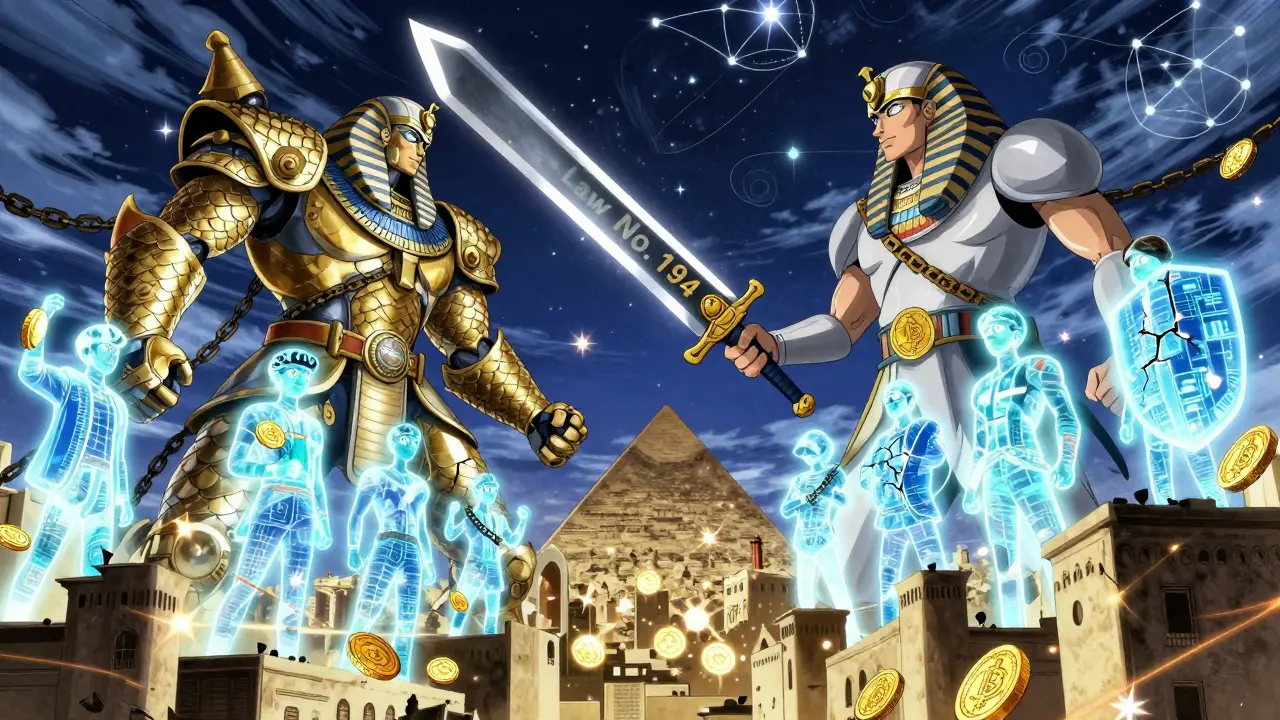
If you're trading cryptocurrency in Egypt, you're breaking the law - and the penalties are brutal. Fines range from 1 million to 10 million Egyptian pounds (roughly $51,600 to $516,000 USD), plus possible jail time. This isn’t a warning. It’s a criminal charge under Law No. 194 of 2020.
What Exactly Is Banned?
Egypt doesn’t just discourage crypto. It outlawed it entirely. Under Article 206 of Law No. 194 of 2020, every part of the crypto ecosystem is illegal:- Buying or selling Bitcoin, Ethereum, or any other digital asset
- Operating a crypto exchange or wallet service
- Promoting or advertising crypto investments
- Accepting crypto as payment
- Even mining cryptocurrency within Egypt’s borders
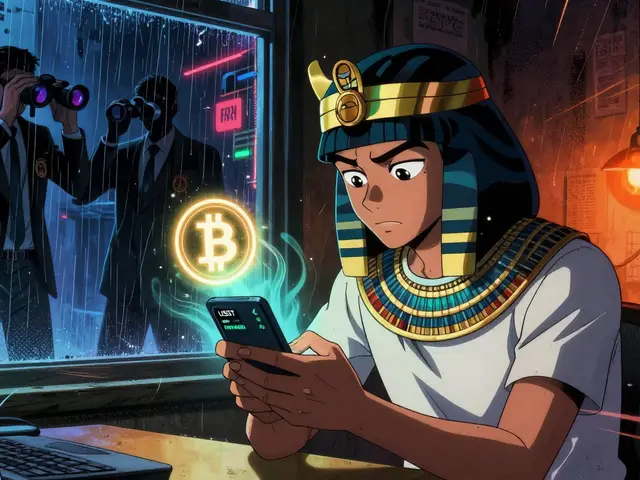
The Central Bank of Egypt (CBE) and the Financial Regulatory Authority (FRA) both enforce this ban. They don’t just issue warnings - they actively track down violators. Social media influencers pushing crypto staking schemes? Targeted. Websites offering crypto trading platforms? Shut down. Telegram groups coordinating P2P trades? Investigated.
Why Such Harsh Penalties?
The government’s reasoning is straightforward: crypto is dangerous. According to the CBE, digital currencies have no real value behind them. They’re not backed by gold, government guarantees, or physical assets. That makes them unpredictable - and easy to manipulate.Authorities say crypto fuels crime. Money laundering. Tax evasion. Cyber fraud. Online scams. Egypt’s banking system is already under strain, and regulators fear crypto could destabilize it further. They point to global trends: crypto wallets linked to darknet markets, ransomware payments, and untraceable transfers. In their view, allowing crypto is like opening a backdoor to financial chaos.
But here’s the twist: Egypt has one of the highest crypto adoption rates in Africa and the Middle East. A 2022 report from TripleA found over 1.7 million Egyptians - about 1.75% of the population - owned cryptocurrency. That’s more than half the number of people who own bank accounts in some rural areas. People aren’t ignoring the law because they’re ignorant. They’re doing it because they have to.
The Real Reason People Use Crypto in Egypt
The Egyptian pound has lost more than 60% of its value since 2022. Inflation hit 37% in 2023. Salaries don’t keep up. Savings vanish. Banks impose strict withdrawal limits. Foreign currency is hard to get. For many Egyptians, crypto isn’t a speculative gamble - it’s survival.People use crypto to:
- Send money to family abroad without going through slow, expensive banks
- Protect savings from hyperinflation by holding Bitcoin or USDT
- Buy goods from international sellers who won’t accept EGP
- Work remotely and get paid in crypto instead of waiting months for salary transfers
One Cairo-based freelancer told a local news outlet: “I get paid in USDT. If I convert it to pounds, I lose 40% in a week. If I don’t, I can’t pay rent. So I take the risk.”
The government sees this as illegal. The people see it as necessary.

Who Gets Caught?
The FRA has published lists of unlicensed crypto platforms and social media accounts promoting digital assets. They’ve shut down dozens of websites and arrested several influencers who ran “crypto training” courses that doubled as investment schemes.Most arrests target promoters - not casual traders. But that doesn’t mean individuals are safe. If you’re caught using a P2P app like Paxful or Binance P2P to buy Bitcoin with Egyptian pounds, you can still be charged. Authorities monitor bank transfers linked to crypto exchanges. They track IP addresses. They follow digital footprints.
One case in Alexandria involved a man who bought $5,000 worth of USDT over six months. He was fined 3 million EGP ($155,000 USD) after his bank flagged suspicious transactions. He didn’t sell or trade - he just held it. Still, the law doesn’t care about intent. Possession and use are enough.
What Happens If You’re Caught?
The law gives judges two options:- Imprisonment (no minimum term specified)
- A fine between 1 million and 10 million EGP
- Or both
There’s no “first offense” exception. No warning letter. No probation. The fine is non-negotiable. If you can’t pay, you go to jail. And if you’re a business owner? Your assets can be seized.
Foreigners operating crypto services in Egypt face the same rules. One American expat running a crypto consulting firm was deported after being fined 7 million EGP. He didn’t realize his business model violated Egyptian law.
How This Affects Businesses
International companies working with Egyptian partners are stuck. No crypto payments. No blockchain contracts. No decentralized finance tools. Everything must go through banks - which means delays, high fees, and currency conversion losses.Some tech startups have moved their operations to Dubai or Jordan just to avoid the legal risk. Others hire third-party intermediaries in Europe to handle payments - but that adds cost and complexity.
The ban also kills innovation. No local blockchain startups. No crypto-related apps. No fintech incubators. Egypt’s digital economy is being held back by a policy that ignores reality.
Is There Any Hope for Change?
Not anytime soon. The government shows no sign of softening. In fact, they’ve doubled down. In late 2024, the FRA announced a new system to report illegal crypto activity. Citizens can now submit anonymous tips via a government portal. Rewards are offered for information leading to convictions.Meanwhile, crypto usage keeps rising. More people use P2P apps. More sellers accept USDT. More freelancers get paid in crypto. The gap between law and practice is widening.
Some experts believe Egypt will eventually legalize crypto - but only under strict state control. Imagine a government-run digital wallet. Or a central bank digital currency (CBDC) that replaces Bitcoin, not complements it. Until then, the ban stays.
What Should You Do?
If you’re in Egypt:- Don’t trade, buy, or promote crypto - the risk isn’t worth it
- Don’t use local exchanges or P2P platforms that claim to be “safe” - they’re not
- If you already hold crypto, consider moving it out - but be careful how you do it
- Don’t assume you’re anonymous - banks and authorities are watching
If you’re outside Egypt and work with Egyptians:
- Avoid accepting crypto payments from Egyptian clients
- Use bank transfers or licensed payment processors only
- Don’t offer crypto education or consulting services to Egyptian residents
The law is clear. The penalties are severe. And the enforcement is real.
Is it illegal to own cryptocurrency in Egypt?
Yes. While the law doesn’t explicitly say “owning crypto is illegal,” it bans all trading, promotion, and operation of crypto services. Simply holding crypto can lead to investigation if authorities trace how you acquired it. If you bought it through a P2P transaction or exchanged EGP for USDT, you’re already in violation.
Can I use crypto to send money to family abroad?
Technically, no. Sending crypto abroad is still considered a violation of Law No. 194 of 2020. Even if your goal is to support relatives, the law treats it the same as trading. Many Egyptians do it anyway, but they risk fines, account freezes, or legal action. There are no legal exceptions for humanitarian reasons.
What happens if I get fined but can’t pay?
If you can’t pay the fine, you’ll be sent to prison. Egyptian courts don’t offer payment plans for crypto violations. The fine is mandatory, and non-payment triggers automatic incarceration. There’s no negotiation - even if you’re unemployed or in debt.
Are crypto ATMs legal in Egypt?
No. Any machine that allows buying or selling crypto with cash or bank cards is illegal. Egypt has no licensed crypto ATMs. Any device you see advertised as a “crypto kiosk” is operating unlawfully and can be shut down by authorities at any time.
Can I be arrested for using Binance or Coinbase?
You won’t be arrested just for having an account. But if you deposit Egyptian pounds, withdraw crypto, or trade on those platforms, you’re breaking the law. Egyptian banks report suspicious transfers to the FRA. If your account shows repeated transactions linked to crypto exchanges, you’ll be investigated - and possibly charged.
Is mining cryptocurrency illegal in Egypt?
Yes. Mining uses electricity and computing power to create new crypto coins - both of which are regulated under Law No. 194. The government considers mining an unlicensed financial operation. Even running a single rig at home can lead to prosecution if detected.
Do foreign banks report crypto transactions involving Egyptians?
Some do. Banks in the UAE, Turkey, and Europe have started flagging transfers to and from Egyptian accounts that match crypto exchange patterns. The FRA has formal agreements with international financial regulators to share data on suspicious activity. If you’re sending large sums to Binance or Kraken from Egypt, it’s being monitored.
Can I legally invest in blockchain technology in Egypt?
Only if it doesn’t involve cryptocurrency. You can invest in companies building blockchain infrastructure - like supply chain tracking systems or digital ID platforms - as long as they don’t use or promote tokens. The government supports blockchain for efficiency, but only if it’s separate from crypto assets.






Comments (16)
Edward Drawde
February 3, 2026 AT 20:54 PMBro, just don’t do it. It’s not worth jail time for some digital hype coin.
Will Pimblett
February 5, 2026 AT 08:06 AMSo let me get this straight - the government bans crypto because it’s ‘unstable,’ but the Egyptian pound’s been on a 60% rollercoaster? That’s not hypocrisy, that’s just pathetic.
Nickole Fennell
February 6, 2026 AT 21:53 PMOMG I JUST REALIZED - if you’re using crypto to survive inflation, are you a criminal or a hero? 😭 I mean, imagine having to choose between your family eating or following a law written by people who’ve never seen a 500-pound note. This isn’t policy, it’s cruelty.
Elle M
February 8, 2026 AT 05:45 AMLet me guess - the same people who banned crypto also think the moon landing was faked. Egypt’s economy is a dumpster fire and they’re trying to blame Bitcoin? Classic.
Rico Romano
February 9, 2026 AT 22:24 PMIt’s fascinating how the masses romanticize crypto as some kind of economic liberation, while ignoring the fact that decentralized finance is inherently unregulated, untraceable, and incompatible with any functional monetary system. This isn’t oppression - it’s fiscal responsibility.
Crystal Underwood
February 10, 2026 AT 06:16 AMY’all are missing the point. Crypto isn’t money - it’s a cult. People are brainwashed into thinking their USDT is ‘safe’ when it’s just a digital IOU from a guy in a basement with a laptop. The government’s not the villain - the influencers are.
Jack Petty
February 12, 2026 AT 04:21 AMThey’re not banning crypto. They’re banning freedom. This is the same regime that banned WhatsApp calls, then blamed ‘foreign interference.’ Crypto’s just the next thing they can’t control. Welcome to digital authoritarianism, folks.
Meenal Sharma
February 13, 2026 AT 19:18 PMThe state’s position is logically consistent with the preservation of monetary sovereignty. Cryptocurrencies, by their decentralized nature, undermine the central bank’s ability to implement macroeconomic policy. This is not repression - it is governance.
Freddy Wiryadi
February 15, 2026 AT 18:45 PMMan… I just can’t imagine being in that position. You’re stuck between a collapsing currency and a law that treats you like a criminal for trying to survive. 🤯 I mean, if I had to choose between my rent and a felony… I’d pick rent. No question. 🙏
Brianne Hurley
February 16, 2026 AT 20:55 PMUgh. I can’t believe people are defending this. It’s like saying ‘I stole medicine for my sick kid so it’s fine!’ - no, it’s still theft. And crypto is just a scam waiting to happen. Everyone knows it. Why are you all so emotional about digital glitter?
christal Rodriguez
February 18, 2026 AT 04:49 AMThey’re not banning crypto. They’re banning hope.
Gustavo Gonzalez
February 18, 2026 AT 16:12 PMWait - so if I hold USDT and don’t trade it, I’m still guilty? That’s like arresting someone for owning a dictionary because they might use it to write a novel. This law is so badly written it’s almost poetic. In a dystopian way.
Gavin Francis
February 19, 2026 AT 12:23 PMReal talk - if you’re in Egypt and using crypto to feed your family, you’re not breaking the law. You’re outsmarting a broken system. Keep going. Stay safe. 💪
Rob Duber
February 20, 2026 AT 08:14 AMImagine getting fined 10 MILLION EGP for holding a coin you bought with your last 500 bucks. That’s not justice - that’s financial terrorism. They might as well start charging people for breathing too hard.
Steven Dilla
February 20, 2026 AT 13:13 PMMy cousin in Cairo uses USDT to pay his daughter’s school fees. He doesn’t even know what blockchain is - he just knows it’s the only way his money doesn’t vanish overnight. This isn’t about crypto. It’s about dignity.
Aaron Poole
February 22, 2026 AT 04:50 AMLook, I get why the government’s scared. But banning something that 1.7 million people rely on isn’t control - it’s denial. Maybe instead of hunting down freelancers, they should fix the economy. Or at least build a legal bridge instead of a wall.