


When you hear the word Humaniq, you might think it’s the next big thing in crypto - a blockchain project built to give banking to the 1.7 billion people around the world who don’t have access to banks. But here’s the reality: Humaniq (HMQ) is a project that started with big promises, but today, it’s barely alive.
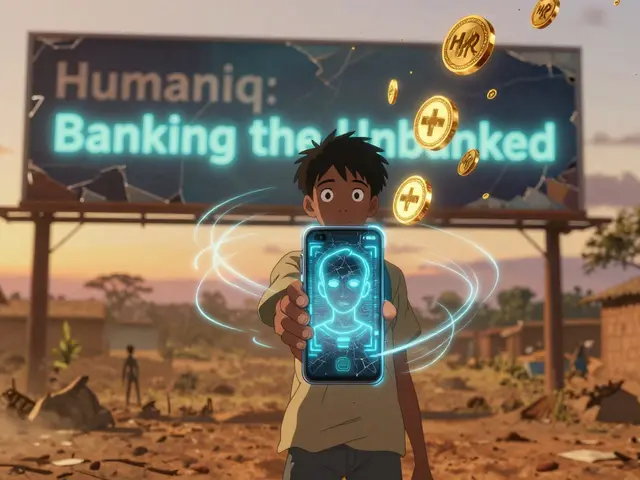
Launched in 2017, Humaniq wasn’t just another altcoin. It claimed to solve a real problem: how do you give financial services to someone who doesn’t have an ID, a bank account, or even a smartphone? Their answer? Use your face or fingerprint. No paperwork. No branch. Just a phone, a biometric scan, and the HMQ token.
What Is Humaniq (HMQ) Actually?
Humaniq is a mobile app built on the Ethereum blockchain that lets users send, receive, and store money using HMQ - its own cryptocurrency. The app uses facial recognition or fingerprint scanning to verify your identity. No passport. No driver’s license. Just you and your phone.
That sounds revolutionary, right? Especially if you live in a rural part of Nigeria, Kenya, or India, where banks are miles away and paperwork is a nightmare. Humaniq said it would let people earn HMQ by doing small tasks - like identifying photos, translating text, or tagging locations. Those tasks would pay in crypto, and users could then use HMQ to pay for goods, send money to family, or even get microloans.
But here’s the catch: Humaniq doesn’t work unless you have a smartphone with a camera and a fingerprint sensor. And you need internet. And you need to understand how to download an app, set up a wallet, and trust a blockchain you’ve never heard of. For many people in the unbanked communities it targets, that’s a huge barrier.
How Does HMQ Work?
HMQ is an ERC-20 token. That means it runs on the Ethereum network, just like Chainlink, Uniswap, or Polygon. You can’t mine it. You can’t earn it by staking. You get it by buying it - or by doing tasks inside the Humaniq app.
The app itself was designed to be simple. You open it, scan your face, and boom - you’re in. You can send HMQ to another user just by entering their phone number. No wallet address. No QR code. It’s like WhatsApp for money, but on blockchain.
There’s also a feature called "HMQ Rewards" - where users complete microtasks to earn tokens. For example, identifying a photo of a product in a market, or tagging a location on a map. Sounds harmless. But how much do you actually earn? No one knows. There are no public records of payouts. No user testimonials. No screenshots of people cashing out.
And here’s the kicker: Humaniq says it uses a "fourth-generation Ethereum blockchain." That’s not a real technical term. Ethereum doesn’t have generations. This sounds like marketing fluff to make the project seem more advanced than it is.
Current Market Status of HMQ
As of February 2026, HMQ trades at $0.002751. That’s less than a third of a cent. Its total market cap? Just $570,000. For comparison, Bitcoin’s market cap is over $1 trillion. Even small, forgotten coins like Shiba Inu have a market cap 10,000 times bigger.
The 24-hour trading volume? $275. That’s less than what you’d spend on coffee in Auckland. That means almost nobody is buying or selling HMQ. If you wanted to cash out right now, you’d struggle to find a buyer. Most exchanges - Binance, Coinbase, Kraken - don’t list HMQ at all. The only places you can trade it are tiny, unknown platforms that no one trusts.
And the price? It hasn’t moved in months. Up 0.0% in 24 hours. That’s not a stablecoin. That’s a dead coin.

Why Humaniq Failed
Let’s be honest: Humaniq had a good idea. But good ideas don’t win in crypto. Execution does.
First, they targeted the unbanked - but ignored the biggest barrier: smartphones. In Sub-Saharan Africa, only 48% of adults own a smartphone. In rural India? Even lower. You can’t build a mobile banking app for people who use flip phones.
Second, they didn’t partner with anyone. No telecoms. No NGOs. No local governments. Compare that to M-Pesa - the mobile money system in Kenya that serves over 50 million people. M-Pesa works because it’s tied to Safaricom, the country’s biggest phone company. Humaniq? No partnerships. Just an app on a server.
Third, no one knows if the app even works. There are zero reviews on Trustpilot. No Reddit threads. No YouTube tutorials. No users saying, "I earned HMQ and bought food with it." If a project this big had real users, we’d hear about it. We don’t.
And then there’s the silence. No GitHub updates. No blog posts. No team announcements. The last official update from Humaniq was in 2019. Since then? Radio silence. In crypto, if you’re not building, you’re dying.
Who’s Competing? And Who’s Winning?
Humaniq isn’t alone in trying to bank the unbanked. But it’s losing badly.
- Celo - a blockchain built for mobile users. Works on low-end Android phones. Has 3 million active users. Listed on Coinbase.
- Stellar (XLM) - used by nonprofits and banks to send money across borders. Market cap: $3 billion.
- Worldcoin - uses iris scans (not facial recognition) to verify identity. Raised $100 million. Backed by Sam Altman.
These projects have real users, real partnerships, and real traction. Humaniq? It’s a ghost.

Is HMQ Worth Buying?
If you’re thinking of buying HMQ as an investment - don’t.
You’re not buying a coin. You’re buying a graveyard. With a $570,000 market cap and $275 in daily trading, there’s no liquidity. No volume. No chance of a price pump. Even if the team woke up tomorrow and launched a new version, it would take years to rebuild trust - and no one believes they will.
And if you’re hoping to use it to send money to family in a developing country? Forget it. You can’t convert HMQ to cash in most places. No ATMs. No exchanges. No merchants accept it.
This isn’t a crypto project. It’s a cautionary tale.
Final Thoughts
Humaniq (HMQ) started with a noble goal: to give financial freedom to the world’s poorest. But it failed because it ignored reality. It assumed everyone had smartphones. It assumed people would trust a blockchain app with no track record. It assumed a small team in a city could solve a problem that took decades for companies like M-Pesa to crack.
Today, HMQ is a zombie token - barely trading, barely known, barely alive. The app still exists. The website still loads. But the project? It’s over.
If you’re looking for crypto that helps the unbanked, look at Celo or Stellar. They’re real. They’re growing. They’re working.
Humaniq? It’s a reminder that in crypto, good intentions don’t matter - if you don’t deliver.
Is Humaniq (HMQ) still active?
No, Humaniq is not meaningfully active. The last official updates were in 2019. There are no recent GitHub commits, no team announcements, no exchange listings, and no user activity. The app still exists, but it’s essentially abandoned.
Can I buy HMQ on Binance or Coinbase?
No, HMQ is not listed on any major exchange like Binance, Coinbase, or Kraken. It only trades on a few tiny, obscure platforms with almost no liquidity. Buying it is risky and often pointless.
Is Humaniq a scam?
There’s no proof Humaniq was a scam. The team didn’t disappear with funds. But the project has failed. It made big claims, delivered almost nothing, and stopped updating years ago. In crypto, a project that stops building is effectively dead - whether it was a scam or not.
How do I get HMQ tokens?
You can only get HMQ by buying it on small, unsupported exchanges - or by completing tasks in the Humaniq app. But task rewards are unverified, and the app’s functionality is unclear. There’s no reliable way to earn or use HMQ today.
Why did Humaniq fail when M-Pesa succeeded?
M-Pesa worked because it didn’t try to be high-tech. It used basic SMS, partnered with mobile carriers, and focused on simplicity. Humaniq tried to use blockchain and biometrics in places where people didn’t have smartphones or internet. It overcomplicated a simple problem.
Is there any value in holding HMQ?
No. With a market cap under $1 million and zero trading volume, HMQ has no liquidity or future potential. Holding it won’t make you money. It’s not an investment - it’s a relic.






Comments (23)
Lauren Brookes
February 15, 2026 AT 00:38 AMIt's wild how many projects start with this noble 'help the unbanked' mission, then turn into a blockchain vanity project. Humaniq had the right intent but zero grounding in reality. You can't just slap biometrics on an app and expect people in rural Nigeria to adopt it when they're still figuring out how to charge their phone with a solar panel. The real heroes are the ones building on SMS and USSD - no smartphone needed. That’s where the impact actually happens.
jennifer jean
February 15, 2026 AT 15:57 PMSo basically HMQ is the crypto version of a ghost town 🏚️💀
Sasha Wynnters
February 17, 2026 AT 07:42 AMHumaniq didn’t fail because of tech - it failed because it confused aspiration with accessibility. You don’t solve financial exclusion by forcing blockchain onto people who don’t have Wi-Fi, let alone a wallet. It’s like trying to teach someone to sail by giving them a yacht and a PhD in hydrodynamics. The problem isn’t the lack of money - it’s the lack of infrastructure, trust, and simplicity. M-Pesa didn’t use facial recognition. It used a damn text message. Sometimes the most revolutionary idea is the dumbest one.
Charrie VanVleet
February 18, 2026 AT 15:59 PMI get why people get excited about crypto solving global inequality - I really do. But this is why so many of these projects flop. They’re built by people who’ve never been without running water, let alone a bank account. Real solutions come from listening - not from coding an app in Silicon Valley and assuming everyone else will just figure it out. Celo and Stellar? They got it. They partnered with local agents, used local languages, and worked with what people already had. Humaniq? It was a beautiful dream with no roadmap.
Scott McCrossan
February 19, 2026 AT 21:55 PMOh wow, another crypto unicorn that turned into a dead rat. This is why I don’t trust any project that says 'unbanked' in its pitch. It’s just a marketing buzzword for 'we have no idea how to make money.' $570k market cap? That’s less than my rent. And the team went silent? Classic. They raised funds, made a slick video, and vanished. No remorse. No transparency. Just another crypto ghost story.
Rajib Hossaim
February 21, 2026 AT 09:57 AMWhile the analysis is largely accurate, I must emphasize that the fundamental flaw lies in the assumption that technological sophistication equals adoption. In India, where I am from, millions rely on feature phones and local agents for financial transactions. A system that requires a smartphone and internet connectivity is inherently exclusionary. The failure of Humaniq is not in its ambition but in its failure to adapt to the realities of its target demographic. Simplicity, not spectacle, wins in financial inclusion.
Beth Erickson
February 22, 2026 AT 10:47 AMSo you’re telling me a bunch of tech bros thought facial recognition was gonna fix poverty? LMAO. They didn’t even check if people had phones with cameras. Half the villages in Africa don’t have electricity at night. How’s your app gonna work then? HMQ is just another example of white savior tech. Stop pretending you’re helping. You’re just collecting data and selling dreams.
Ruby Ababio-Fernandez
February 23, 2026 AT 23:01 PMDead coin. Move on.
Jenn Estes
February 25, 2026 AT 07:37 AMIt’s not that Humaniq failed - it’s that it was never meant to succeed. The whole thing was a fundraising stunt disguised as social good. Look at the team. All Westerners. No local advisors. No field testing. Just a PowerPoint deck and a whitepaper full of buzzwords. The unbanked didn’t need a blockchain app. They needed someone to show up and listen. And no one did.
Jeremy Fisher
February 25, 2026 AT 10:54 AMYou know what’s funny? Humaniq’s whole premise was built on the idea that biometrics could replace ID systems - which makes sense if you’ve never had to deal with a government that doesn’t recognize you. But in places like rural India or Nigeria, the problem isn’t ID - it’s trust. Who do you trust when the bank’s corrupt, the government’s absent, and the only tech you’ve seen is a broken phone? No amount of facial recognition fixes that. You need community. You need local champions. You need someone who walks into the village, not someone who codes an app from a co-working space in Austin. And that’s what Humaniq never understood. They wanted to solve a human problem with a technical solution. That’s like trying to heal a broken heart with a wrench.
Anandaraj Br
February 26, 2026 AT 12:48 PMThey said HMQ was revolutionary but it’s just another pyramid scheme wrapped in blockchain glitter. The app still exists? Yeah because someone forgot to shut it down. The team? Gone. The whitepaper? A joke. The investors? Probably already cashed out. And now we’re supposed to believe this is a 'cautionary tale'? Nah. This is just another crypto graveyard where dreams go to die. I’ve seen this movie before. The credits roll the same every time.
AJITH AERO
February 28, 2026 AT 02:12 AMFace scan for banking? Bro. In my village we still use a guy with a notebook and a pencil. He knows everyone’s name. He remembers when you paid last. He gives you a smile. Humaniq tried to replace that with a camera. And now the camera’s broken. Who’s gonna fix it? The guy in San Francisco? Nah. He’s on his third vacation this year.
Angela Henderson
March 2, 2026 AT 00:34 AMI used to think crypto could actually help people. Then I saw Humaniq. It’s like they took all the cool tech stuff and threw it at the poorest people without asking if they even wanted it. I live in a city. I have a phone. I still don’t get why I’d need to scan my face to send money. Imagine trying to explain that to someone who’s never even seen a QR code. It’s not empowerment. It’s just another way to make people feel dumb. And now it’s dead. Like, literally dead. The app opens but nothing works. It’s sad.
Geet Kulkarni
March 2, 2026 AT 19:24 PMWhile the economic and technological critique presented is undeniably valid, I must respectfully posit that the underlying philosophical error lies in the epistemological assumption that technological innovation alone can catalyze socio-economic transformation. The unbanked are not merely 'unconnected' - they are disenfranchised. To impose a blockchain-based identity system upon populations lacking institutional trust, digital literacy, and infrastructural stability is not progress - it is colonialism repackaged as disruption. The success of M-Pesa lay not in its technological superiority, but in its contextual embedding within existing social and economic ecosystems. Humaniq, by contrast, attempted a top-down, techno-utopian intervention - a fatal flaw in any development initiative.
Paul David Rillorta
March 4, 2026 AT 02:25 AMWait wait wait - did you know the founder of Humaniq used to work for a company that got sued for selling facial data? And now he’s using your face to 'bank the unbanked'? That’s not a coincidence. That’s a trap. I’m telling you - this was never about helping people. It was about harvesting biometric data from the most vulnerable on earth. The app doesn’t work? Of course it doesn’t. They already got what they wanted. Your face. Your fingerprint. Your identity. And now they’re selling it to some government or corporation. This isn’t crypto. It’s surveillance with a blockchain logo.
andy donnachie
March 4, 2026 AT 23:02 PMInteresting read. I’ve been working in mobile finance in Ireland for over a decade, and the lesson is always the same: tech must serve the user, not the other way around. Humaniq’s mistake was assuming that innovation = adoption. In reality, adoption = trust + simplicity + accessibility. M-Pesa won because it was cheap, reliable, and understood by grandmothers. Humaniq lost because it was flashy, confusing, and required a smartphone. The tech world forgets this too often.
Alex Williams
March 5, 2026 AT 20:02 PMFrom a dev perspective, HMQ’s architecture was a mess. ERC-20 on Ethereum? Fine. But trying to do biometric verification on-chain? That’s insane. Biometric data is huge - you can’t store that on Ethereum. They must’ve been hashing or storing it off-chain, which defeats the whole 'decentralized identity' claim. And if they were using a 'fourth-gen Ethereum' - that’s not even a thing. That’s like saying 'fifth-gen iPhone.' It’s marketing noise. No serious dev team would’ve signed off on that. The whole thing reeks of a pitch deck built by a non-technical founder who Googled 'blockchain' and 'biometrics' and mashed them together.
Sarah Shergold
March 6, 2026 AT 11:27 AMWow. So a project with no traction, no team, no liquidity… and you’re calling it a 'cautionary tale'? Nah. It’s not a tale. It’s a footnote. A blinking cursor on a dead server. The only thing more tragic than HMQ is the people who still think it’s worth buying. You’re not investing. You’re donating to a museum of failed crypto dreams.
Tarun Krishnakumar
March 7, 2026 AT 09:54 AMThey said Humaniq was going to revolutionize finance - but the only thing it revolutionized was how fast you can lose your faith in crypto. I used to believe blockchain could fix inequality. Then I saw this. A company that raised millions, built an app nobody used, and vanished into thin air. And now they’re selling HMQ to fools who think 'low price = high potential.' It’s not. It’s a tombstone. And every time someone buys it, they’re just adding another brick to the grave.
george chehwane
March 9, 2026 AT 02:20 AMHere’s the uncomfortable truth: Humaniq wasn’t designed for the unbanked. It was designed for venture capitalists who wanted to say they 'invested in social impact.' The real beneficiaries weren’t the people in Kenya - they were the VCs who cashed out during the 2018 ICO boom. The app? A prop. The team? A facade. The token? A liquidity grab. The 'mission'? A tax write-off. This is capitalism with a blockchain filter - and it’s not noble. It’s predatory.
Nikki Howard
March 10, 2026 AT 07:55 AMI find it deeply concerning how easily we romanticize 'crypto for the poor' while ignoring the power dynamics at play. Who owns the data? Who controls the nodes? Who profits when users are forced into a system they can’t opt out of? Humaniq didn’t empower - it extracted. And now that the hype has faded, the victims are left with nothing but a broken app and a false promise. This isn’t innovation. It’s exploitation dressed in whitepapers.
James Breithaupt
March 10, 2026 AT 14:41 PMAs someone who’s worked in fintech across Southeast Asia and Africa, I can tell you this: the most successful solutions don’t come from Silicon Valley. They come from local engineers who understand the rhythms of daily life. Humaniq thought they could drop a solution into a village like a drone delivery. But financial inclusion isn’t about tech - it’s about relationships. M-Pesa succeeded because it worked with kiosks run by local shopkeepers. Humaniq? They tried to replace the shopkeeper with a camera. And now the village has no one to trust.
Charrie VanVleet
March 11, 2026 AT 22:56 PMReading this thread makes me realize something - the real tragedy isn’t that Humaniq failed. It’s that we keep letting projects like this happen. We celebrate the 'visionaries' while ignoring the people on the ground. If we want to help the unbanked, we need to stop funding apps and start funding community-led initiatives. Pay local agents. Train microfinance workers. Build trust first. Tech can follow. But never the other way around.