


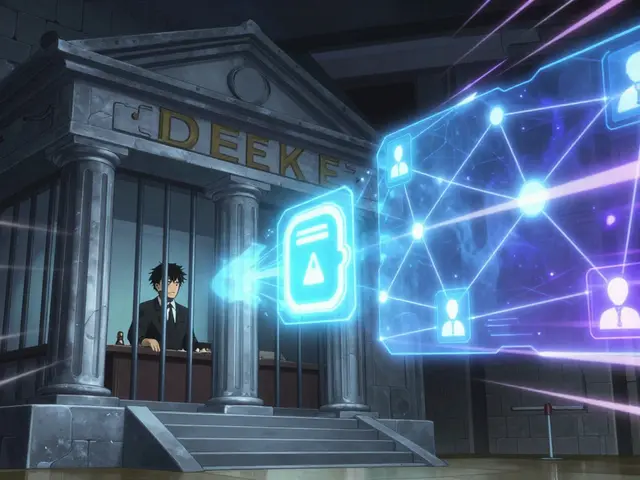
Blockchain isn’t broken because of weak cryptography. It’s broken - or at least weakened - because of how nodes talk to each other. The peer-to-peer (P2P) network is the invisible backbone of every blockchain, and it’s surprisingly fragile. While everyone talks about hacking wallets or breaking smart contracts, the real danger often lies in the quiet, behind-the-scenes connections between nodes. This is where attacks happen that don’t leave a trace on the ledger but still make your transactions disappear, delay your swaps, or isolate your node from the rest of the network.
How P2P Networks Keep Blockchain Alive
Every time you send Bitcoin or Ethereum, your transaction doesn’t go to a bank. It gets broadcast to a network of thousands of computers - called nodes - that all talk directly to each other. No central server. No middleman. That’s the whole point. Bitcoin’s original P2P design, laid out in Satoshi Nakamoto’s 2008 whitepaper, created a system where trust isn’t placed in a company or government, but in the collective behavior of these connected machines.
Bitcoin nodes use port 8333 and connect randomly to other nodes, forming a messy but resilient web. Ethereum, on the other hand, uses a more organized system called Kademlia DHT, which helps nodes find each other faster. Both systems rely on TCP/IP connections and encrypt traffic with TLS 1.2 or higher. But encryption doesn’t mean safety. It just means attackers can’t easily read your data - not that they can’t block it, trick your node, or cut you off entirely.
Here’s the paradox: the more decentralized the network, the harder it is to secure. There’s no single firewall to update. No IT team to patch. Every node is its own little fortress - and most are poorly built.
The Eclipse Attack: Cutting You Off From Reality
Imagine someone secretly replaces all your friends with impersonators. You talk to them every day. You trust them. But they’re feeding you lies. That’s an eclipse attack.
In Bitcoin’s P2P network, a single attacker can control enough IP addresses to fill up all 125 connection slots on your node (up from the old limit of 8). Once they do, your node only talks to their fake nodes. They can show you a fake version of the blockchain - one where your transaction never happened, or where someone else spent your coins. Your node thinks it’s synced with the real network. It’s not. It’s trapped.
This isn’t theory. In December 2022, Bitcoin Core developers confirmed that around 0.3% of public nodes showed signs of being eclipsed. That’s not a lot - but it’s enough to cause real damage. If you’re running a wallet service or exchange node, and you’re eclipsed, you might approve a double-spend. You might think a payment cleared when it didn’t. And your users? They’ll blame your app. Not the network.
Ethereum’s Kademlia system was thought to be safer. But in 2023, researchers proved otherwise with the Gethlighting Attack. Even with just 1.5% of the network’s total bandwidth, attackers could disrupt Ethereum nodes without fully eclipsing them. They didn’t need to take over every connection. Just enough to slow down, delay, or misroute messages. Users reported swap transactions failing for over 45 minutes - even with high gas fees. The fix? Ethereum rolled out Geth v1.11.0 in March 2023. It helped. But it didn’t eliminate the problem.
Why Your Node Is an Easy Target
Most people running full nodes don’t know how to secure them properly. According to Qualysec’s 2023 pentest report, 68% of public blockchain nodes had misconfigured firewalls. That means attackers can scan for open ports, find vulnerable nodes, and target them with connection floods or malformed packets.
Here’s what most node operators miss:
- Connection limits: Bitcoin nodes default to 125 connections. If you don’t manually set outbound/inbound ratios, you’re inviting abuse.
- No peer scoring: Ethereum added peer scoring in EIP-5845 to flag bad actors. Bitcoin still doesn’t have it. That means a malicious node can connect, spam you with junk, and stay connected until you restart.
- Static DNS seeds: Many nodes still use hardcoded lists of initial peers. Attackers can hijack those lists or DNS servers to redirect new nodes to their own infrastructure.
- Missing certificate pinning: Only 63% of networks properly verify TLS certificates. That leaves room for man-in-the-middle attacks on node-to-node traffic.
And then there’s bandwidth. A Bitcoin node uploads 50GB per month just to stay synced. That’s more than most home internet plans allow. Many users run nodes on low-power VPS servers with limited bandwidth - and when the network gets busy, their node gets dropped. Suddenly, they’re isolated. And isolated nodes are easy prey.

The Real Cost: When Transactions Disappear
People don’t realize how often P2P attacks affect them. In January 2019, Monero suffered a major eclipse attack involving 130 IP addresses. Transactions were delayed by 8 to 12 minutes. Binance’s transparency report later showed 2,341 affected transactions across 1,872 user accounts. Users thought their transfers were stuck. They panicked. Some sent duplicates. Others filed support tickets. The blockchain itself was fine. The network layer? Broken.
On Reddit, users in r/ethereum described the Gethlighting Attack like this: “My swap failed for 47 minutes. Gas was high. My wallet said ‘pending.’ I refreshed. Nothing changed. I thought I got scammed.”
That’s the emotional cost. Not the money lost - but the trust eroded. When your wallet app says “transaction confirmed,” you expect it to be true. But if the P2P layer is compromised, that confirmation is a lie. And there’s no way to prove it.
What’s Being Done - And What’s Not
Efforts to fix this are real - but slow. Ethereum’s EIP-7002, released in September 2024, made peer scoring mandatory. Nodes now automatically ban bad actors. Bitcoin Core’s PR #27891, merged in July 2024, now requires nodes to connect to a diverse set of IP ranges, making it harder to target a single subnet.
But these are patches, not solutions. The real problem is structural. Blockchain’s core design - no central control - makes centralized security impossible. You can’t force every node to update. You can’t audit every connection. You can’t guarantee everyone runs the latest software.
Vitalik Buterin admitted it plainly in February 2024: “Complete elimination of P2P layer vulnerabilities is theoretically impossible without compromising decentralization.” That’s the trade-off. More security? You need more rules. More rules? You get less decentralization.
Meanwhile, the market is reacting. The global blockchain security market is projected to hit $12.7 billion by 2028. Enterprises are adopting enhanced P2P protections - 63% according to Gartner. But public chains? They’re still playing catch-up. And users? They’re still trusting apps that don’t warn them about network instability.

What You Can Do Right Now
If you run a node:
- Use outbound-only connections if you’re on a home network. Limit inbound slots to 10 or fewer.
- Enable peer scoring if your client supports it (Ethereum Geth, Bitcoin Core v25+).
- Use multiple DNS seeds - don’t rely on defaults. Rotate them monthly.
- Update to TLS 1.3. The Blockchain Security Alliance now recommends it for all new implementations.
- Monitor your node’s connection logs. If you see 20+ connections from the same IP range, something’s wrong.
If you use a wallet or exchange:
- Check if they run their own full nodes - or if they rely on third-party APIs.
- Look for transparency reports about network outages. If they never mention P2P issues, they might be hiding them.
- Avoid wallets that don’t show transaction status changes. A good wallet will tell you “waiting for network confirmation,” not just “confirmed.”
And if you’re just holding crypto? Understand this: your funds are safe on the chain. But your access to the chain? That’s not guaranteed. Network attacks don’t steal your keys. They just make you feel like they did.
The Future: A New Arms Race
Ethereum’s DevP2P 2.0 upgrade, coming in Q2 2026, aims to reduce P2P attack surface by 70%. It’s a big step. But it’s also a sign of how far we’ve fallen. We’re not building a new system. We’re patching a broken one.
And then there’s quantum. Dr. Ari Juels warned in 2025 that quantum networking could break current P2P encryption models within 5-7 years. We’re not talking about breaking SHA-256. We’re talking about breaking the way nodes discover and authenticate each other. That’s a whole new layer of risk.
The truth? P2P vulnerabilities aren’t a bug. They’re a feature of decentralization. The same trait that makes blockchain resilient - no central control - also makes it easy to exploit. And until we accept that trade-off, we’ll keep seeing the same attacks. The same delays. The same lost trust.
Decentralization isn’t magic. It’s math. And math has limits.








Comments (22)
Jessie X
January 8, 2026 AT 12:51 PMP2P is the weakest link and nobody talks about it. Nodes are just sitting ducks with default configs. I run a Bitcoin node and I had to manually block 3 IPs in a week. It's wild how easy it is to isolate someone.
Danyelle Ostrye
January 9, 2026 AT 12:57 PMI've seen this play out in real time. My node got eclipsed for 14 hours last month. No alerts. No warnings. Just my wallet stuck on 'pending' while the blockchain moved on without me. The system is designed to trust, not verify. That's the flaw.
Kip Metcalf
January 10, 2026 AT 12:28 PMLook, if you're running a node on a $5 VPS with 1gb ram, you're asking for trouble. I get it, crypto's for the people. But the people don't know how to run a node. Maybe we need a 'node in a box' thing. Like a router for blockchain. Plug and play. No config needed.
Natalie Kershaw
January 11, 2026 AT 10:30 AMEthereum's peer scoring is a game changer. Seriously. Once you turn it on, your node stops talking to the noise. It's like filtering spam but for blockchain peers. Bitcoin needs this yesterday. I've seen nodes get flooded with 500+ junk connections in 20 minutes. It's not a bug, it's a feature of the wild west.
Mujibur Rahman
January 13, 2026 AT 01:55 AMIn the UK we've had a few incidents where DNS seeds got hijacked. New nodes connecting to fake peers. One guy thought he was synced but his chain was 12 blocks behind. He sent a transaction and it vanished. No one could explain why. The fix? Use multiple DNS seeds. Rotate them. Don't trust defaults. Simple but ignored.
Dennis Mbuthia
January 15, 2026 AT 01:51 AMThis whole thing is a joke. We're letting anarchists run the infrastructure. No central authority means no accountability. You think a random guy in Belarus with a Raspberry Pi is going to update his node? He's playing Minecraft. Meanwhile, your money's at risk because someone didn't read a 300-word guide. We need regulation. Or at least mandatory updates. This isn't a democracy. It's a dumpster fire with a whitepaper.
Sherry Giles
January 16, 2026 AT 18:41 PMYou think this is bad? Wait till quantum networks drop. The government already has the tools to hijack P2P traffic. They don't need to break encryption. They just need to control the routing. All those 'decentralized' nodes? They're just endpoints in a honeypot. The blockchain isn't broken. It's being slowly turned into a surveillance layer. They're letting us think we're free while they control the pipes.
Andy Schichter
January 18, 2026 AT 12:29 PMSo we've spent 15 years building a system that's immune to censorship... but falls apart if someone has a static IP and 30 minutes to spare? Brilliant. I'm just waiting for the documentary: 'How We Built a $2 Trillion Trust Machine That Can Be Broken by a Teenager with a Laptop'.
Caitlin Colwell
January 19, 2026 AT 15:34 PMI used to run a node. I stopped because it felt like babysitting a toddler with a firewall. Every time I looked, it was connected to 30 new IPs I didn't recognize. I just wanted to send BTC. Not debug network topology.
Charlotte Parker
January 19, 2026 AT 16:18 PMDecentralization is a marketing term. What we have is a distributed system with inconsistent security standards. It's not resilient. It's just... scattered. And the fact that people call this 'trustless' is hilarious. You trust your node. You trust your client. You trust that the person who wrote the code didn't slip in a backdoor. We're just outsourcing trust to strangers on the internet. And pretending it's revolutionary.
Calen Adams
January 21, 2026 AT 11:44 AMIf you're not using TLS 1.3, you're running a vulnerability. Period. I've audited 40+ public nodes. Half of them still use TLS 1.2. That's like locking your door but leaving the key under the mat. And peer scoring? If your client doesn't have it, update. Or get off the network. This isn't optional. It's hygiene.
Valencia Adell
January 22, 2026 AT 16:53 PMThe real tragedy? Nobody cares. Exchanges don't warn users. Wallets don't show network health. Users just see 'confirmed' and assume it's real. The system is designed to look like it works. Not to actually work. And the people who built it? They're too busy talking about lambo dreams to fix the damn plumbing.
Paul Johnson
January 23, 2026 AT 22:29 PMYou think your node is safe because you use a VPN? Lol. I've seen attackers spoof IP ranges so well your node thinks it's connecting to Germany when it's actually connecting to a server in a datacenter in Ukraine. No one checks certs. No one audits peers. This isn't crypto. It's a game of hide and seek with your money.
Kelley Ramsey
January 25, 2026 AT 00:58 AMI love how everyone says 'just update your node' like it's easy. What if you're using a wallet app that bundles the node? You don't even know it's there. How do you update it? Do you need a PhD in blockchain engineering just to send 0.01 BTC? We need user-friendly security. Not developer-only fixes.
Krista Hoefle
January 25, 2026 AT 17:57 PMP2P attacks? More like P2P fantasies. If your transaction gets delayed, maybe you just have bad gas fees. Not a conspiracy. Not a hack. Just bad timing. Stop blaming the network. Blame your wallet app that doesn't even show mempool status.
Emily Hipps
January 26, 2026 AT 06:58 AMHey, if you're running a node, you're already ahead of 99% of users. Don't feel bad if you're learning. I started with default settings too. Took me 3 months to realize I needed outbound-only. Now I monitor logs daily. It's not hard. Just time-consuming. And honestly? Worth it. You start seeing the network for what it is: messy, human, and alive.
Jacob Clark
January 28, 2026 AT 06:22 AMI just want to say-this is why I don't run nodes. I don't need to be the one holding up the entire blockchain. I'm not a sysadmin. I'm not a network engineer. I'm just someone who wants to buy coffee with crypto. Why do I have to be the one fixing the infrastructure? Why can't the devs just make it work? Why does everything have to be so complicated? I just want to send money!
Jon Martín
January 28, 2026 AT 08:18 AMThis is the most important thing nobody's talking about. The blockchain is only as strong as its weakest node. And most nodes? They're running on Raspberry Pis in basements with no power backup. No security updates. No monitoring. We're building a cathedral on sand. And the people who built the sand? They're not even looking up.
Jennah Grant
January 29, 2026 AT 14:09 PMThe real issue isn't the attacks-it's the lack of visibility. Wallets don't show you if your node is isolated. They don't tell you if your transaction is stuck because of a P2P issue. They just say 'confirmed.' That's not transparency. That's deception. We need network health indicators baked into every wallet. Like signal bars on your phone.
Staci Armezzani
January 30, 2026 AT 15:42 PMI run a node for my local crypto meetup. We all share tips. We rotate DNS seeds. We use peer scoring. We monitor logs. It's not hard. It just takes 10 minutes a week. If you're not doing this, you're not just at risk-you're putting others at risk. Your node is part of the network. Don't be the weak link.
Mollie Williams
January 31, 2026 AT 18:51 PMThere's a quiet beauty in how broken this is. We built a system that refuses to be controlled, and in doing so, we made it fragile. The same openness that lets anyone join also lets anyone poison it. Maybe the answer isn't more security. Maybe it's more humility. We're not building a perfect machine. We're building a community. And communities are messy. They're slow. They're imperfect. And that's okay. Maybe the goal isn't to fix the P2P layer. Maybe it's to accept that it will always be broken-and still trust it anyway.
Tiffani Frey
February 1, 2026 AT 18:13 PMTLS 1.3 adoption is still below 70%. That's unacceptable. I've written scripts to auto-detect outdated nodes and send them alerts. I've sent over 200 emails to node operators. Only 12 replied. Most didn't even know they were running outdated software. The problem isn't technical. It's cultural. We need education. Not just patches.