


Imagine a digital notebook where every page is glued to the one before it with super-strong, tamper-evident adhesive. If you try to tear out a page or change a word on an earlier page, the glue breaks, and everyone in the room knows immediately. That is essentially how a blockchain block works. It is not just a random collection of data; it is a carefully engineered container designed to hold transactions securely and link them permanently to history.
When people talk about blockchain technology, they often focus on Bitcoin prices or smart contracts. But the real magic happens at the lowest level: the block itself. Understanding the anatomy of a single block helps you see why this technology is so secure and why it’s nearly impossible to cheat the system. Let’s break down exactly what goes into these digital containers.
The Two Main Parts: Header and Body
Every block in a blockchain network consists of two primary sections: the header and the body. Think of the header as the metadata-the label on a file folder-and the body as the actual content inside that folder.
The block body contains the transaction data. In the context of cryptocurrencies like Bitcoin, this means details about who sent money to whom, how much was transferred, and the digital signatures proving ownership. For other types of blockchains, the body might contain supply chain records, property deeds, or contract executions. The size of this body varies by network, but its purpose remains the same: to record the state changes happening on the network at that specific moment.
The block header is where the heavy lifting for security happens. It contains several critical pieces of information that allow the network to verify the block’s integrity without needing to check every single transaction individually. This efficiency is crucial for keeping the network scalable.
Decoding the Block Header Components
To understand how blocks stay secure, we need to look closer at the fields within the header. Each field serves a specific function in maintaining the chain’s order and validity.
- Version: A small number indicating which protocol rules were used to create the block. This allows the network to upgrade over time while still recognizing older blocks.
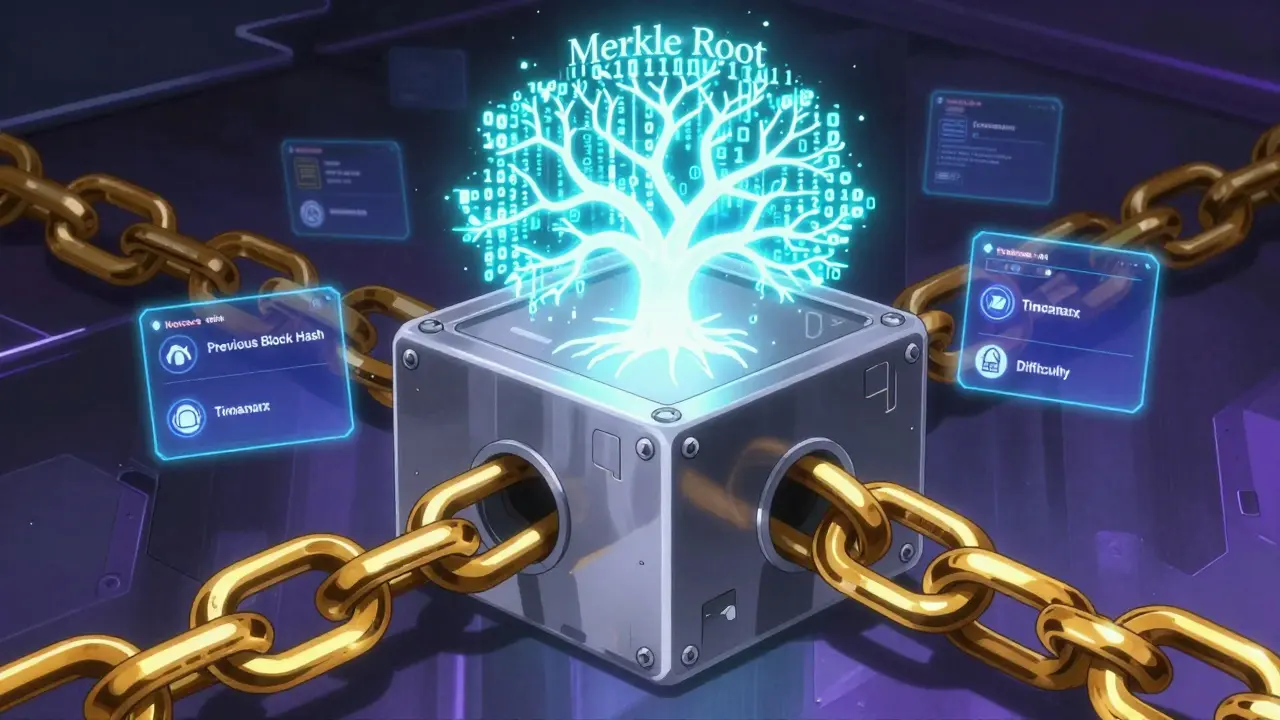
- Previous Block Hash: This is the most important field for creating the "chain." It is a unique identifier (hash) of the block that came immediately before this one. By including this reference, each block cryptographically locks itself to its predecessor.
- Merkle Root: A single hash value that summarizes all the transactions in the block body. We will dive deeper into this below, as it is key to verifying data efficiently.
- Timestamp: A record of when the block was created. This ensures transactions are processed in chronological order.
- Difficulty Target (Bits): In proof-of-work networks like Bitcoin, this field sets the challenge level for miners. It adjusts periodically to ensure blocks are found at a steady rate (e.g., every 10 minutes for Bitcoin).
- Nonce: A random number that miners change repeatedly to solve the mathematical puzzle required to add the block to the chain. It has no other meaning than being part of the calculation.
The Role of Cryptographic Hashing
You cannot understand blockchain anatomy without understanding hashing. A cryptographic hash function, such as SHA-256 used in Bitcoin, takes any amount of input data and converts it into a fixed-length string of characters. This output is called a hash.
Here is why hashes are magical:
- Uniqueness: Even if you change a single comma in the input data, the resulting hash looks completely different. There is no visible pattern between the input and the output.
- Irreversibility: You cannot look at a hash and figure out what the original data was. It is a one-way street.
- Determinism: The same input will always produce the exact same hash. If I hash the word "hello" today, tomorrow, or next year, the result is identical.
In a blockchain, the block header is hashed to create the block’s unique ID. This ID becomes the "Previous Block Hash" for the next block. This creates a dependency chain. If you alter data in Block 1, its hash changes. Because Block 2 contains the old hash of Block 1, Block 2 is now invalid. To fix Block 2, you’d have to recalculate its hash, which would then invalidate Block 3, and so on. This cascading effect makes historical tampering computationally impractical.
Understanding the Merkle Root
If a block contains thousands of transactions, how can nodes verify them quickly? They use a Merkle tree. This is a binary tree structure where pairs of transactions are hashed together. Those hashes are then paired and hashed again, continuing up until only one hash remains at the top: the Merkle Root.
This root hash is stored in the block header. Its power lies in efficiency. If you want to prove that a specific transaction is included in a block, you don’t need to download the entire block. You only need a small subset of hashes from the tree (called a Merkle proof) to mathematically verify the connection to the root. This feature enables lightweight wallets, known as Simplified Payment Verification (SPV) clients, to operate securely without storing the full blockchain history.
| Component | Location | Primary Function |
|---|---|---|
| Transaction Data | Body | Records the actual transfers or state changes |
| Block Hash | Derived from Header | Unique fingerprint identifying the block |
| Previous Hash | Header | Links the block to the prior block, forming the chain |
| Merkle Root | Header | Summarizes all transactions for efficient verification |
| Nonce | Header | Variable used in mining to meet difficulty targets |
How Blocks Link Together to Form a Chain
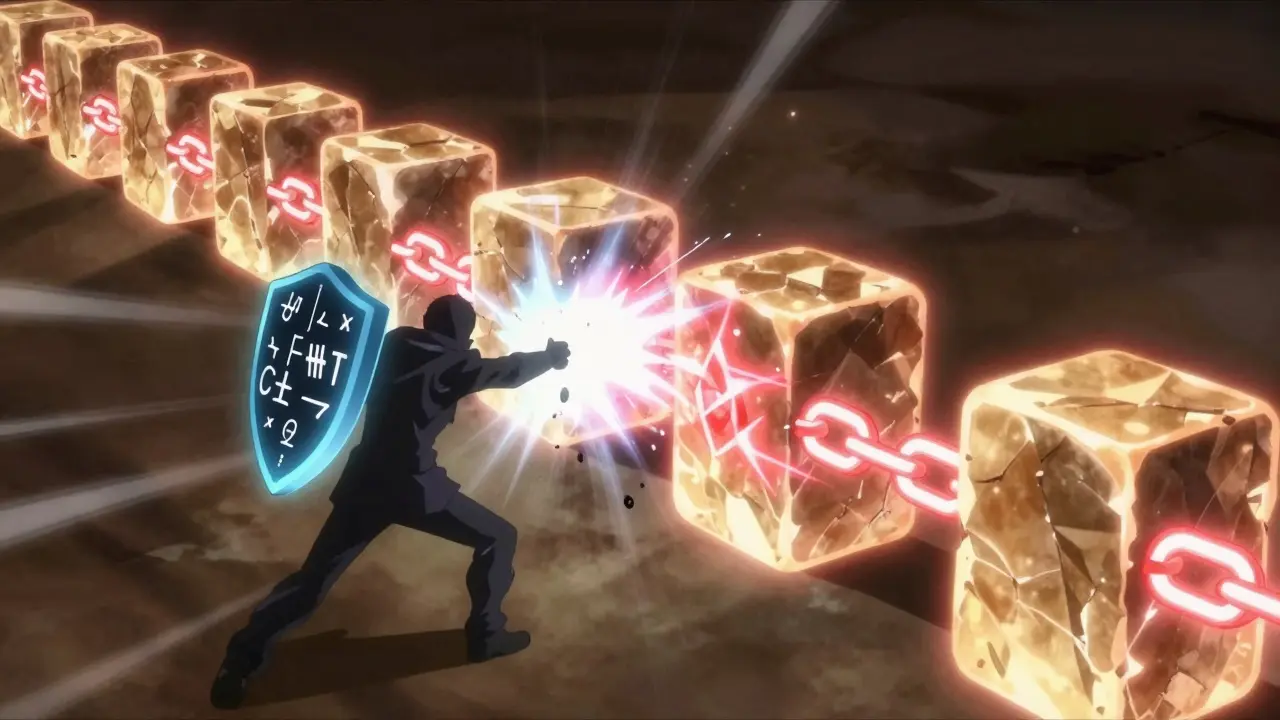
The term "blockchain" comes from this linking mechanism. Each block points backward to the one before it. Imagine a line of dominoes standing upright. If you knock over the first one, the rest fall in sequence. In a blockchain, the "knock" is the cryptographic link.
Let’s say Block 100 has a hash of A1B2C3. Block 101 includes A1B2C3 in its header as the previous block hash. Now, suppose a hacker tries to change a transaction in Block 100 to steal funds. As soon as they change that data, the hash of Block 100 changes to X9Y8Z7. However, Block 101 still references A1B2C3. The network sees the mismatch. Block 101 is now considered invalid because its pointer doesn’t match the current reality of Block 100.
To successfully hack the chain, the attacker would need to recalculate Block 100, then Block 101, then Block 102, and so on, faster than the rest of the honest network. Since new blocks are added continuously, the attacker would need more computational power than the entire combined network-a scenario known as a 51% attack, which is economically unfeasible for large networks like Bitcoin or Ethereum.
Consensus and Immutability
Blocks don’t just appear; they must be agreed upon by the network. This process is called consensus mechanism. In Proof of Work (PoW), miners compete to find a valid nonce. In Proof of Stake (PoS), validators are chosen based on their stake in the network currency.
Once a block is added and subsequent blocks are built on top of it, it becomes immutable. The deeper a block is in the chain (the more confirmations it has), the harder it is to change. For most practical purposes, after six confirmations in Bitcoin, a transaction is considered final. This immutability is what gives blockchain its trustless nature-you don’t need to trust a bank or a government; you trust the mathematics and the distributed agreement of the network.
Why This Anatomy Matters for Users
You might wonder why you should care about headers, nonces, and Merkle roots if you’re just buying crypto or using a dApp. Here is why:
First, it explains security. Knowing that your transaction is protected by complex cryptography and linked to thousands of other records helps you understand why blockchain is resistant to fraud. Second, it clarifies scalability issues. The size of the block body and the complexity of the consensus mechanism directly impact how many transactions per second a network can handle. Finally, it aids in troubleshooting. If your transaction is stuck, understanding that it is waiting to be packaged into a block with a valid nonce helps you realize that adjusting your gas fee (in Ethereum) or transaction fee (in Bitcoin) increases the likelihood of a miner picking it up.
What happens if two blocks are created at the same time?
This is called a fork. Both blocks are temporarily valid. Nodes accept the first one they receive. Eventually, one chain becomes longer than the other. The network agrees on the longest chain as the correct one, and the block on the shorter chain is orphaned, meaning its transactions are returned to the mempool to be re-included in future blocks.
Can a block contain no transactions?
Yes, although it is rare. A block with only the coinbase transaction (the reward given to the miner) is technically valid. However, miners usually fill blocks with as many fee-paying transactions as possible to maximize profit.
What is the difference between a block and a transaction?
A transaction is a single request to change the state of the ledger, such as sending 1 BTC from Alice to Bob. A block is a container that groups many transactions together, adds metadata, and seals them with a cryptographic hash to add them permanently to the chain.
Why is the Merkle Root important for privacy?
The Merkle Root allows users to verify their own transactions without revealing others' data. Lightweight wallets can check if their transaction is in the block by comparing hashes, ensuring they don't need to download or expose the entire list of transactions in that block.
Does every blockchain use the same block structure?
No. While the core concept of linking blocks via hashes is universal, specific fields vary. For example, Ethereum blocks include state roots and receipt roots, which are not present in Bitcoin's simpler structure. Private blockchains may also omit the nonce if they do not use Proof of Work.