


Most people think zero-knowledge proofs (ZKPs) are just about hiding transactions in cryptocurrencies. But that’s like saying GPS is only for finding pizza places. ZKPs are quietly rewriting how systems verify truth-without exposing secrets. And they’re doing it in places you’d never expect: hospitals, election booths, grocery supply chains, and corporate HR departments.
Proving You’re Over 21 Without Showing Your ID
Imagine logging into a bar website and proving you’re old enough to drink-without ever typing your birthdate, uploading a driver’s license, or letting the site store your personal data. That’s not sci-fi. It’s happening now, using ZKPs. In 2022, the U.S. recorded over 1.1 million cases of identity theft, costing $43 billion. A big reason? Companies collect way more data than they need. Your passport number, Social Security number, home address-all stored in databases that hackers love to crack. ZKPs flip that model. Instead of handing over your full identity, you prove a single fact: "I am over 21." The system checks the math behind that claim. Nothing else is revealed. Not your name. Not your address. Not even which country you’re from. Decentralized identity platforms like Worldcoin and Sovrin use this to let users prove citizenship, residency, or age without sharing documents. Banks and fintech apps can comply with KYC rules without ever holding sensitive data. That means less risk of breaches, fewer fines under GDPR, and users who actually control their own info.Doctors Without Paperwork
Hospitals need to know if a doctor is licensed. Traditionally, they’d ask for a copy of the license, scan it, store it, and hope their IT team didn’t mess up the security. But what if the hospital never sees the license at all? With ZKPs, a doctor can prove they hold a valid medical license from a state board-without revealing the license number, expiration date, or even which state issued it. The system verifies the signature on the credential using cryptographic proof. The hospital gets a green light. The doctor keeps their data private. This isn’t theoretical. Hospitals in Canada and Australia are testing ZKP-based credential verification for temporary staff. It cuts hiring time from days to minutes. And because no personal data is stored on hospital servers, they avoid the legal nightmare of data breaches involving medical records.Verifying Votes Without Knowing Who Voted
Election fraud claims have shaken trust in democracies worldwide. But what if you could prove every vote was counted correctly-without ever knowing who voted for whom? ZKPs make this possible. In a ZKP-powered voting system, each vote is encrypted and published on a public ledger. Anyone can check that the total votes match the final count. But the link between a voter and their choice? Gone. The proof shows: "This ballot was valid. It was counted. It wasn’t duplicated." That’s it. Countries like Switzerland and Estonia are piloting such systems. Even in the U.S., groups like the Election Integrity Project are building ZKP-based audit tools for paperless voting machines. The goal? Restore trust without sacrificing secrecy. No more conspiracy theories about "hidden ballots." The math speaks for itself.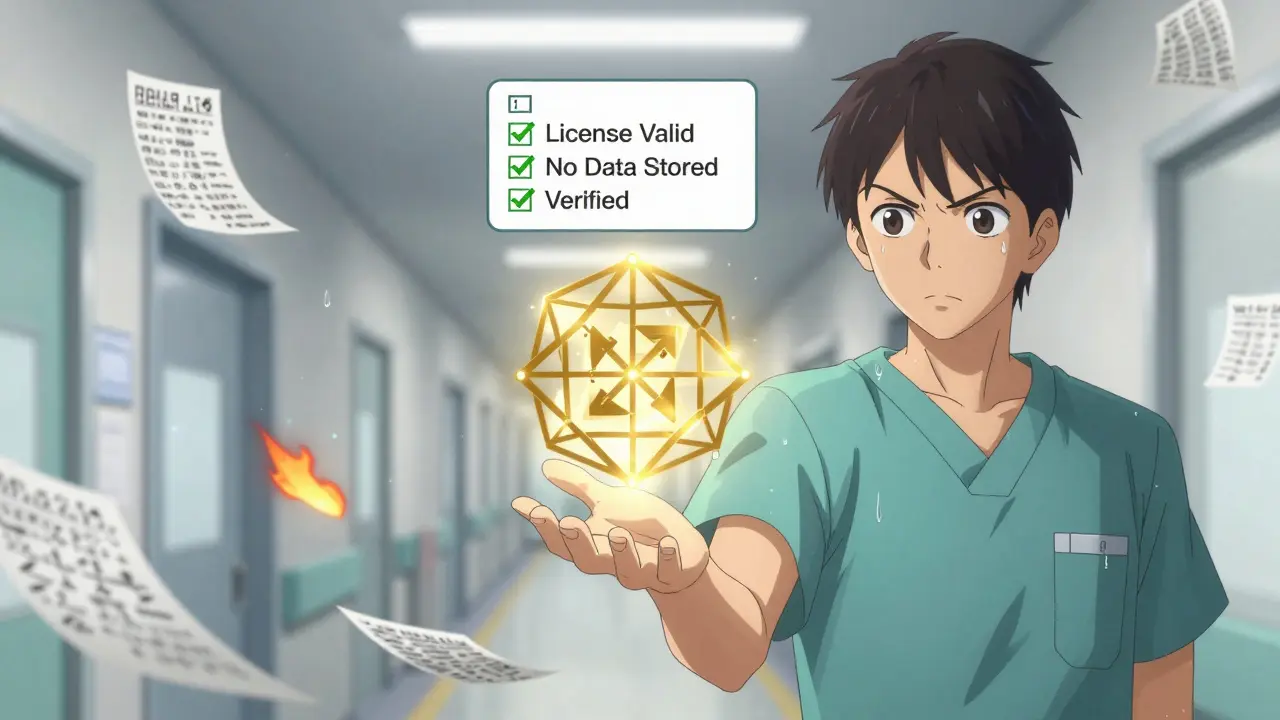
Proving Your Coffee Is Fair Trade-Without Naming the Farm
You buy organic coffee because you care about sustainability. But how do you know it’s real? Most brands rely on third-party audits, paper trails, and certifications that can be forged. ZKPs let supply chains prove ethical sourcing without exposing trade secrets. A coffee exporter can prove: "This batch came from farms that pay fair wages and avoid pesticides"-without naming the farms, sharing contracts, or revealing pricing. The proof is generated from encrypted data points: GPS logs, payment records, drone imagery-all processed into a single cryptographic statement. Companies like IBM and Provenance are already using this for seafood, diamonds, and textiles. Consumers scan a QR code and see a green checkmark: "Verified ethical source." They don’t see the supplier’s name. The brand doesn’t risk competitors stealing their sourcing network. Everyone wins.Smart Contracts That Don’t Leak Your Bank Balance
In DeFi, you need to prove you’re eligible for a loan, staking pool, or governance vote. Traditionally, you’d connect your wallet and let the dApp see your entire transaction history-your balance, your past trades, your wallet addresses. That’s a privacy nightmare. ZKPs change that. Now, you can prove: "I have at least 10 ETH in this wallet" or "I’ve held this token for 90 days"-without showing the wallet address or any other details. The smart contract accepts the proof. It doesn’t need to know who you are. Just that you meet the rule. Projects like zkSync and Aztec use this to let users interact with DeFi protocols anonymously. Even institutions are adopting it. Hedge funds use ZKPs to prove they meet regulatory capital thresholds without revealing their portfolio holdings.
Training AI Without Sharing Your Data
Healthcare companies want to use AI to predict disease outbreaks. But they can’t share patient records due to HIPAA. Banks want to detect fraud using transaction patterns-but can’t hand over customer data to third-party AI firms. Enter ZK-powered machine learning. A hospital can train an AI model on its private patient data. Then, it generates a ZKP that proves: "This model correctly predicts diabetes risk with 92% accuracy." The model itself stays locked inside their system. The proof goes public. Anyone can verify the claim without seeing a single patient’s name or medical history. Tools like zkVMs (zero-knowledge virtual machines) make this easier. Developers can now write code in Python or JavaScript, then compile it into a ZKP. No PhD in cryptography needed. Startups in San Francisco and Berlin are already using this to build compliant AI tools for finance, insurance, and pharma.Why This Matters More Than You Think
ZKPs aren’t just a privacy tool. They’re a new way to trust systems. You don’t need to trust the company. You don’t need to trust the government. You just need to trust the math. That’s powerful. It turns compliance from a burden into a feature. It turns transparency into something you can verify yourself. It turns data collection from a liability into an option. The tech isn’t perfect yet. Generating proofs still takes time. Integrating with old systems can be messy. But the speed of progress is staggering. In 2020, generating a ZKP took 30 seconds on a powerful server. Today, it takes under 200 milliseconds on a laptop. And the adoption curve is steep. From identity systems used by millions to voting pilots in national elections, ZKPs are moving out of labs and into real-world infrastructure.What’s Next?
The next five years will see ZKPs embedded in everyday apps:- Job portals that prove you have a degree without showing your transcript
- Insurance apps that verify your driving record without accessing your DMV file
- Land registries that prove ownership without exposing buyer/seller identities
- Cloud providers that prove they didn’t access your data-without giving you a backdoor





Comments (17)
Katie Teresi
February 1, 2026 AT 10:30 AMZKPs are just crypto bros' latest way to avoid taxes and hide from the IRS. If you're not showing your ID at a bar, you're probably trying to buy alcohol with stolen credit cards. This isn't innovation-it's law evasion dressed up as tech.
Moray Wallace
February 3, 2026 AT 05:26 AMInteresting perspective. The potential for reducing data exposure in public services is compelling, though implementation challenges remain significant-especially around legacy systems and regulatory alignment.
Dahlia Nurcahya
February 5, 2026 AT 05:02 AMThis is the kind of tech that could actually give people back control over their digital lives. Imagine not having to hand over your entire identity just to prove you’re not a child. It’s not magic-it’s math, and it’s beautiful. Kudos to the devs building this quietly in the background.
William Hanson
February 6, 2026 AT 08:00 AMAnother tech bro fantasy. You think some math trick is going to fix systemic fraud? Wake up. People still lie, cheat, and game systems-ZKPs just give them a fancier way to do it. And who’s auditing the auditors? Nobody. Because no one wants to look too closely at the black box.
Lori Quarles
February 7, 2026 AT 20:22 PMTHIS. IS. THE. FUTURE. 🌍 Imagine a world where your data isn’t a product-it’s yours. No more breaches. No more identity theft. Just clean, elegant proof. This isn’t just cool tech-it’s human rights in code. Let’s build it together!
Jeremy Dayde
February 8, 2026 AT 02:25 AMYou know I’ve been thinking about this for a while and honestly the most exciting part isn’t even the privacy angle it’s the fact that you can verify something without ever needing to store anything which means you’re not building another honeypot for hackers and honestly if you think about it this could be the foundation for a whole new class of trustless systems like imagine your car proving it passed inspection without the DMV ever seeing your name or your address or your insurance info or your VIN or your license plate or your credit score or your social security number or your phone number or your email or your home address or your blood type or your allergies or your medical history or your employment status or your criminal record or your tax returns or your voter registration or your passport number or your driver’s license number or your bank account number or your credit card number or your SSN or your mother’s maiden name or your pet’s name or your favorite color or your birthdate or your zodiac sign or your astrological chart or your Spotify playlist or your Netflix history or your Google search history or your Amazon purchase history or your Facebook likes or your Twitter posts or your Instagram photos or your LinkedIn profile or your LinkedIn connections or your LinkedIn endorsements or your LinkedIn recommendations or your LinkedIn endorsements again because you keep getting them and you don’t even know why
Steven Dilla
February 8, 2026 AT 13:59 PMBro this is literally the future 🤯 I just used a ZKP to prove I’m over 21 on a dating app and it didn’t even ask for my ID 😭 No more awkward DMV scans. Just a ✅ and boom. You’re in. This is the kind of tech that makes me believe in humanity again.
Pamela Mainama
February 9, 2026 AT 14:08 PMTruth without exposure. That’s the real revolution.
Rachel Stone
February 10, 2026 AT 13:00 PMSo you’re telling me I can prove I’m not a robot without proving I’m human? Cool.
Will Pimblett
February 11, 2026 AT 01:46 AMWait-so if I can prove I’m over 21 without showing my ID, can I also prove I didn’t steal that coffee? Because I definitely didn’t. Probably. Maybe. Anyway, this is wild. Who’s building the ZKP for ‘I swear I paid for this’?
Christopher Michael
February 11, 2026 AT 02:43 AMLet’s not forget the foundational layer: zk-SNARKs vs. zk-STARKs. The former requires trusted setup, which introduces potential attack vectors; the latter is transparent but computationally heavier. For identity use cases, zk-STARKs are preferable due to their post-quantum resilience and lack of dependency on initial parameters. Also, the performance gains since 2020 are staggering-proof generation latency has dropped by over 99% thanks to recursive proof composition and hardware acceleration via GPU/ASIC. This isn’t vaporware-it’s the next-gen infrastructure stack.
Parth Makwana
February 13, 2026 AT 00:36 AMZero-knowledge proofs represent a paradigmatic shift in cryptographic verifiability, enabling non-interactive, succinct, and computationally sound assertions without information leakage. The application matrix-spanning decentralized identity, verifiable credentials, supply chain provenance, and privacy-preserving ML-is not merely disruptive; it is ontologically transformative. We are witnessing the emergence of a post-trust architecture wherein verification supersedes authorization.
Elle M
February 13, 2026 AT 01:47 AMOh wow, so now we’re letting people prove they’re adults without showing ID? Next you’ll tell me we can prove we’re not criminals without a background check. What’s next? Proving you’re not a terrorist without TSA? This is how countries get hacked. America’s better than this.
Rico Romano
February 13, 2026 AT 05:12 AMMost of these applications are trivially solvable with basic encryption and access controls. ZKPs are overengineered solutions to problems that don’t exist-unless you’re a crypto bro who thinks every problem needs a blockchain. The real innovation here is marketing.
Crystal Underwood
February 13, 2026 AT 20:08 PMY’all are so naive. ZKPs are just a new way for Big Tech to collect more data under the guise of privacy. They’ll say ‘we don’t store your info’ but then they’ll store the proof metadata, the timestamp, the IP, the device fingerprint, the browser hash, the geolocation, the screen resolution, the mouse movements, the keystroke dynamics, the facial recognition from your webcam, the voiceprint, the heartbeat pattern, the sweat composition, the DNA sample, the iris scan, the fingerprint, the palm print, the gait analysis, the social graph, the friend count, the follower ratio, the engagement rate, the ad click history, the search query history, the autocomplete predictions, the cache, the cookies, the localStorage, the sessionStorage, the indexedDB, the service worker, the manifest, the manifest.json, the robots.txt, the sitemap.xml, the favicon.ico, the apple-touch-icon.png, the android-chrome-192x192.png, the android-chrome-512x512.png, the manifest.webmanifest, the browserconfig.xml, the site.webmanifest, the crossdomain.xml, the humans.txt, the security.txt, the well-known/assetlinks.json, the well-known/assetlinks.json, the well-known/assetlinks.json again because they keep adding it for no reason
Raymond Pute
February 15, 2026 AT 14:01 PMLook I get it ZKPs are cool and all but what about the people who don’t have smartphones or internet access or can’t afford a laptop or live in rural areas or are elderly or disabled or illiterate or don’t trust tech or speak a language that isn’t English or have religious objections to digital IDs or are undocumented or are refugees or are homeless or are in prison or are in a war zone or are in a country that bans cryptography or are in a country that requires backdoors or are in a country that doesn’t have electricity or has power outages every day or has bandwidth caps or uses 2G networks or can’t afford data plans or don’t know what a QR code is or think the internet is a government spy tool or believe the moon landing was fake or think ZKPs are just mind control waves from Elon’s satellites or think this is all a plot by the Illuminati to replace cash with crypto and then track everyone and then make us all work for the AI overlords and then upload our consciousness to the cloud so we can be taxed as digital entities and then forced to watch ads for eternity while our souls are monetized as NFTs
Calvin Tucker
February 17, 2026 AT 13:25 PMTruth is not a function of visibility. It is a function of verification. ZKPs do not conceal truth-they reveal its integrity. The real tragedy is not that we hide data, but that we have forgotten how to trust the process itself.