
Remember that wild summer of 2021 when every new cryptocurrency seemed to feature a dog, a cat, or some other animal? That was the era when Zoo Token, known by its ticker symbol ZOOT, launched with a bold promise: to become the central hub for all animal-themed cryptocurrencies. It wasn't just another joke coin; it aimed to build an entire ecosystem around betting on which meme coins would perform best.
Fast forward to mid-2026, and the picture looks very different. If you are searching for ZOOT today, you might be wondering if it’s still worth your time, or perhaps you stumbled upon an old portfolio holding and want to know what happened. The short answer is that while the concept was innovative, the reality has been harsh. Today, we will break down exactly what Zoo Token is, how its unique prediction market worked, why the price collapsed, and what this means for anyone looking at it now.
The Original Vision: More Than Just a Meme
To understand where Zoo Token stands today, you have to look at what it tried to be in May 2021. Unlike standard meme coins like Dogecoin or Shiba Inu, which rely primarily on community hype and viral marketing, Zoo Token Finance proposed a structured utility model. The core idea was to create a convergence point for trending "animal coins."
The project was built on the Ethereum blockchain as an ERC-20 token, with a mirrored version on Binance Smart Chain to facilitate trading on platforms like PancakeSwap. But the blockchain was just the foundation. The real draw was the suite of tools designed to give traders data and ways to interact with the volatile meme coin market.
At launch, the ecosystem consisted of four main modules:
- ZooPrediction: A platform where users could bet ZOOT tokens on which meme coin would rise more in value over a set period, such as 24 or 72 hours.
- ZooIndex (ZIndex): A 100-point grading system that scored animal-themed tokens based on metrics like liquidity, community growth, and roadmap progress.
- ZooNFT: A marketplace for limited-edition, animal-themed non-fungible tokens.
- ZooPad: A launchpad intended to help new meme token projects get off the ground.
This structure was meant to add a layer of sophistication to the chaotic world of meme investing. Instead of just buying and hoping, users could use ZIndex scores to make informed decisions and hedge their bets through ZooPrediction.
How ZooPrediction Worked
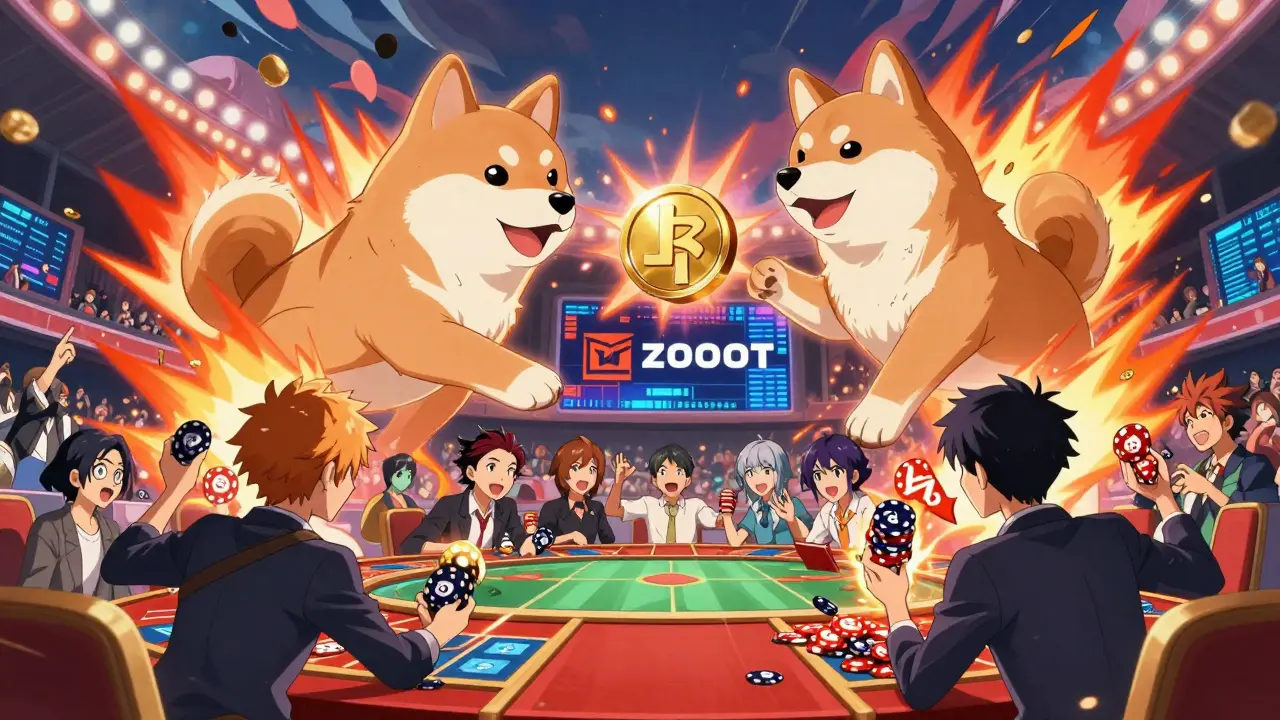
The most talked-about feature of Zoo Token was ZooPrediction. Think of it as a sports betting pool, but instead of football teams, you were betting on the price performance of cryptocurrencies. Here is how the mechanics played out according to the original 2021 whitepapers and analyst breakdowns:
- The Setup: Two or three meme coins-often heavyweights like Dogecoin and Shiba Inu-were pitted against each other in a "race" lasting a specific timeframe.
- The Stake: Participants would stake their ZOOT tokens on the coin they believed would outperform the others.
- The Payout: If your chosen coin won, you received a share of the total pot. Approximately 95% of the staked amount was distributed among the winners.
- The Fee: About 5% of the total stake was automatically redirected into the ZOOT liquidity pool on Uniswap. This was designed to provide buy pressure for ZOOT itself, theoretically stabilizing its price.
For example, if investors collectively staked $1 million worth of ZOOT on a race, and Dogecoin won, roughly $950,000 would go back to the winners, while $50,000 would boost the liquidity of the ZOOT token. It sounded like a clever flywheel mechanism: more betting activity led to more liquidity, which supported the token's value.
Tokenomics: The Problem with Quadrillions
While the utility sounded promising, the tokenomics of Zoo Token presented a massive structural hurdle from day one. The maximum supply of ZOOT was set at 100 quadrillion (100,000,000,000,000,000) tokens. To put that number in perspective, Bitcoin has a max supply of 21 million, and even inflationary tokens like Tether usually operate in the billions or trillions.
A supply of 100 quadrillion means that for the price of a single ZOOT token to reach even $0.000001, the market capitalization would need to be astronomical. As a result, ZOOT has always traded at microscopic fractions of a cent. When it launched, the price was already in the range of $0.0000000009 USD. This extreme dilution appealed to speculative buyers who liked the idea of owning "trillions" of tokens for just $50, but it made significant price appreciation nearly impossible without exponential demand.
As of mid-2026, data providers show a total supply of roughly 50.66 quadrillion ZOOT tokens minted, with circulating supply figures hovering around 51.61 quadrillion. The discrepancy between total and circulating supply often points to complex burn mechanics or bridge contracts, but the sheer volume remains the dominant factor keeping the per-token value near zero.
From Hype to Dormancy: The Price Collapse
If you held ZOOT during its peak, you experienced a dramatic ride. In November 2021, CoinGecko recorded an all-time high of approximately $0.00000001388 USD. At that moment, the project had generated enough buzz to achieve a market cap estimated at nearly $10 million. Analysts compared it to SafeMoon, suggesting there was "room to grow" given its smaller size.
However, the crypto market is unforgiving, especially for micro-cap projects with unproven utility. By 2026, the landscape has shifted entirely. Current data from major trackers like CoinGecko and Coinbase shows ZOOT trading at roughly $0.000000000012 USD. That represents a decline of over 99.9% from its all-time high.
More concerning than the price drop is the lack of liquidity. Daily trading volumes have fallen to under $50 USD. For context, major meme coins like Floki Inu or Baby Doge Coin once saw daily volumes in the tens of millions. With less than $50 changing hands per day, moving any significant amount of ZOOT would cause massive slippage, meaning you would lose a huge percentage of your value just by trying to sell.
| Feature | Zoo Token (ZOOT) | Dogecoin (DOGE) | Floki Inu (FLOKI) |
|---|---|---|---|
| Max Supply | 10>100 Quadrillion | Inflationary (5B/year) | 10 Trillion |
| Primary Utility | Prediction Markets / Indexing | Tips / Payments | Ecosystem / Gaming |
| Current Liquidity | Negligible (<$50/day) | High (Billions) | Moderate (Millions) |
| Exchange Listing | DEX Only (Uniswap/PancakeSwap) | Major CEXs (Binance, Coinbase) | Major CEXs (Binance, Kraken) |
Risks and Red Flags for Investors
When evaluating a token like ZOOT in 2026, it is crucial to look beyond the price chart and assess the underlying risks. The broader DeFi space has seen numerous failures, and ZOOT exhibits several characteristics common to high-risk assets.
First, consider the issue of anonymity and development activity. Since late 2022, there have been no significant updates to the Zoo Prediction platform, no new audits of the smart contracts, and no active governance proposals. In the crypto world, silence often signals abandonment. Without active development, the utility features like ZooIndex and ZooNFT effectively cease to function as intended.
Second, there is the ever-present threat of rug pulls. While there is no direct evidence that Zoo Token Finance developers maliciously drained liquidity pools (a "hard" rug pull), the situation resembles a "soft" rug pull where interest fades, liquidity evaporates, and early holders are left with worthless tokens. Reports from Chainalysis indicate that rug pulls accounted for 37% of crypto scam revenue in 2021, extracting billions from victims. Projects with anonymous teams and unaudited code are particularly vulnerable.
Additionally, the regulatory environment has tightened. Authorities in countries like Thailand and the UK have cracked down on meme coins lacking clear utility. While ZOOT attempted to provide utility through its prediction markets, the collapse of those markets leaves it exposed as a speculative asset with little substance.
Is Zoo Token Still Worth It?
If you are asking whether you should buy ZOOT today, the answer leans heavily toward caution. The combination of a 100 quadrillion supply, negligible trading volume, and lack of recent development makes it a highly speculative asset with extremely low probability of recovery. It does not trade on major centralized exchanges like Binance or Coinbase, limiting access to decentralized swaps where fees and slippage can eat into small investments.
However, if you hold ZOOT from 2021, you might wonder if you should cut your losses or wait for a miracle. Given that the daily volume is under $50, selling large amounts is impractical due to price impact. Small amounts might be swapped on Uniswap or PancakeSwap, but expect the value to remain microscopic.
Ultimately, Zoo Token serves as a case study in the lifecycle of niche DeFi projects. It started with an ambitious idea to bring structure to the meme coin chaos. It achieved brief success but could not overcome the hurdles of extreme token supply and sustained user engagement. For most investors, the lesson here is to prioritize projects with transparent teams, reasonable supply caps, and proven, active utility.
What is the current price of Zoo Token (ZOOT)?
As of mid-2026, Zoo Token trades at a microscopic fraction of a cent, approximately $0.000000000012 USD. The price has dropped over 99.9% from its all-time high in late 2021.
Can I buy ZOOT on Binance or Coinbase?
No, ZOOT is not listed on major centralized exchanges like Binance or Coinbase for spot trading. You can only trade it on decentralized exchanges (DEXs) like Uniswap (on Ethereum) or PancakeSwap (on Binance Smart Chain).
What happened to the Zoo Prediction platform?
The Zoo Prediction platform, which allowed users to bet on meme coin performance, appears to be inactive. There have been no significant updates or active development reports since late 2022, and liquidity has dried up significantly.
Why is the supply of ZOOT so high?
Zoo Token has a maximum supply of 100 quadrillion tokens. This massive supply was likely designed to allow retail investors to own large nominal quantities of tokens for small dollar amounts, but it severely limits the potential price per token.
Is Zoo Token a scam?
There is no direct evidence of a malicious "rug pull" where developers stole funds. However, the project exhibits signs of abandonment, including zero liquidity, no development updates, and a collapsed price. It is considered a high-risk, dormant asset.