

Ever wondered why your favorite YouTuber or artist still relies on erratic brand deals and platform algorithms that change every week? For years, creators have been building massive empires on rented land. They own the audience, but the platforms own the pipes. That's where creator social tokens is a digital asset issued by a creator that allows fans to buy into their personal brand and community. Instead of just hitting a like button, you're essentially buying a stake in their future success.
This isn't just a new way to make money; it's a complete rewrite of the relationship between a creator and their community. We're moving away from the "platform-as-middleman" model and heading toward a world where creators operate as their own sovereign economies. If you've followed the rise of Web3, you know the trend is decentralization, and social tokens are the fuel for this shift.
How Social Tokens Actually Work
At its core, a social token is a fungible asset living on a blockchain. Unlike an NFT, which is a unique one-of-a-kind item (like a specific piece of digital art), social tokens are interchangeable. If you hold ten tokens of a musician, they are identical to the ten tokens held by another fan. Their value isn't based on rarity, but on creator social tokens' utility and the collective demand of the community.
Think of it as a digital membership card that actually has financial value. Creators can use these tokens to unlock a variety of perks. For instance, owning a certain amount of tokens might grant you access to a private Discord channel, a VIP backstage pass at a live show, or a vote on which city the creator should visit for their next tour. This creates a "virtuous cycle": as the creator grows and adds more value to the token, the demand increases, and the value of the token rises for everyone who held it early.
| Feature | Social Tokens | NFTs |
|---|---|---|
| Fungibility | Fungible (all tokens are equal) | Non-Fungible (each is unique) |
| Primary Value | Community access & Utility | Scarcity & Collectability |
| Purpose | Building a personal economy | Digital ownership of an asset |
| Governance | Often allows voting on decisions | Rarely involves governance |
The Shift from Platforms to Personal Economies
For a long time, the Creator Economy was a game of percentages. YouTube, Spotify, and TikTok take a cut of the ad revenue or the subscription fee. The creator does the work, but the platform controls the payment terms. Social tokens flip the script. By issuing their own currency, creators can monetize directly. They don't need a talent agency to negotiate a deal or a platform to approve a payout.
Venture capital firms like Andreessen Horowitz have pointed out that this turns the internet into a universal library of media. Instead of a walled garden, the blockchain becomes the infrastructure. In this setup, the creator retains ownership of their monetization strategy. They can "airdrop" tokens to loyal fans as a reward, effectively paying their community for helping them grow. It transforms a passive viewer into an active stakeholder.
The Arrival of Social Token 2.0
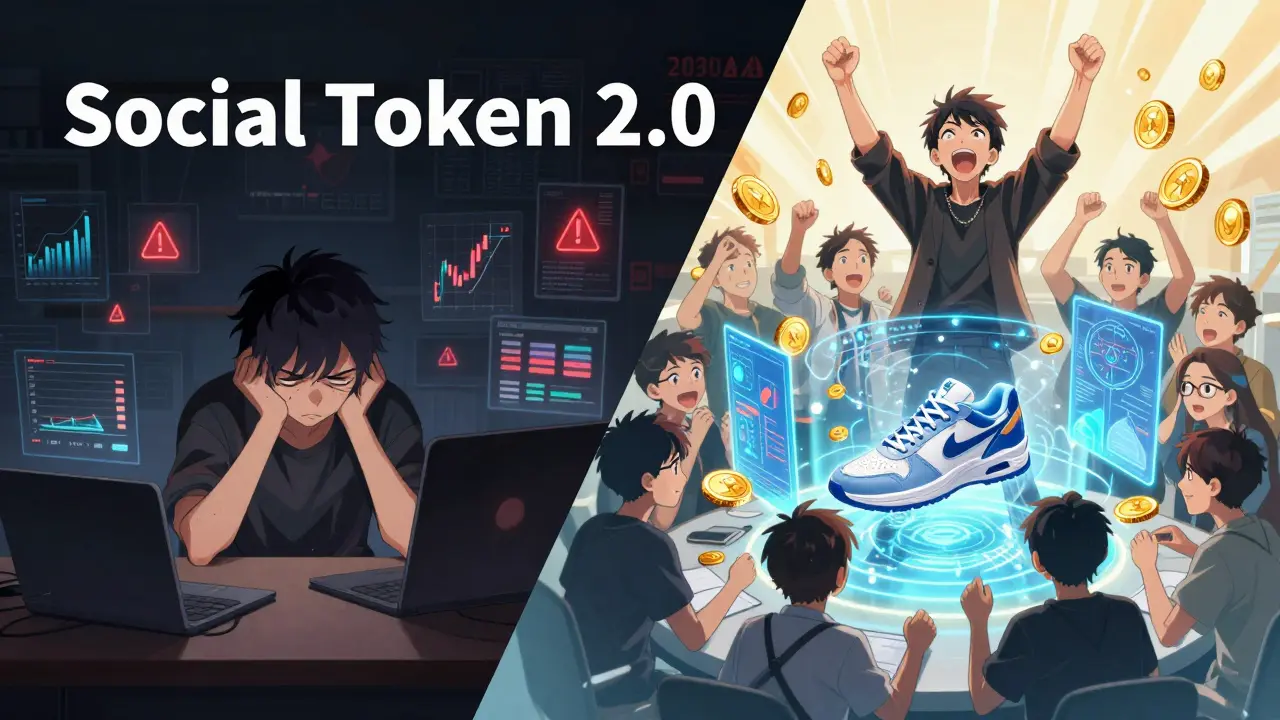
We are currently moving past the basic "access token" phase into what experts call Social Token 2.0. In the early days, tokens were mostly used for chat room access or simple discounts. Now, we're seeing personal brands treated as tradeable financial assets. This means tokens are becoming more sophisticated instruments that can represent a share of future earnings or a more complex set of rights.
This evolution is being pushed forward by Decentralized Social Media (or DeSoc). Platforms like Zora Network are blending the familiarity of Instagram and X with crypto-native features. These platforms ensure that the value generated by a post doesn't just go to the company's shareholders, but is distributed back to the creators and the users who engaged with it. It removes the information asymmetry where platforms hide the real numbers from creators to keep them dependent.
Institutional Money is Entering the Fray
One of the biggest signs that this isn't just a niche hobby is the entrance of institutional capital. For years, creators struggled with financial instability-one bad month or one algorithm change could wipe out their income. Now, organizations like Capital Trust Group Limited are creating institutional funding pools specifically for creators.
Take their approach with digital bond licenses. By providing professional-grade financial infrastructure, they are essentially bridging the gap between traditional finance and the tokenized economy. When you have 100,000 digital bond licenses backing creator initiatives, it's no longer just about "fan coins"; it's about sustainable business models that can attract serious investment and provide a safety net for artists to innovate without fear of starving.
The Roadblocks: Regulation and Volatility
It's not all smooth sailing. If you've spent any time in crypto, you know that volatility is the name of the game. If a creator's token price crashes because of a controversy or a market dip, it can alienate the very community they're trying to build. Moreover, the regulatory landscape is a minefield. Governments are still deciding if social tokens are "utilities" or "securities." If they're classified as securities, the compliance burden becomes massive, which could scare off smaller creators.
There's also the human element of burnout. Many creators find the pressure of managing a token economy-basically becoming a CEO of their own currency-exhausting. They have to balance creating a great video or song with managing token supply, burning tokens to keep prices stable, and communicating a financial roadmap to their fans. Not every artist wants to be a token economist.
What's Next for the Creator Economy?
Looking toward 2030, we can expect social tokens to move from experimental tools to foundational infrastructure. We'll likely see corporate loyalty programs replaced by tokenized systems. Imagine a brand like Nike issuing a token that doesn't just give you a discount, but gives you a say in the design of the next shoe or a share of the royalties from a digital collection.
The end goal is a world where the most valuable asset a person owns is their reputation and their community, and they have a direct, programmable way to monetize that value. We are shifting from a "pay-per-view" world to a "pay-for-participation" world. Whether you're a gamer, a writer, or a coder, the ability to tokenize your influence allows you to build a business that you actually own.
Are social tokens the same as NFTs?
No. NFTs are non-fungible, meaning each one is unique (like a specific piece of art). Social tokens are fungible, meaning every token is identical to every other token of the same creator, similar to how one dollar is the same as another dollar. NFTs focus on scarcity and ownership of a specific item, while social tokens focus on community access and utility.
How does a creator make a social token valuable?
Value is driven by demand and utility. A creator makes their token valuable by offering exclusive benefits to holders, such as private chats, early access to content, or voting rights on future projects. If more fans want these benefits than there are tokens available, the price typically goes up.
Can I lose money investing in a creator token?
Yes. Social tokens are highly volatile. If a creator loses their popularity, stops producing content, or if the broader crypto market crashes, the value of the token can drop significantly. They are speculative assets and carry a high level of risk.
What is "burning" a token?
Burning is the process of permanently removing tokens from circulation by sending them to an unreachable address. This reduces the total supply of the token, which, if demand remains the same or increases, can help push the price of the remaining tokens higher.
Do I need a crypto wallet to use social tokens?
Currently, most social tokens require a blockchain-compatible wallet (like MetaMask). However, new decentralized social platforms are working on "abstracting" this away, allowing users to sign up with an email while the wallet is managed in the background to make it easier for non-crypto users.
Next Steps for Creators and Fans
If you're a creator, don't just jump into tokenization because of the hype. Start by defining what "value" you can actually provide to a token holder that isn't just a promise of future wealth. Map out your utility-will it be access, governance, or physical rewards? Consider starting with a small, loyal group before scaling up.
For fans, approach social tokens as a mix between a community membership and a high-risk investment. Only put in what you are comfortable losing, but treat the tokens as a way to support creators you genuinely believe in. The real value often lies in the community and the access, not just the price chart.

Comments (20)
Jason Davis
April 11, 2026 AT 12:33 PMActually thnk this is the only way creators surivive. The algos are just too unpredictable these days and ownership is the only real hedge against a random ban or shadowban lol
Amanda Faust
April 11, 2026 AT 13:08 PMthis is just basic tokenomics not a new era
jennelle williams
April 12, 2026 AT 07:12 AMit lets people grow together
Jessie Tayaban
April 13, 2026 AT 20:32 PMOMG this is literally so exciting!!!
Imagine being able to actually help your fav artist grow and then see the value go up it's just... wow! I'm so here for this era of digital ownership tho i hope it doesnt get too messy with regulators
Scott Fenton
April 15, 2026 AT 04:21 AMIt is imperative to note that the regulatory framework regarding securities laws may present significant hurdles for creators who are not equipped with legal counsel. One must ensure a clear distinction between a utility token and an investment contract to avoid litigation.
Omotola Balogun
April 16, 2026 AT 20:30 PMThe author mentions institutional money, but fail to clarify that most of these "funding pools" are just high-risk venture plays. In my experience, the liquidity for these tokens is often abysmal, making the "tradeable asset" part of the argument quite shaky, no?
Rima Dinar
April 18, 2026 AT 17:32 PMI really feel that we should look at this as a journey of empowerment where the creator isn't just a content machine but a leader of a community, and if we provide the right coaching and support systems, these social tokens could actually become a way for marginalized artists to find financial stability without needing a corporate gatekeeper to approve their vision of art.
Alan Seiden
April 19, 2026 AT 00:08 AMAbsolute rubbish. This is just another way for grifters to fleece gullible fans under the guise of "community ownership." It's a speculative bubble and nothing more.
william manes
April 20, 2026 AT 02:47 AMFake money for fake people 🤡 Just stick to US dollars 🇺🇸
ssjuul z
April 20, 2026 AT 11:22 AMLet's get it! 🚀 This is how we take the power back from the big corps! Anyone who isn't on board is just staying behind! :)
aletheia wittman
April 21, 2026 AT 16:04 PMliterally so stressfull tho... like imagine your whole income depending on a coin price lol i would laiterally scream
Lane Montgomery
April 22, 2026 AT 04:38 AMWho is the creator? Give me a name.
Rebecca Violette
April 23, 2026 AT 22:28 PMmy last token investment went to zero and i'm still recovering from the trauma of it all... it's just so hard when you trust someone and they just disappear with the rug pull
Hope Johnson
April 25, 2026 AT 20:26 PMWhen we consider the philosophical implications of tokenizing a human's reputation, we are essentially quantifying the essence of social trust into a tradeable commodity, which raises the question of whether a relationship based on financial stakes can ever truly be authentic or if we are simply replacing one form of corporate exploitation with a more decentralized, yet equally cold, market-driven interaction that prioritizes profit over genuine human connection.
Stanly Hayes
April 27, 2026 AT 09:15 AMThis is the future! Get with the program or get left in the dust! It's about time we stopped letting these platforms bleed us dry!
Rob Mitchell
April 28, 2026 AT 15:35 PMGreat breakdown. This helps a lot.
Tyler Webb
April 29, 2026 AT 21:53 PMI can see how that volatility would be really scary for a lot of people. Just gotta be careful with what you put in :)
Mikayla Murphy
April 30, 2026 AT 11:39 AMIt's interesting to see how different cultures might adopt this. In some places, the community aspect is way more important than the financial gain, and that's where I think this could actually thrive.
Akshay Gorad
May 1, 2026 AT 13:53 PMI agree with the point on decentralized social media. It's a necessary evolution for the internet to remain open.
logan bates
May 1, 2026 AT 19:56 PMDoesn't matter as long as it's built on American tech.