


The Math That Makes Crypto Work (and Why It's at Risk)
Most blockchains rely on Elliptic Curve Cryptography (ECC) to generate public and private keys. In simple terms, it's easy for a computer to multiply two numbers, but incredibly hard to do the reverse-finding the original numbers from the result. This "one-way street" is what ensures only you can spend your coins. Enter Shor's Algorithm. Back in 1994, Peter Shor proved that a quantum computer could solve these specific math problems exponentially faster than any laptop or supercomputer we have today. If a machine can run this algorithm, it can derive your private key from your public key. Once a hacker has your private key, they own your funds. It isn't just about the keys, though. SHA-256, the hashing function that powers Bitcoin mining, is also in the crosshairs. While Grover's Algorithm doesn't "break" hashing as completely as Shor's breaks ECC, it does make it much easier. It effectively cuts the security strength of symmetric encryption in half. For example, AES-256 would only provide 128 bits of security against a quantum attacker.The "Harvest Now, Decrypt Later" Strategy
You might think, "Fine, IBM doesn't have a million-qubit computer yet, so I'm safe." Not exactly. There is a scary tactic called "Harvest Now, Decrypt Later" (HNDL). Bad actors and state-sponsored agencies are likely collecting encrypted blockchain data right now and storing it in massive warehouses. They can't read it today, but they are betting that in ten or fifteen years, they will have a quantum machine capable of cracking it. If you've reused addresses or left your public keys exposed, your historical transactions are essentially sitting in a waiting room for future decryption. This makes the threat a present-day privacy risk, even if the actual "hack" hasn't happened yet.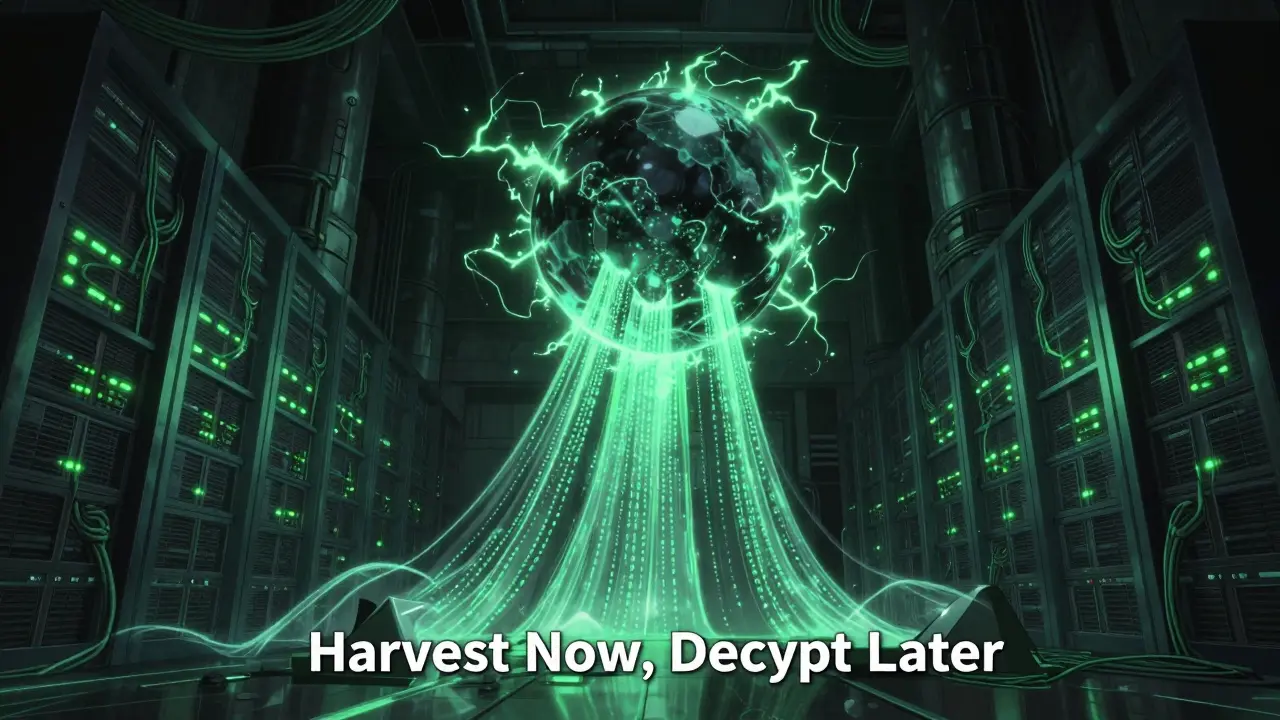
Who Is Most at Risk?
Not all crypto addresses are created equal when it comes to quantum vulnerability. The level of risk depends largely on whether your public key is known to the network.- Reused Addresses: If you've sent and received funds using the same address multiple times, your public key is out there. Deloitte reported in October 2025 that about 25% of circulating Bitcoins are vulnerable because they reside in reused addresses.
- Old "Pay-to-Public-Key" (p2pk) Wallets: Very early Bitcoin wallets exposed the public key directly. These are essentially "sitting ducks" for a quantum computer.
- Modern p2pkh Addresses: Most modern wallets hash the public key. A quantum computer can't crack the hash until you attempt to spend from the wallet and reveal the public key. If the transaction is confirmed within 10 minutes (Bitcoin's average block time), you're generally safe because the attacker doesn't have enough time to derive the private key before the coins are moved.
| Encryption Type | Used In | Quantum Threat | Risk Level |
|---|---|---|---|
| ECC / ECDSA | Bitcoin, Ethereum Signatures | Shor's Algorithm (Full Break) | Critical |
| RSA | Traditional Web Security | Shor's Algorithm (Full Break) | Critical |
| SHA-256 | Bitcoin Mining / Hashing | Grover's Algorithm (Efficiency Boost) | Moderate |
| AES-256 | Data Encryption | Grover's Algorithm (Strength Halved) | Low/Moderate |
The Road to Q-Day: When Does the Clock Run Out?
"Q-Day" is the hypothetical date when quantum computers become powerful enough to break current encryption. Experts are split on the timing, but the window is narrowing. IBM is scaling its hardware rapidly. We've moved from the 433-qubit Osprey chip toward systems that will likely exceed several thousand qubits by 2035. Some analysts at BCG suggest there's a better than 50% chance that RSA-2048 (a common encryption standard) will be broken by then. In a more aggressive scenario, some projections suggest Bitcoin signatures could be cracked in as little as 30 minutes once the hardware hits a certain threshold. However, we shouldn't ignore the engineering hurdles. Error correction is a massive problem. Quantum bits are finicky; they crash if a stray photon hits them. IBM researchers believe these technical glitches might push practical attacks back to 2045. The gap between 2035 and 2045 is where the battle for crypto survival will be fought.
The Shield: Post-Quantum Cryptography (PQC)
The good news is that we aren't just sitting around waiting to be hacked. The National Institute of Standards and Technology (NIST) has been working on Post-Quantum Cryptography (PQC) standards since 2016. These are new mathematical problems that even quantum computers find nearly impossible to solve. In 2022, NIST selected several winning algorithms. For example, CRYSTALS-Kyber is designed for general encryption, while CRYSTALS-Dilithium and FALCON are intended for digital signatures. To implement these, blockchains will need to undergo "hard forks." This means the entire network must agree to upgrade its code to the new standards. Ethereum is already discussing quantum-resistant upgrades, though developers estimate this could take 18 to 24 months of heavy lifting once a full plan is in place.Practical Steps to Protect Your Assets
While you can't rewrite the Bitcoin protocol yourself, you can change how you interact with it. The most immediate way to reduce your quantum footprint is to stop reusing addresses. Every time you reuse an address, you provide a permanent public key on the ledger. If you use a fresh address for every transaction (a practice encouraged by many modern wallets), the public key is only revealed for a short window during the transaction. If you have old coins sitting in a reused address, the safest bet is to migrate them to a new, single-use address. Keep an eye on projects that are "Quantum Resistant" from the start. While they currently make up less than 0.1% of the market, networks using lattice-based cryptography are building the foundations that Bitcoin and Ethereum are now racing to catch up with.Will quantum computers make Bitcoin worthless?
Not necessarily. While the threat is real, the community can upgrade to post-quantum cryptography (PQC). If the network migrates to quantum-resistant signatures before a powerful enough computer exists, the value of Bitcoin would likely be preserved. The risk lies in a slow or failed migration.
Can I use a special wallet to protect myself from quantum attacks?
Currently, most mainstream wallets use the same ECDSA encryption. Your best protection is not using a specific "quantum wallet" but following the best practice of never reusing addresses. This keeps your public key hidden until the very moment you send a transaction.
What is the difference between Shor's and Grover's algorithms?
Shor's algorithm is the "killer" for asymmetric encryption (like public/private keys) because it can completely break the math. Grover's algorithm targets symmetric encryption and hashing; it doesn't break them but makes the search process much faster, effectively halving the security strength (e.g., making a 256-bit key feel like 128-bit).
When is "Q-Day" expected to happen?
There is no fixed date. Estimates range from 2035 (for state-sponsored espionage) to 2045 or later (due to error correction challenges). The consensus is that it is inevitable, but the timing depends on hardware breakthroughs.
Are stablecoins more vulnerable than Bitcoin?
Stablecoins face a unique risk because they bridge the gap between crypto and traditional banking. If a quantum attack hits the banking interfaces or the specific legislation governing them, it could potentially compromise both the digital asset and the fiat reserves simultaneously.







Comments (23)
Shantal Sanjur
April 20, 2026 AT 09:26 AMOh sure, let's just trust that the "experts" at NIST have it all figured out while the government is probably already using quantum machines to read our emails. HNDL is literally the only part of this that feels honest because that's exactly how the deep state operates. Just wait until the "hard fork" happens and magically half your coins disappear during the migration. Absolute joke.
Joshua Salwen
April 21, 2026 AT 09:17 AMTHIS IS LITERALLY A NIGHTMARE!! we are all just sitting ducks waiting for some IBM nerd to press a button and wipe out our entire portfollo!! i can't even sleep thinking about the HNDL stuff, its just too much to handle right now!!
Michelle Stanish
April 22, 2026 AT 01:47 AMI dont think it is a big deal.
Jeff Barlett
April 23, 2026 AT 16:49 PMActually, the whole idea that a hard fork solves this is a fantasy. You're basically asking users to trust a centralized group of developers to move their keys to a new system without a backdoor being installed. It's a total circus.
Yuhan Mo
April 25, 2026 AT 08:58 AMThe transition to lattice-based cryptography is definitely the most viable path forward here. From a technical standpoint, the overhead of PQC signatures is the main hurdle for on-chain efficiency. It will be interesting to see how the gas costs on Ethereum fluctuate once they implement these heavier cryptographic primitives.
Alex Long
April 25, 2026 AT 11:54 AMwhatever. just sounds like more hype to make us panic buy something else.
Nishant Goyal
April 25, 2026 AT 11:55 AMStay positive, everyone. We have the tools to adapt.
Gaurav Undirwade
April 25, 2026 AT 17:36 PMIt is a matter of grave concern that so many individuals are neglecting the basic hygiene of address management. One must maintain a disciplined approach to digital security if they wish to be considered a serious participant in this ecosystem. It is frankly disappointing to see a 25% vulnerability rate due to sheer laziness.
Ian Chait
April 26, 2026 AT 12:04 PMTypical globallist agenda pushin. They want us to move to "NIST standards" so they can bake in a backdor for the New World Order. Shor's algorithm is just the carrot they use to make us jump into their new controlled system. Wake up sheeple, the cryptographee is being weaponised against us by the crown.
Sean Douglas
April 26, 2026 AT 14:04 PMThe sheer, unadulterated terror of having my digital legacy dismantled by a rogue qubit is simply poetic in its cruelty. I can feel the cold breath of the quantum void extinguishing the flame of my financial independence!
Vicky Duffala
April 28, 2026 AT 00:06 AMThis is such a great reminder that technology is always a double-edged sword! 🌟 We just need to embrace the evolution and support the devs making the shift to PQC. It's all part of the grander journey of human discovery and learning how to protect our digital souls! :)
Trudy Morse
April 29, 2026 AT 17:49 PMActually, the math is pretty straightforward. Quantum isn't magic, it's just linear algebra on steroids.
Kevin Lư
April 29, 2026 AT 20:05 PMI'm just gonna keep my coins where they are and hope for the best, lol. If the world ends because of a computer, I guess I'll just find a new hobby.
Prachi Bhadarge
May 1, 2026 AT 05:53 AMOh wow, a 10-minute window of safety. I feel so much better knowing a quantum supercomputer just needs to be slightly faster than a Bitcoin block to rob me blind. Truly a fortress of security we have here.
nikki krinkin
May 3, 2026 AT 04:11 AMIt's really helpful to have this broken down into risk levels. I'll definitely start using new addresses for my transfers now.
Ankit Sindhu
May 3, 2026 AT 05:56 AMWe can all get through this by helping each other migrate safely when the time comes. Education is the best tool we have.
nathan jones
May 3, 2026 AT 15:52 PMKeep it simple. Just move the funds.
Andrew Southgate
May 4, 2026 AT 17:27 PMI truly believe that the community will rise to the occasion because the brilliance of the developers in this space is unparalleled, and while the threat of Shor's algorithm is mathematically sound, the engineering reality of error correction is a much bigger wall than people realize, so we should really look at the historical trend of how we've overcome every single "crypto-killing" bug in the past ten years as a reason to remain hopeful and focused on the long-term utility of the technology rather than the short-term fear of a theoretical machine that doesn't even exist in a stable form yet!
Mike Kempenich
May 5, 2026 AT 01:51 AMThe PQC transition is going to be a huge win for the industry once the dust settles.
Shannon Kelly Smith
May 5, 2026 AT 02:52 AMExactly! Just stay ahead of the curve and keep learning! 🚀💪
Kim Smith
May 5, 2026 AT 20:29 PMIt's funny how we treat these things as a race against a clock, but in reality, the flow of information is more like a river and we're just tryin to build a better dam before the tide rises too high, but maybe the tide is actually what we need to wash away the old, broken systems and make room for something genuinely new and unhackable in the long run, even if the process of getting there is messy and full of errors as we try to translate our human greed into quantum-proof code that can survive the heat death of the universe or at least the next decade of corporate greed.
Mark Pfeifer
May 7, 2026 AT 20:14 PMI'm curious about the energy requirements for these quantum attacks. Surely the cost of running a million-qubit machine makes small-scale theft inefficient?
Chintu Parikh
May 7, 2026 AT 23:08 PMI wholeheartedly concur with the sentiment that collective vigilance is our greatest asset. It is most inspiring to see such a robust discussion on these technical challenges. Let us strive together to implement these safeguards with the utmost precision to ensure a secure digital future for all participants in the blockchain ecosystem!