


Imagine owning a piece of the internet's future infrastructure. Most people think of crypto as just buying a coin and hoping the price goes up, but there is a deeper way to participate: running a node. A node isn't just a piece of software; it's the heartbeat of a decentralized network. But why would anyone spend money on hardware and electricity to keep a network running? The answer lies in economic incentives for running blockchain nodes, a complex system of rewards designed to keep networks secure and honest.
What Actually Happens When You Run a Node?
At its simplest, a Blockchain Node is a computer that talks to other computers in a network. These nodes verify transactions, ensure no one spends the same coin twice, and maintain the official record of the ledger. Because this work is vital, networks can't just ask for volunteers; they need to pay people to do it.
If nodes stopped running, the network would freeze. To prevent this, blockchain architects create financial lures. Depending on the network, these incentives can range from a few extra tokens a month to a full-time professional income. For instance, by 2024, Ethereum saw its validator count climb past one million, proving that when the rewards are right, people will flock to secure the network.
The Main Ways Nodes Make Money
Not all rewards are created equal. Depending on the type of node you run, your paycheck will look different. Here are the most common mechanisms used to attract operators:
- Staking Rewards: Common in Proof of Stake (PoS) systems. You lock up a certain amount of currency as a "security deposit." In exchange for validating transactions, the network pays you a percentage yield on that deposit.
- Transaction Fees: Every time someone sends a payment or interacts with a smart contract, they pay a fee. A portion of these fees goes directly to the node that processes the block.
- Inflationary Rewards: Some networks create new tokens out of thin air to reward early adopters and maintainers. This is essentially "printing money" to pay for network security.
- MEV (Maximal Extractable Value): This is a more advanced strategy. Skilled operators can reorder or bundle transactions within a block to capture extra profit from arbitrage opportunities.
Comparing Modern Node Opportunities
The barrier to entry varies wildly. Some networks want you to be a professional data center, while others let you start with a laptop. Let's look at how a few different options stack up for someone looking to enter the space in 2025 and 2026.
| Network/Node Type | Min. Stake/Requirement | Expected Incentive | Key Characteristic |
|---|---|---|---|
| Gnosis Chain | 1 GNO token | ~13% Annual Yield | Low entry barrier via Erigon 3 |
| Flux Titan Nodes | 50 FLUX tokens | Variable (Lock-up based) | Flexible lock-up periods |
| Ethereum Validator | 32 ETH | Staking + MEV + Fees | High security, high capital |
| Algorand (Project King Safety) | Varies | Diversified (Fees/MEV/Inflation) | Evolving to fix sustainability |

The Algorand Case: When Incentives Need a Reboot
It's not always smooth sailing. Algorand provides a great lesson in economic sustainability. For a while, their fee structure didn't pay enough to make stakers happy. Plus, because they have a hard cap of 10 billion tokens, they couldn't just print more money to solve the problem.
To fix this, they introduced "Project King Safety." The goal here is to diversify where the money comes from. Instead of relying on one source, they're mixing fee-based rewards with MEV and inflation-based incentives. This transition, planned for 2026, shows that node economics are a living science-they have to be adjusted as the network grows to ensure people don't just turn off their machines.
Risks You Can't Ignore
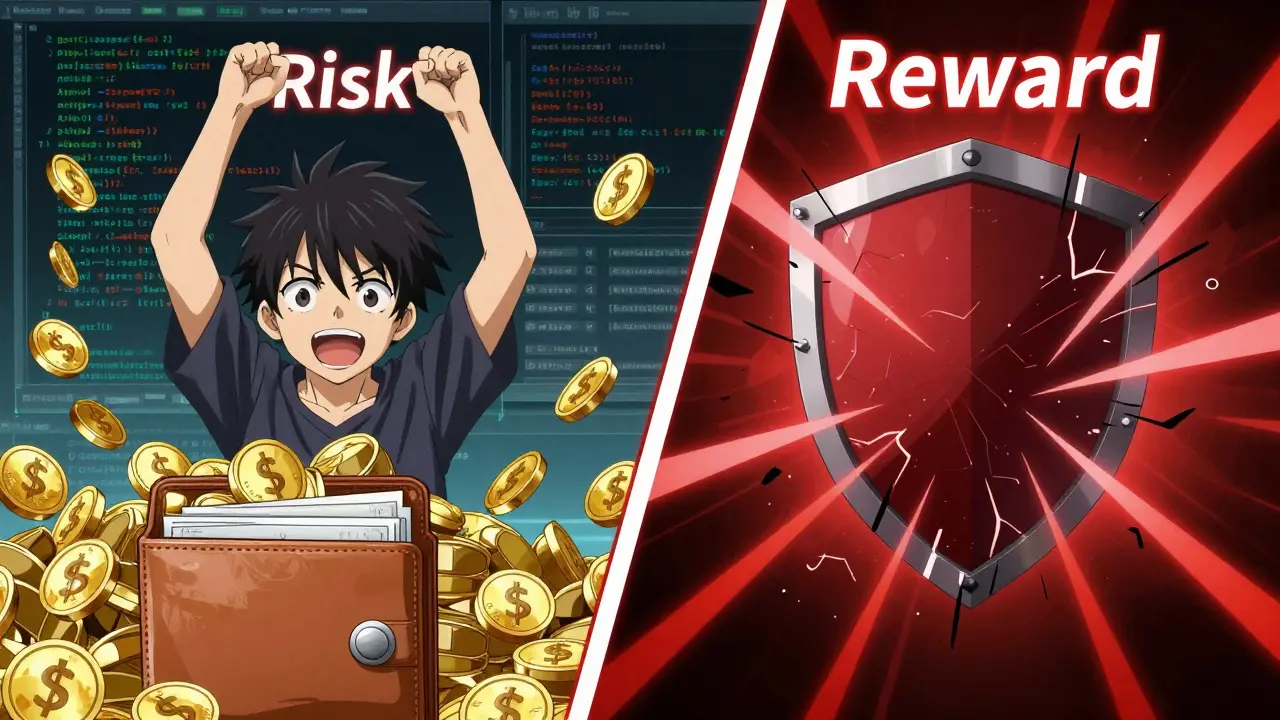
If it were free money, everyone would do it. Running a node comes with "slashing" and operational risks. Slashing is when the network takes away part of your stake because your node went offline or tried to cheat. If your internet cuts out or your server crashes during a critical update, you might actually lose money.
Then there's the hardware cost. While tools like Erigon 3 have made Gnosis Chain more accessible, other networks still require industrial-grade SSDs and high-speed connections. If you're spending $2,000 on a rig to earn $50 a month in tokens, your ROI (Return on Investment) will be painfully slow. You also have to deal with token volatility; a 15% yield is great until the underlying token drops 80% in value.
The Bigger Picture: Regulatory Shifts and DeFi
For years, DeFi (Decentralized Finance) protocols were scared to share revenue with token holders because the SEC might label those tokens as securities. But the wind is shifting. With new leadership and a more pro-crypto Congress, we're seeing a move toward clear market structure legislation.
This is huge for node operators. When protocols can legally share the value they generate, governance tokens transform from "voting chips" into yield-generating assets. This creates a virtuous cycle: better rewards lead to more nodes, which leads to a more secure network, which attracts more users and higher fees.
Is Running a Node Right for You?
Deciding to run a node depends on your goal. If you're a developer or a hardcore believer in a project, the governance power-the ability to vote on the network's future-is often more valuable than the tokens. If you're looking for passive income, the "low-stake" options like Gnosis or Flux are a good starting point.
However, don't underestimate the learning curve. You'll need to get comfortable with Linux, command-line interfaces, and security protocols. It's not a "set it and forget it" investment; it's more like owning a small business. You are providing a service (computation and security) and getting paid for that service.
Do I need expensive hardware to run a blockchain node?
It depends on the network. Some "light nodes" can run on a basic PC. However, "full nodes" or "validators" usually require high-speed NVMe SSDs for fast data retrieval and significant RAM to handle the blockchain state. Some newer updates, like Erigon 3 on Gnosis Chain, are specifically designed to lower these hardware requirements for everyday users.
What is 'slashing' and how does it affect my earnings?
Slashing is a penalty mechanism used in Proof of Stake networks to discourage bad behavior or negligence. If your node goes offline (downtime) or signs conflicting blocks (double-signing), a portion of your staked tokens is permanently removed. This means your actual earnings are (Staking Rewards - Slashing Penalties).
Can I earn rewards without owning a lot of crypto?
Yes. Some networks have very low minimum stakes. For example, Gnosis Chain allows validators to start with as little as 1 GNO token. Additionally, some people use "staking pools" where they combine their small amounts of crypto with others to meet the high requirements of networks like Ethereum, sharing the rewards proportionally.
How does MEV increase node profitability?
Maximal Extractable Value (MEV) allows node operators to earn extra profit by strategically ordering transactions within a block. For example, if a node sees a large trade about to happen on a decentralized exchange, it can place its own trade right before it to profit from the price move (front-running). This is a highly competitive and technical way to boost earnings beyond standard fees.
Is running a node a guaranteed way to make money?
No. Profitability depends on three things: the current price of the token, the cost of your electricity/hardware, and the network's current reward rate. If the token price crashes or the network becomes too crowded with validators (diluting the rewards), you could potentially lose money on your operational costs.








Comments (23)
Rob Mitchell
April 14, 2026 AT 01:34 AMGnosis is a great entry point for beginners since the hardware requirements are so low.
Will Dixon
April 15, 2026 AT 07:35 AMI think its cool how anyone can try this out now without spending a ton of money on gear
Samson Selleck
April 16, 2026 AT 03:38 AMThe obsession with 'low entry barriers' is quaint, but let's be intellectually honest about the asymmetric risk here. We're talking about a marginal utility that barely covers the electricity overhead for the retail plebs, while the real alpha is sequestered within the MEV-boost layer where high-frequency algorithmic execution dominates. If you aren't optimizing your block-building strategy with a dedicated relay, you're essentially donating your hardware's compute power to the network's vanity. Most of these 'incentives' are just glorified yield traps designed to inflate the token price by locking up liquidity in a stagnant validator set. The systemic fragility of relying on a handful of professional data centers-which the author glosses over-completely undermines the decentralized ethos of the Trilemma. It's frankly embarrassing that we're still discussing 'passive income' when the volatility of the underlying asset can wipe out a year's worth of staking rewards in a single 15-minute candle. The structural reality of the current validator landscape is a plutocracy disguised as a democracy. One should analyze the decay of inflation rewards over time, which effectively creates a diminishing return on the initial capital expenditure. It's a race to the bottom where only those with zero-cost energy or institutional-grade infrastructure can maintain a positive ROI. The notion that a laptop can 'participate' is a fallacy; you aren't securing the network, you're just a rounding error in the consensus mechanism. This entire paradigm shift toward 'user-friendly' nodes is just a marketing ploy to attract exit liquidity from retail investors who don't understand the technical debt they are inheriting. Truly, the cognitive dissonance required to see this as a 'business' for the average person is staggering.
Carroll Foster
April 16, 2026 AT 21:27 PMOh look, another 'passive income' dream. I'm sure the ROI on a $2k rig making $50/month is just fantastic if you enjoy waiting a decade to break even while your SSD dies from constant writes. Pure genius!
Artavius Edmond
April 17, 2026 AT 02:13 AMHaha, I get the skepticism but it's still a cool way to learn how the tech works!
Tracie and Matthew Hartley
April 17, 2026 AT 09:40 AMidk why everyone is so hype about it... its just more ways for the big guys to eat the little guys lol
Omotola Balogun
April 17, 2026 AT 20:26 PMActually, the mention of Algorand's project is slightly misplaced since the transition is more about the PURE mechanism than just fees. Its a common misconception among amateurs to ignore the BFT consensus nuances.
ssjuul z
April 18, 2026 AT 03:58 AMLet's keep it positive! This is the future of the web! 🚀
Rima Dinar
April 19, 2026 AT 07:16 AMI truly believe that for those of us who are just starting our journey in the world of decentralized finance, taking the time to understand the underlying infrastructure like nodes is the most rewarding part because it moves you from being a mere spectator to an active participant in a global movement that is fundamentally changing how we perceive value and ownership. It can be intimidating at first, especially for people who didn't grow up with a computer in their hands, but the community support is usually so wonderful that you can find a mentor almost anywhere if you just show a genuine interest in learning the command line and the basic principles of network security.
Alan Seiden
April 21, 2026 AT 04:21 AMTypical rubbish. Most of these 'chains' will be dead in two years and the 'investors' will be left holding useless digital pebbles.
Lela Singh
April 21, 2026 AT 12:46 PMJust dive in! The learning curve is a wild ride but totally worth the gold!
Kelly Cantrell
April 23, 2026 AT 09:40 AMThe SEC isn't just 'shifting'-they're tracking everything. Running a node is basically leaving a digital breadcrumb trail for the government to find your home IP. Be careful.
Chidinma Sandra okafor
April 24, 2026 AT 19:15 PMImagine thinking the US government actually cares about 'market structure' other than finding ways to tax us more. So cute.
william manes
April 25, 2026 AT 15:34 PMStop daydreaming. Get a real job. 🤡
Tyler Webb
April 25, 2026 AT 22:38 PMI can see how the risk of slashing would be stressful for some people :(
Terrance Hausmann
April 26, 2026 AT 22:00 PMIt's definitely a balance. You have to weigh the potential for yield against the time you spend troubleshooting your Linux config. For me, the peace of mind of a stable setup is worth more than an extra 2% yield.
Agnessa Dale
April 28, 2026 AT 14:01 PMEverything always works out in the end, just keep experimenting!
Prasanna Shembekar
April 29, 2026 AT 16:31 PMmy node crashed yesterday omg i thought i lost everything
Jessie Tayaban
April 30, 2026 AT 21:00 PMWait, so you're tellnig me i can just use a laptop for Gnosis?? Omggg i need to try this tonight!
Amanda Faust
May 1, 2026 AT 01:53 AMStaking pools are just centralized exchanges with a different name
Rebecca Violette
May 2, 2026 AT 13:00 PMi tried to set one up and it just made my computer make a loud humming noise and now i'm scared
Akshay Gorad
May 4, 2026 AT 07:03 AMI appreciate the detailed breakdown of the different node types.
logan bates
May 6, 2026 AT 04:51 AMAs long as the tech stays onshore and we aren't relying on foreign servers to secure our assets, I'm in.