

When you hear "Bitcoin," you think of the original digital gold. But what if someone built a version of Bitcoin that runs on Solana - and makes itself scarcer every time someone trades it? That’s Purple Bitcoin (PBTC). Launched in January 2025, PBTC isn’t just another meme coin. It’s a bet on scarcity, automation, and the idea that crypto can be both speculative and structured at the same time.
What Exactly Is Purple Bitcoin?
Purple Bitcoin ($PBTC) is a deflationary cryptocurrency built on the Solana blockchain. It doesn’t try to replace Bitcoin. Instead, it borrows Bitcoin’s core idea - limited supply - and adds modern blockchain tools to make that scarcity automatic. The total supply is locked at 19,314,746 tokens. No more will ever be created. That’s less than Bitcoin’s 21 million, but the real twist is what happens after you buy or sell it.
Every single transaction - whether you’re trading, sending, or swapping PBTC - triggers an automatic burn. A small percentage of the tokens involved in that trade gets permanently destroyed. No one controls it. No team can turn it off. The code just does it. This is designed to shrink the total supply over time, making each remaining token potentially more valuable. Think of it like Bitcoin’s halving, but happening every few seconds, not every four years.
How Does PBTC Differ From Other Solana Tokens?
Solana is full of meme coins. Dog-themed tokens. Cat-themed tokens. Tokens with names that sound like random keyboard smashes. Most of them rise fast on hype, then crash when the buzz dies. PBTC tries to break that pattern.
Unlike those coins, PBTC doesn’t rely on influencers or viral TikTok trends. Its value proposition is built into the contract: fewer tokens over time. It also includes a "burn halving" feature - meaning the rate at which tokens are burned slows down over time, mimicking Bitcoin’s decreasing reward schedule. This is meant to prevent early hyper-deflation and give the token a smoother, more predictable path.
It’s not perfect. PBTC still lives on Solana, which means it’s vulnerable to Solana’s own issues. The network has had outages before. If Solana goes down, PBTC goes down with it. There’s no independent blockchain here - just a token riding on top of another.
Why the Price Is All Over the Place
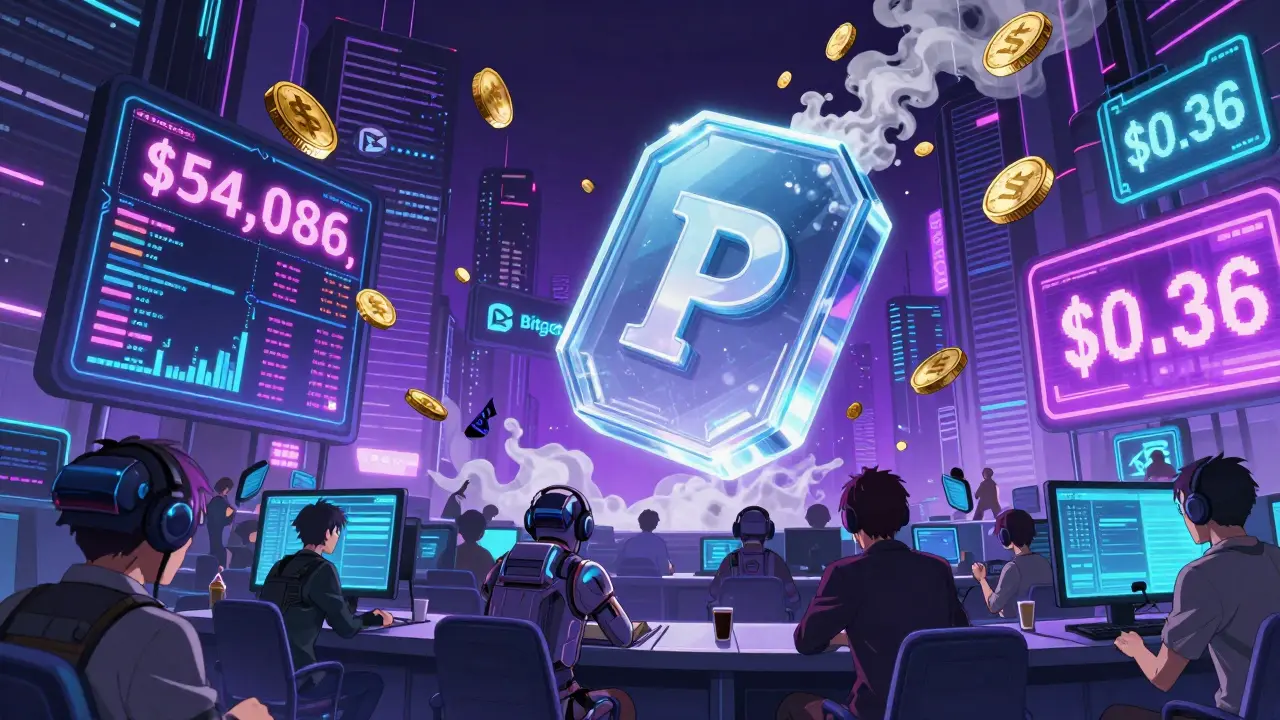
Check PBTC’s price on CoinGecko, CoinMarketCap, or BeInCrypto, and you’ll get wildly different numbers. One site says $0.36. Another says $54,086. That’s not a typo. One reports zero trading volume. Another says $300,000 in a day.
This isn’t normal. It’s a red flag. Either the data aggregators are confused - which happens with new, low-liquidity tokens - or there’s manipulation. PBTC has a market cap around $5.5 million according to Blockspot.io, but with trading volumes fluctuating between $300K and $350K, it’s clear this isn’t a major player yet. The price swings suggest a small group of traders moving the needle, not broad market adoption.
There’s no consensus on its real value because there’s no real demand yet. No big institutions. No major exchanges beyond Bitget. No proven track record. Just a contract, a website, and a promise.
Where Can You Buy PBTC?
Right now, your main option is Bitget. That’s the only major exchange listing PBTC. You can buy it directly with USDT, SOL, or other crypto. Bitget also offers staking and lending options for PBTC holders - meaning you can earn interest just by holding it. But don’t expect to find it on Binance, Coinbase, or Kraken. Not yet.
To get started, you need a Solana-compatible wallet like Phantom or Solflare. Then, you’ll need to buy SOL first, swap it for PBTC on Bitget’s spot market, and store it in your wallet. There’s also a "Learn2Earn" program on Bitget where you can earn small amounts of PBTC by watching educational videos. It’s a way to dip your toes in without spending money.
Is PBTC Safe?
There’s no independent audit of the PBTC smart contract. No public security review from firms like CertiK or Hacken. The contract address - HfMbPyDdZH6QMaDDUokjYCkHxzjoGBMpgaUvpLWGbF5p - is live and public, but without an audit, you’re trusting code that no one has verified.
Also, the team behind PBTC is anonymous. No LinkedIn profiles. No public founders. No roadmap beyond the burn mechanics. That’s common in crypto, but it’s riskier when you’re betting on long-term scarcity. If the team vanishes, the burns keep running. But if there’s a hidden backdoor in the code, you won’t know until it’s too late.
Compare that to Bitcoin. Its code is open, audited thousands of times, and maintained by a global network. PBTC is a single contract on a single chain. That’s a huge difference in risk.
Who Is PBTC For?
PBTC isn’t for beginners. It’s not for long-term investors looking for stability. It’s for people who understand crypto’s volatility and want to play a high-risk, high-reward game based on supply dynamics.
If you believe that scarcity drives value - and you’re willing to accept that the market might not agree - then PBTC gives you a tool to test that theory. It’s not a store of value like Bitcoin. It’s not a platform like Ethereum. It’s a speculative experiment wrapped in deflationary mechanics.
It’s also not for those who want to use it for payments. No merchants accept PBTC. No DeFi protocols integrate it yet. Its only use is trading, staking, and hoping the burn rate creates upward pressure on price.
What’s Next for PBTC?
The project’s future depends on three things: adoption, liquidity, and trust.
Adoption means more people buying and holding, not just trading. Liquidity means more exchanges listing it, so the price stops jumping around. Trust means an audit, a team identity, and maybe even a real whitepaper - none of which exist yet.
Right now, PBTC is a gamble on a theory. The theory is simple: if you keep destroying tokens, the ones left behind will be worth more. But theory doesn’t pay bills. Demand does. And right now, demand is thin.
If PBTC gains traction on major exchanges, gets audited, and shows real supply reduction over six months, it could become a case study in deflationary token design. If not, it’ll fade into the graveyard of Solana memes - another coin with a cool idea and no staying power.
Should You Invest in PBTC?
Only if you can afford to lose it. PBTC is not a long-term hold. It’s a short-term play on hype and scarcity. If you’re curious, put in a small amount - $50, $100, not $5,000. Watch the burn rate. Watch the volume. Watch the price movements. If you see real growth over months, not just spikes, then maybe it’s worth more attention.
But don’t buy it because someone on Twitter called it "the next Bitcoin." Buy it because you understand the mechanics, accept the risks, and are okay with losing everything. That’s the only smart way to play this game.






Comments (25)
Raju Bhagat
January 29, 2026 AT 02:56 AMbro this is either genius or the dumbest thing i've ever seen 😭 i bought 20 bucks worth and now my wallet feels like a casino slot machine
laurence watson
January 30, 2026 AT 21:28 PMi love how this is trying to be Bitcoin but on Solana... it's like putting a Tesla engine in a go-kart. cute idea but the chassis can't handle it. also please someone audit this contract before more people lose money
Elizabeth Jones
February 1, 2026 AT 08:44 AMThe concept of automated deflation via transactional burns is mathematically elegant, but it ignores the fundamental economic principle that value is derived from utility and trust, not arithmetic. Without institutional adoption, audit transparency, or real-world integration, this is merely a numerical illusion dressed in blockchain aesthetics.
Edward Drawde
February 2, 2026 AT 20:53 PMthis is just another rug pull with a fancy name and a cool website. if the devs are anonymous then the coins are fake. duh
Raymond Pute
February 3, 2026 AT 22:51 PMLet’s be real here - this isn’t crypto innovation, it’s performance art for degens. You’re telling me a token that burns 0.1% per trade on Solana - a chain that’s crashed three times this year - is somehow more "structured" than Bitcoin? That’s like calling a paper airplane a jet because it has wings. The burn halving? Cute. But it’s still just a script with a heartbeat. And don’t get me started on the $54k price on some sketchy aggregator. That’s not data, that’s a glitch in the matrix.
Jack Petty
February 4, 2026 AT 10:05 AMthey’re not just burning tokens... they’re burning your sanity. if you think this isn’t a pump-and-dump with a blockchain skin, you’ve been reading too many crypto twitter threads. the fact that it’s only on bitget? red flag city. also who names their coin purple bitcoin? sounds like a kids’ toy
Lori Quarles
February 4, 2026 AT 11:21 AMYESSSS this is the future!!! scarcity + automation = pure alpha!!! if you’re not in this you’re sleeping on the next 100x!!! buy buy buy!!! 🚀💎🔥
Jeremy Dayde
February 4, 2026 AT 23:45 PMi mean i get the idea like its like bitcoin but its on solana and every time you send it some coins disappear and that sounds cool but what if the whole network goes down and you cant trade it anymore and then what happens to the burn and also why is the price so all over the place like one site says 36 cents and another says like fifty thousand dollars and that makes me think maybe its not real
Steven Dilla
February 5, 2026 AT 21:37 PMthis is either the most brilliant thing ever or the dumbest scam since dogecoin but with less memes 🤡💰 i’m in for 100 bucks let’s go!!!
josh gander
February 6, 2026 AT 02:24 AMhey if you're thinking about jumping in, start small. like $20. watch how the burn rate moves over a week. if volume stays up and the price doesn’t just spike and crash, maybe it’s got legs. but don’t go all in - this isn’t a savings account, it’s a rollercoaster with no seatbelts. you got this though 💪
Akhil Mathew
February 6, 2026 AT 23:42 PMinteresting but why solana? if you want scarcity why not build on bitcoin layer 2? solana’s uptime is garbage. also 19 million supply is random why not 21 million like btc? feels like they just picked a number
Tom Sheppard
February 7, 2026 AT 23:13 PMi think this is kinda cool but also kinda scary? like if the team vanishes the burns still happen but who’s gonna fix it if there’s a bug? also why purple? why not blue or green? just wondering 😅
Aaron Poole
February 8, 2026 AT 01:44 AMthe burn mechanism is clever, no doubt. but without an audit, it’s just a black box with a countdown timer. if you’re going to play this game, at least check the contract on Etherscan-style tools. Solana’s explorer lets you see the code - read it yourself. if it looks like spaghetti, walk away.
Ramona Langthaler
February 9, 2026 AT 09:27 AMthis is why america is going to hell. first they let crypto happen then they let people think this is real money. burn tokens? lol. you think i care about your digital paper? go back to your mom's basement
Sunil Srivastva
February 9, 2026 AT 14:58 PMi’ve been watching PBTC for a month. the burn rate is real - 3.2 million tokens burned so far. volume is low but steady. no rug pull yet. still risky but not the worst thing on solana. worth a small position if you’re patient
Devyn Ranere-Carleton
February 9, 2026 AT 20:53 PMwait so if i send pbtc to myself does it burn? like if i just move it between my own wallets?
Kevin Thomas
February 11, 2026 AT 01:43 AMif you’re new to crypto and you’re thinking of putting money into this - stop. go learn how wallets work first. then come back. this isn’t a game. people lose everything on stuff like this
Robert Mills
February 12, 2026 AT 20:37 PMPBTC = profit time 🚀
Jerry Ogah
February 13, 2026 AT 14:23 PMthis is exactly why crypto is a scam. you’re telling me a token that burns itself is valuable? what’s next? a coin that eats its own supply and then cries? this is pure delusion
Andrea Demontis
February 15, 2026 AT 02:10 AMThe philosophical underpinning here is fascinating - a token that enforces scarcity through mechanical inevitability rather than human governance. It mirrors the natural decay of physical resources, yet in digital form. But this raises deeper questions: If value emerges from scarcity, and scarcity is artificially accelerated, does that make the token more valuable or merely more volatile? And if the burn rate slows over time, is that a feature or a surrender to market realities? The answer might lie not in the code, but in the collective belief of its users.
Joseph Pietrasik
February 15, 2026 AT 05:33 AMpbtc is just another meme coin with a burn button. the price difference between sites is because one is real and the other is made up by bots. duh
Pamela Mainama
February 16, 2026 AT 11:06 AMi think it’s brave to try something new. even if it fails, someone had to build it first. i’m not investing but i’m rooting for the idea
Rachel Stone
February 16, 2026 AT 18:03 PMso the coin is purple because the devs were high? makes sense
Nickole Fennell
February 18, 2026 AT 06:05 AMI JUST BOUGHT 500K PBTC AND I’M GOING TO MAKE IT TO THE MOON!! I’M RICH!! MY MOM IS SO PROUD!! I’M BUYING A YACHT AND A PENGUIN!! 🐧💸👑
Richard Kemp
February 19, 2026 AT 03:24 AMi read the contract and it looks legit but i dont trust solana. if it goes down for a week like last time, this coin just sits there. not good