


PureFi Protocol isn’t another meme coin or speculative DeFi project. It’s a compliance toolkit built for blockchain developers who want to follow the law without giving up decentralization. The token, UFI, is the fuel that powers it. But here’s the catch: despite its ambitious goal, the market has barely noticed.
What PureFi Protocol Actually Does
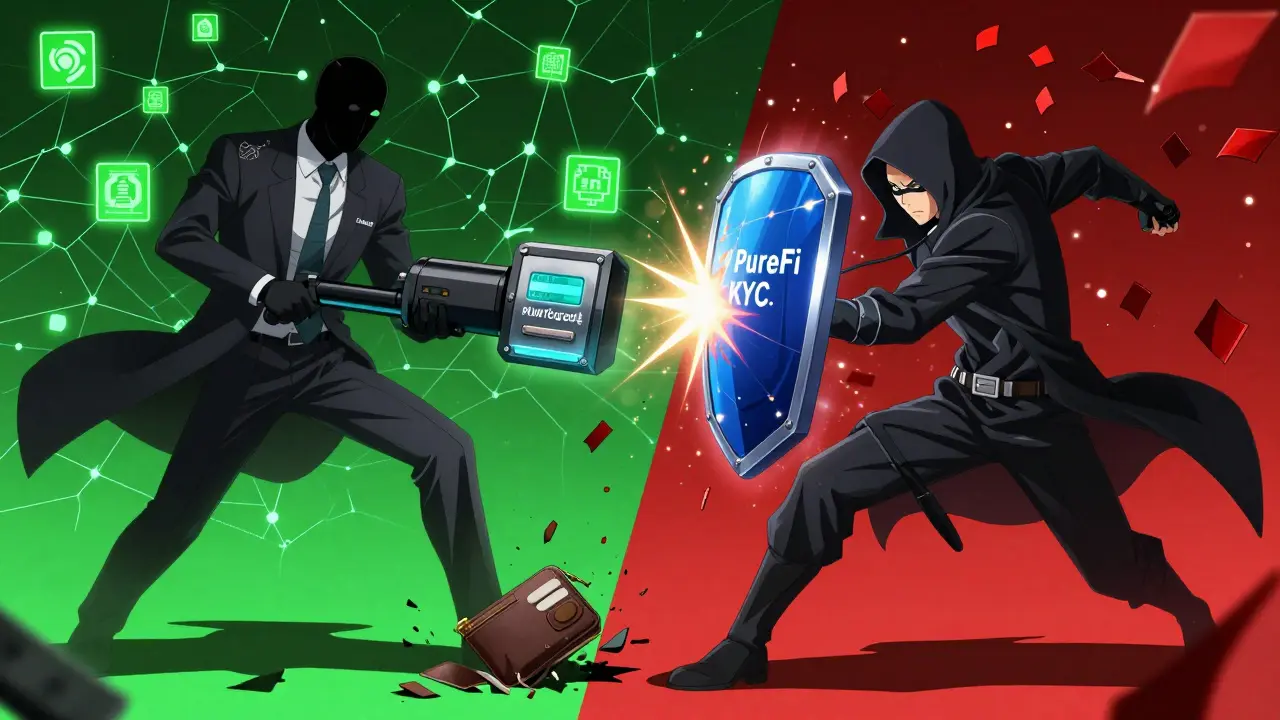
PureFi Protocol tackles a real problem in crypto: how do you stop money laundering and fraud in DeFi without turning it into a surveillance state? Traditional AML tools like Chainalysis or Elliptic scan transactions after they happen. By then, the money’s already gone. PureFi flips that. It checks for red flags before a transaction goes through.
Imagine you’re trying to swap ETH for a new DeFi token. Instead of just clicking ‘Confirm’, your wallet talks to PureFi’s system. It asks: Is this address linked to a known darknet market? Has this token been flagged for pump-and-dump schemes? Is the liquidity pool suspicious? If something looks off, the transaction gets blocked - or at least flagged - before it’s finalized. No personal data is collected. No ID uploads. It’s all done through on-chain behavior analysis.
This isn’t theory. It’s built into smart contracts. Developers use PureFi’s SDK (Solidity V5) to plug compliance checks directly into their dApps. That means any project using PureFi - whether it’s a DEX, lending platform, or NFT marketplace - automatically gets risk screening baked in.
The UFI Token: How It Works
The UFI token is the only way to pay for PureFi’s services. If you’re a DeFi project and you want to use PureFi’s compliance engine, you need to pay in UFI. Even if your platform runs on Solana or Arbitrum, PureFi has a conversion system that lets you swap your native token into UFI to cover the cost.
There are 100 million UFI tokens total. Right now, about 58.4 million are in circulation. That’s not a lot compared to Bitcoin or Ethereum, but it’s typical for niche protocol tokens.
UFI isn’t meant for trading. It’s meant for access. Think of it like a subscription fee - you pay to use the tool, not to speculate on its price.
How It’s Different From Chainalysis or Elliptic
Chainalysis and Elliptic are enterprise tools. They’re used by exchanges, banks, and regulators. They need KYC data - names, addresses, government IDs. That’s fine for Coinbase or Binance, but it kills the whole point of DeFi.
PureFi doesn’t ask for any of that. It looks at patterns: transaction frequency, wallet history, liquidity traps, token velocity. If a wallet sends small amounts to 50 different addresses in 10 minutes? That’s a mixer. If a token’s liquidity gets pulled within 24 hours of launch? That’s a rug pull. PureFi flags those.
It’s like comparing a security guard who checks your ID at the door (Chainalysis) vs. a system that watches for suspicious behavior inside the building (PureFi). One is reactive. The other is preventive.
The Market Reality: A 1K Coin With The Market Reality: A $171K Coin With $0 Volume
Volume
Here’s where things get awkward.
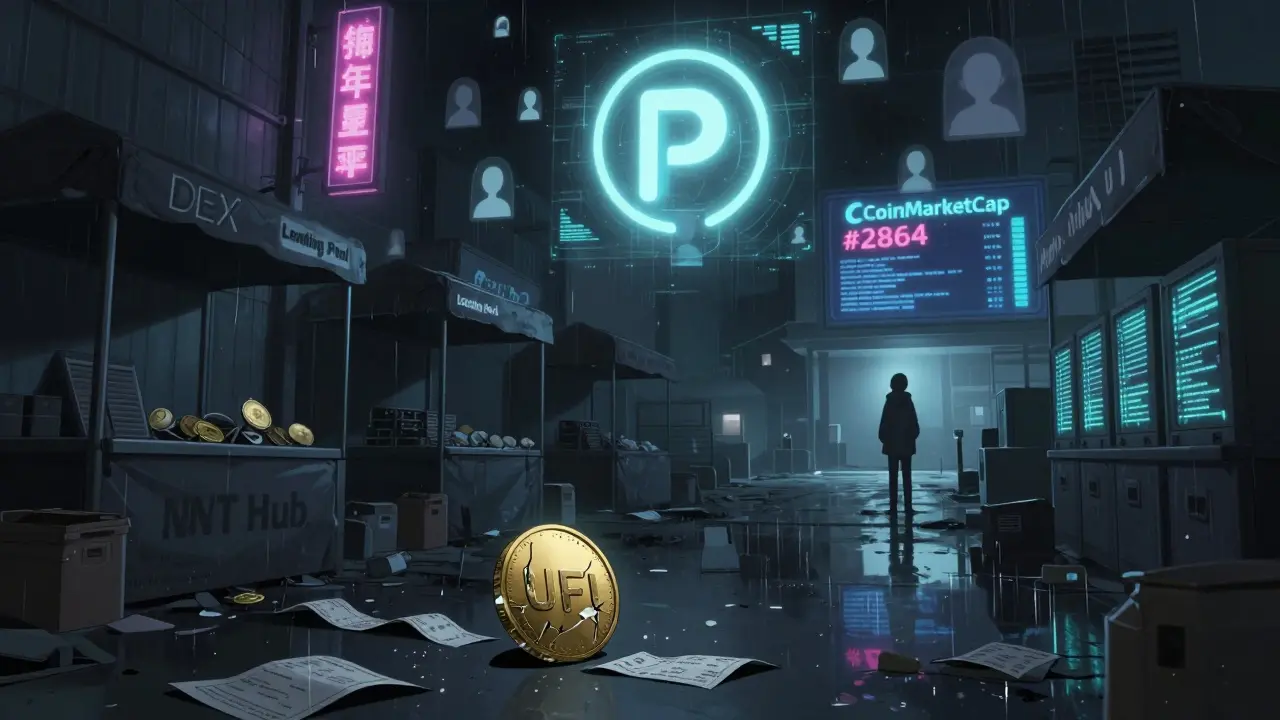
PureFi’s all-time high was $0.5745 in November 2021. Today, it trades at $0.002929. That’s a 99.49% drop.
Its market cap? Just $171,120. That’s less than the price of a single NFT from a popular collection. It ranks #2864 on CoinMarketCap - buried under thousands of other tokens.
And the trading volume? $0 over the last 24 hours. Zero. Not $100. Not $10. $0.
There are 8,900 holders. That sounds like a lot until you realize that Ethereum has over 10 million. PureFi’s community is tiny. Reddit threads about it are sparse. Bitcointalk has almost nothing. The only real discussion is people asking: ‘Is this dead?’
Some analysts say it’s a ghost project. Others say it’s too early. But the numbers don’t lie: nobody’s buying UFI. Nobody’s using it. And if nobody’s using it, the protocol can’t grow.
Who’s Behind It?
PureFi was developed by AMLBot, a compliance tech firm, in partnership with Hacken Foundation - a well-known blockchain security auditor. That’s a good sign. Hacken has audited hundreds of DeFi projects. If they’re involved, the code is probably solid.
The roadmap includes a Compliance Dashboard for AML officers, PureFi Issuer V2, and future governance rewards for UFI holders. But none of that matters if no one’s using the product.
There’s also a compliant DEX built on UniChain and Uniswap V4, using ZK Panther Zone Manager for privacy. That’s technically impressive. But again - if no one’s trading on it, it’s just a demo.
The Bigger Problem: Does Compliance Kill DeFi?
PureFi’s biggest challenge isn’t technology. It’s philosophy.
DeFi was built to remove intermediaries. To give people control. To be censorship-resistant. Now, PureFi wants to build compliance checks into every transaction. Is that still DeFi? Or is it just TradFi with blockchain labels?
One top comment on a Reddit thread from December 2025 got 24 upvotes: ‘Any compliance solution built into DeFi protocols at the protocol level risks creating censorship points that contradict decentralization principles.’
That’s the core tension. PureFi wants to make crypto legal. But making it legal might mean making it less free.
Should You Buy UFI?
Short answer: No.
If you’re looking to invest, UFI is a terrible bet. The market is dead. The volume is zero. The team hasn’t shown any signs of marketing, partnerships, or adoption. It’s not a coin. It’s a prototype stuck in a lab.
If you’re a developer building a DeFi project and you need compliance tools? Maybe. But even then, you’d be better off using established solutions like TRM Labs or Chainalysis, which have real clients, support teams, and proven track records.
PureFi’s tech is interesting. Its vision is important. But right now, it’s a ghost town.
What’s Next for PureFi?
The protocol’s future depends on one thing: adoption.
Does a major DeFi protocol integrate PureFi? Does a regulated exchange start using it? Does a government agency endorse it as a compliant solution?
Without any of that, UFI will keep sliding. The token will keep losing value. The holders will keep leaving.
It’s not about the tech anymore. It’s about trust. And right now, the market doesn’t trust PureFi.








Comments (22)
Anna Topping
January 19, 2026 AT 11:03 AMSo it’s basically a blockchain bouncer that checks if your wallet has been to the sketchy club before? Kinda wild that it doesn’t need your ID-just your transaction history. Feels like crypto’s version of a nosy neighbor who knows everyone’s business.
katie gibson
January 20, 2026 AT 05:08 AMOMG this is sooo dead 😭 like literally a ghost project. I checked the volume and my heart stopped. $0?? Bro, it’s not even a zombie. It’s a fossil.
Andy Marsland
January 21, 2026 AT 08:38 AMLet’s be clear-PureFi isn’t just underperforming, it’s philosophically contradictory. DeFi was born out of a rejection of centralized oversight, yet here we have a protocol that injects pre-transaction compliance checks into every smart contract. This isn’t innovation-it’s capitulation. You can’t build censorship-resistant finance on top of a system that requires behavioral surveillance. The fact that developers would even consider integrating this speaks volumes about how far the industry has strayed from its original ethos. This isn’t compliance-it’s control dressed up in Solidity.
Arielle Hernandez
January 21, 2026 AT 21:20 PMThe technical architecture of PureFi is actually quite elegant-on-chain behavior analysis without KYC is a non-trivial achievement. Most AML solutions rely on off-chain data, which defeats the purpose of decentralization. PureFi’s approach mirrors how anomaly detection works in cybersecurity: signature-based, not identity-based. The real failure here isn’t the tech-it’s the complete lack of go-to-market strategy. No partnerships, no educational content, no developer incentives. You can have the best tool in the world, but if no one knows it exists or how to use it, you’re just shouting into a void.
Bonnie Sands
January 23, 2026 AT 10:29 AMAnyone else think this is a government backdoor? Like… why would a private firm build this unless they were being funded to monitor crypto? Zero volume? 8,900 holders? That’s not a dead project-that’s a quiet rollout. They’re testing it in the shadows before forcing it on everyone. Trust me, they’ve got a backdoor in the code. The ‘no personal data’ claim? That’s what they want you to think.
Ashok Sharma
January 25, 2026 AT 05:08 AMDear friends, this project has good intention. But without users, good intention is not enough. Please support real projects that have team, roadmap, and community. PureFi is like a beautiful car with no fuel. Beautiful, but cannot move.
steven sun
January 26, 2026 AT 12:38 PMbro i saw this on coinmarketcap and thought it was a glitch. $0 volume?? i checked 3 times. i thought my tracker was broken. this thing is a ghost. like… who even holds this??
Taylor Mills
January 28, 2026 AT 10:01 AMtypical us tech bros thinking they can force compliance on crypto. meanwhile china has a working digital yuan and europe is rolling out mica. we’re over here debating whether a $171k coin is ‘dead’ like it’s some kind of moral failure. wake up. the world moved on. this is just noise.
tim ang
January 28, 2026 AT 18:46 PMimagine building something so smart but then just… leaving it on github. no marketing, no discord, no tweets. it’s like writing a novel and then hiding it in a basement. the tech is legit but the team clearly doesn’t care. or worse-they’re waiting for someone else to do the work.
Melissa Contreras López
January 30, 2026 AT 02:29 AMHey, I know it’s easy to write this off as dead-but sometimes the quietest projects are the ones that come back strongest. Think of Uniswap in 2018. No volume. No hype. Just code. Maybe PureFi’s just waiting for the right moment. Don’t bury it just because the market’s asleep. Sometimes the best ideas need time to grow roots.
Shamari Harrison
January 30, 2026 AT 12:56 PMFor devs reading this: if you’re considering integrating PureFi, start small. Build a test dApp, use their SDK, and see how it affects user flow. The compliance layer is non-intrusive-it doesn’t ask for data, just flags behavior. If your users care about safety (and they do), this could be a quiet differentiator. Don’t judge by market cap. Judge by utility.
MOHAN KUMAR
January 31, 2026 AT 12:02 PMmarket cap under $200k? volume zero? 8900 holders? this is a scam. purefi is a rug pull with a whitepaper. hacken audited it? big deal. they audit everything. even the fake coins. this is just a pump disguised as compliance. don’t fall for it.
HARSHA NAVALKAR
February 1, 2026 AT 09:57 AMwhy does everyone keep talking about the tech? no one talks about the people behind it. who even uses this? who benefits? if the protocol is so great, why are the devs silent? why are there no interviews? no updates? this feels like a ghost town built by people who already left.
Julene Soria Marqués
February 2, 2026 AT 15:07 PMso… you’re telling me the only reason this exists is because someone got tired of getting rug pulled? lol. okay. but if it’s so good, why is it not on binance? why is it not in any airdrop? why is the website still using 2021 design? this isn’t a protocol-it’s a digital tombstone.
Mike Stay
February 3, 2026 AT 13:48 PMLet me offer a global perspective: in emerging markets, where financial exclusion is still rampant, tools like PureFi could be revolutionary. Imagine a farmer in Kenya using a DeFi lending app that protects him from predatory actors without needing a bank account or government ID. PureFi doesn’t just serve compliance-it serves justice. The fact that Western traders dismiss it because it’s not ‘sexy’ or ‘volatile’ is a failure of imagination. The real revolution isn’t in speculation-it’s in protection.
Athena Mantle
February 4, 2026 AT 16:10 PMit’s not dead… it’s just in a spiritual retreat 😌✨ the token is meditating on its purpose… the devs are on a 40-day silent retreat in the mountains… the compliance engine is syncing with the universe… 🌌🪷
carol johnson
February 5, 2026 AT 08:42 AMif you think this is bad… you should’ve seen the 2022 crypto winter. this is nothing. this is just the calm before the storm. mark my words-when the next bull run hits, purefi will be the dark horse no one saw coming. i’ve been holding since 2021. i’m not selling. this is my legacy.
Nadia Silva
February 5, 2026 AT 14:30 PMCanadians don’t care about this. We have our own compliant crypto frameworks. We don’t need some US-based startup re-inventing AML with a side of crypto bro philosophy. If you want compliance, use regulated tools. Don’t turn your wallet into a surveillance node.
Jennifer Duke
February 6, 2026 AT 01:25 AMyou know what’s funny? the people who say this is ‘anti-decentralization’ are the same ones who want banks to be more transparent. hypocrisy much? if you want freedom, you need rules. purefi isn’t killing decentralization-it’s making it sustainable. the real enemy is chaos, not compliance.
Sara Delgado Rivero
February 7, 2026 AT 19:23 PMzero volume means zero future. end of story. no need to overthink it. if no one buys it no one uses it. if no one uses it it dies. simple math. stop romanticizing ghost projects
Mark Estareja
February 9, 2026 AT 01:44 AMthe real tragedy isn’t the token price-it’s the wasted potential. this is the kind of innovation that should be funded by the Ethereum Foundation or the Polygon team. Instead, it’s left to die on the vine because nobody wanted to write a blog post about it. We’re not building the future-we’re just collecting dead prototypes.
Matthew Kelly
February 10, 2026 AT 21:28 PMjust wanted to say… i’ve been watching this since launch. i don’t trade it. i don’t hold it. but i still check it every week. like a weird little hope. maybe one day someone will wake up and say ‘hey, this actually works.’ 🤞