
GAMA Coin Supply & Price Calculator
Input Source Data
Data Reliability Analysis
Current Market Cap Analysis
Healthy tokens maintain 5-20% volume-to-market-cap ratio. GAMA's current ratio is below 0.01% (based on $17,980 daily volume).
GAMA Coin isn’t another meme coin chasing hype. It’s a utility token built for a specific purpose: powering a Web3 gaming platform where your wins earn you tokens, and your losses burn them. That’s not just a gimmick-it’s a deflationary design meant to create scarcity. But here’s the catch: while the idea sounds solid, the real-world data paints a messy picture. Prices jump between $0.42 and $1.69 depending on which site you check. Trading volume is tiny. Major exchanges don’t list it. And no one seems to agree on how many tokens are even out there.
What GAMA Coin Actually Does
GAMA Coin (GAMA) is the native token of a Web3 gaming ecosystem built on the Solana blockchain. Unlike big names like Gala or Immutable, GAMA doesn’t focus on NFTs or staking rewards. Instead, it uses a simple, almost brutal mechanic: when you win a game, you get GAMA tokens. When you lose? Those tokens get burned-permanently removed from circulation.
This isn’t just about rewards. It’s about supply control. The total supply is capped at around 100 million tokens. Every time someone loses a match, a portion of their tokens vanish. That’s meant to make GAMA scarcer over time, theoretically increasing its value for those who hold on. The platform claims this creates a fair, skill-based economy where players are rewarded directly for performance, not just for buying in.
But here’s the problem: there’s no public whitepaper. No detailed economic model. No transparent burn rate. You can’t see how many tokens are burned daily, weekly, or monthly. The entire system runs on trust-and right now, that trust is shaky.
Why Solana? And Why It Matters
GAMA runs on Solana, which makes sense. Solana is fast, cheap, and handles thousands of transactions per second. That’s critical for gaming. Imagine playing a real-time battle game where every move, every win, every burn needs to be recorded on-chain. Ethereum would cost a fortune and lag. Solana keeps it smooth.
But Solana isn’t magic. It’s just infrastructure. The real question is: who’s playing? And how many games actually use GAMA? There’s no list of supported titles. No developer docs. No API access. If you can’t find even one game that accepts GAMA as a reward currency, then the token is just a ledger entry with no real-world use.
The Supply Confusion: Who’s Right?
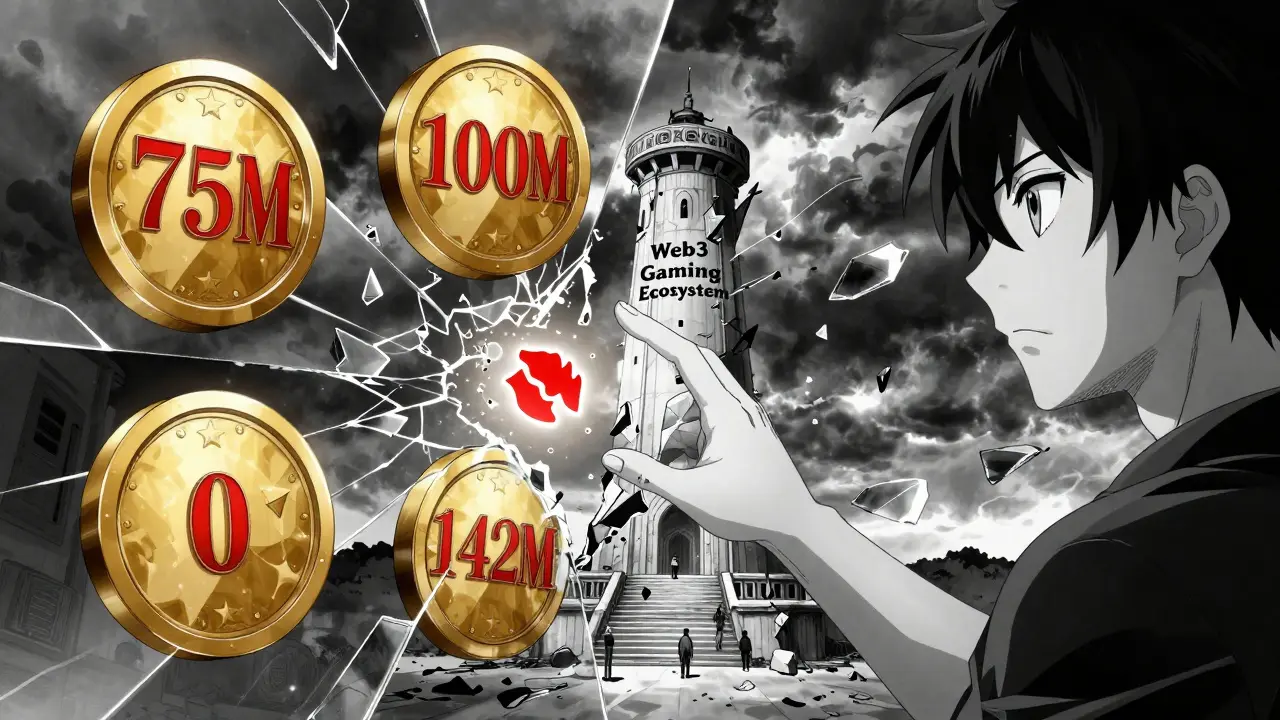
Here’s where things get weird. Different data sites give wildly different numbers for GAMA’s supply and price. CoinMarketCap says there are 75.18 million GAMA in circulation. CoinGecko says 100 million. CoinStats says 142 million. Binance says zero are circulating. How can all of these be true? They can’t.
Same with price:
- CoinMarketCap: $0.4212
- CoinGecko: $0.7641
- Binance: $0.6503
- CoinStats: $1.69
That’s a 300% difference between the lowest and highest prices. That’s not market volatility-that’s data chaos. It suggests either:
- Some exchanges are reporting fake volume or manipulated prices
- The token is traded on tiny, unregulated platforms with no oversight
- There’s a mismatch between the token’s actual contract and the ones being tracked
And it gets worse. In January 2025, the project migrated to a new contract address. That means anyone holding GAMA before that date might have lost access if they didn’t swap manually. No warning. No easy tool. Just a公告 on CoinMarketCap. That’s not user-friendly-it’s risky.
Where You Can Buy (And Why That’s a Red Flag)
You won’t find GAMA on Coinbase, Kraken, or Binance (despite Binance listing it, their data shows $0 market cap). You’ll find it on WEEX, Bitget, and a few other small exchanges. WEEX even advertises up to 400x leverage on GAMA trading. That’s not for gamers. That’s for speculators.
Why does that matter? Because if the primary way people interact with GAMA is by betting on its price with leverage, then the gaming ecosystem is irrelevant. The token is being used as a gambling instrument, not a reward system. That’s the opposite of what it was designed for.
And the volume? On CoinStats, daily trading volume is just $17,980 against a $181 million market cap. That’s a 0.01% volume-to-market-cap ratio. Healthy tokens run at 5-20%. This one is practically dead in the water. Low volume means no liquidity. No liquidity means you can’t sell without crashing the price.
How Does It Compare to Other Gaming Tokens?
Gala (GALA) and Immutable (IMX) are giants in Web3 gaming. Gala has a $1.2 billion market cap. Immutable is at $1.8 billion. Both have dozens of games, clear roadmaps, and active communities.
GAMA? Market cap varies from $0 to $181 million. No game list. No community forums. No Reddit threads. No Twitter buzz. Zero sentiment ratings on Binance. It’s invisible in the broader ecosystem.
Even its deflationary model isn’t unique. Many tokens burn supply. But GAMA ties it directly to gameplay-a clever idea, if it worked. But without real games, it’s just a theoretical model with no players.
Price History and the All-Time Low Mystery
GAMA hit an all-time high of $2.09 in January 2025. Since then, it’s dropped over 79%. That’s a brutal fall. But here’s the odd part: CoinMarketCap says the all-time low was $0.00 on April 20, 2025. That’s impossible for any real token. Either it’s a data glitch, or the token was briefly worthless and reset.
CoinStats says the real low was $0.92. That’s more believable. But why do two major platforms disagree on something this basic? If you can’t trust the price history, how can you trust any analysis?
Is GAMA Coin Worth It?
Let’s be blunt. GAMA Coin has a smart idea: reward players, burn losers’ tokens, create scarcity. But ideas don’t make tokens valuable. Adoption does.
Right now, GAMA has:
- No clear games using it
- No transparent burn mechanism
- No major exchange listings
- No community
- No documentation
- Conflicting data across platforms
- Extremely low liquidity
The only people actively trading it seem to be speculators on WEEX, using high leverage to gamble on price swings. That’s not building a gaming economy. That’s playing roulette with a token that might not even exist as described.
If you’re a gamer looking to earn tokens through skill? GAMA isn’t for you. There’s nothing to play.
If you’re a trader looking for a volatile micro-cap? You might find a short-term opportunity. But with zero liquidity and data inconsistencies, it’s like trying to swim in a puddle that might vanish at any moment.
What’s Next for GAMA?
Bitget predicts a 5% annual growth to $0.61 by 2026. That’s not exciting. That’s barely inflation-adjusted. WEEX’s technical analysis says RSI is at 0-oversold, so a bounce might come. But RSI at 0 on a token with $17,980 daily volume means nothing. It’s a statistical ghost.
Without a public roadmap, a list of partnered games, or a team with a track record, GAMA has no path forward. It’s stuck in limbo: too niche to attract big players, too broken to attract real users.
Right now, GAMA Coin is a concept without execution. A promise without proof. A token with no ecosystem.
Until that changes, treat it like any other micro-cap crypto with no real use case: high risk, zero guarantee, and plenty of red flags.