

You’ve probably heard of Decentraland or The Sandbox. But what about Cindrum (CIND)? It’s one of those tokens that popped up during the 2021 metaverse hype wave, promising to blend our real world with a digital layer using augmented reality (AR). The idea was cool: a virtual world where you could walk around your actual neighborhood and see digital assets overlaid on top. But here’s the kicker-as of late 2026, CIND has crashed over 99% from its all-time high. So, what exactly is this coin, and does it have any life left in it?
The Core Concept: Reality Meets Digital
At its heart, Cindrum is an Ethereum-based ERC-20 token designed to power a planned augmented-reality metaverse platform. Unlike traditional metaverses that exist entirely inside your computer screen, Cindrum aims to integrate with physical locations. Think Pokémon GO, but for social interaction, creator economies, and owning digital land via NFTs. The name "CIN" supposedly stands for "consolidate in network," hinting at their goal to merge separate digital silos into one cohesive experience.
The project launched in 2021, riding the massive wave of enthusiasm created when Facebook rebranded to Meta. Investors were throwing money at anything with the word "metaverse" attached. Cindrum positioned itself as more than just a game; it wanted to be a social layer for the real world. You’d use CIND tokens to buy virtual items, reward creators, and potentially vote on how the world develops. It sounds great on paper, which is exactly why many people bought in before checking the fine print.
Technical Basics: It’s Just a Token on Ethereum
Let’s cut through the marketing jargon. Technically, Cindrum doesn’t run its own blockchain. It’s an ERC-20 token running on the Ethereum mainnet. This means it relies on Ethereum’s security and consensus mechanism. If Ethereum goes down, CIND transactions stop. If gas fees on Ethereum spike, moving CIND becomes expensive.
The contract address is 0xac0968a3e2020ac8ca83e60ccf69081ebc6d3bc3. Because it uses the standard ERC-20 interface, you can store it in any wallet that supports Ethereum, like MetaMask or Trust Wallet. However, being an ERC-20 token also means it inherits specific risks. If the smart contract has bugs, or if the developers hold special admin keys that let them pause transfers or mint new tokens, your investment is vulnerable. As of recent checks, there are no widely cited audits from major firms like CertiK or Trail of Bits for this specific contract, which is a red flag for serious investors.
Tokenomics and Supply: Where’s the Data?
If you try to look up Cindrum’s total supply, you might get confused. Some aggregators show inconsistent data, with some even displaying a current supply of zero due to tracking errors. This lack of transparency is common in micro-cap projects. While we know there is a tradable supply-otherwise it wouldn’t trade-the exact breakdown of how many tokens go to the team, early investors, and community rewards isn’t clearly published in a verifiable whitepaper format that analysts trust.
The utility of CIND is threefold:
- In-world currency: Buying virtual goods, land, or avatar items.
- Rewards: Paying users who create content or engage with the platform.
- Governance: Voting on future developments, though a robust voting system hasn’t been visibly active.
Some promotional materials mentioned staking opportunities, promising yield for holding tokens. But without clear details on lock-up periods or where the yield comes from (inflationary emissions vs. real revenue), these promises often feel like marketing fluff rather than financial mechanics.
Market Performance: From Boom to Bust
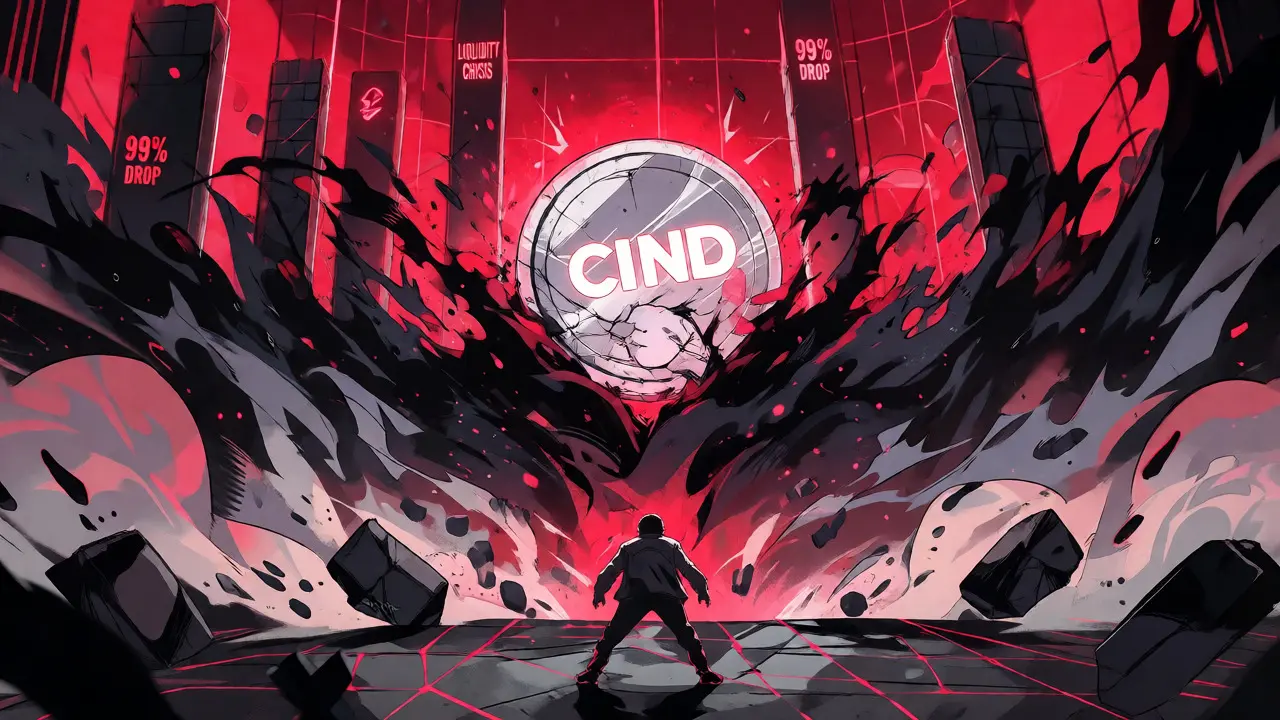
Let’s talk numbers, because they tell the real story. Cindrum hit an all-time high (ATH) of approximately $0.235546 per token during the peak of the 2021 bull market. Fast forward to recent snapshots, and the price hovered around $0.000011. That’s a drop of roughly 99.99%. To put that in perspective, if you invested $1,000 at the peak, you’d be left with pennies today.
Liquidity is another major issue. Many exchanges report "N/A" for 24-hour trading volume, meaning the volume is so low it doesn’t even register on their minimum thresholds. This makes it incredibly hard to sell large amounts of CIND without crashing the price further. You’re essentially buying a lottery ticket where the odds of winning big are slim, and the exit door is very narrow.
| Feature | Cindrum (CIND) | Decentraland (MANA) | The Sandbox (SAND) |
|---|---|---|---|
| Launch Year | 2021 | 2017 (Mainnet later) | 2018 (Mainnet later) |
| Peak Market Cap | <$10M (Est.) | ~$9.2B | ~$7.2B |
| User Activity | Minimal/Low | Tens of thousands monthly | High engagement |
| Exchange Listings | Tier 2/Korean Exchanges | All Major Exchanges | All Major Exchanges |
| Open Source Code | Limited/Proprietary | Public SDKs | Public Game Maker |
Team Transparency and Development Status
Who is behind Cindrum? This is where things get murky. Unlike larger projects with doxxed founders and LinkedIn profiles, Cindrum’s team remains largely anonymous or semi-pseudonymous. There is no clear corporate entity registered under a well-known legal structure that I can find in mainstream databases. In the crypto world, anonymity isn’t always bad-Bitcoin was created by Satoshi Nakamoto after all-but for a service-based platform requiring ongoing development and customer support, it raises questions about accountability.
Development progress appears stalled. While there were teaser videos and concept trailers in 2021 and 2022, there’s little evidence of a widely available, production-ready mobile app or web client that thousands of users are actively using daily. Compare this to Decentraland, which has a public web client, or The Sandbox, which offers tools for users to build their own games. Cindrum seems to have struggled to move beyond the "whitepaper phase." Community forums like Reddit and Discord reflect this sentiment, with many users complaining about a lack of updates and communication from the dev team since the bear market began.

Is Cindrum Dead or Just Sleeping?
So, should you write it off completely? Not necessarily. In crypto, nothing stays dead forever. Micro-cap tokens can sometimes surge 10x or 50x in a bull market simply because their market cap is so small. If Cindrum’s market cap is under $1 million, it only takes a few million dollars of inflow to double the price. Some hopeful holders argue that the AR niche is still untapped and that Cindrum could pivot successfully if they release a solid product.
However, the risks are enormous. You’re dealing with a token that has lost almost all its value, has low liquidity, lacks transparent tokenomics, and has an anonymous team. Regulatory uncertainty also looms large. While not explicitly classified as a security by the SEC yet, the Howey Test could apply if it’s deemed an investment contract. For most retail investors, Cindrum represents a speculative gamble rather than a sound investment.
How to Buy and Store CIND
If you’re still curious and want to take the risk, here’s how you actually get your hands on some CIND:
- Get a Wallet: Install MetaMask or Trust Wallet. These are non-custodial wallets, meaning you control the private keys.
- Fund with ETH: Buy some Ethereum on a major exchange like Coinbase or Kraken. You’ll need ETH to pay for gas fees.
- Find a Listing: Check exchanges like Bithumb (for KRW pairs) or MEXC (for USDT pairs). Note that listings can change, so verify the pair exists before transferring funds.
- Withdraw Carefully: Send CIND to your personal wallet using the correct contract address. Never send to a wrong address; it’s gone forever.
Be prepared for slippage. Because liquidity is thin, the price you see might differ significantly from the price you get when you execute the trade.
What is the Cindrum contract address?
The official contract address for Cindrum (CIND) on the Ethereum network is 0xac0968a3e2020ac8ca83e60ccf69081ebc6d3bc3. Always verify this address on multiple sources like Etherscan before sending funds.
Is Cindrum a good investment in 2026?
It is highly speculative. With a price drop of over 99% from its all-time high and minimal trading volume, it carries extreme risk. It may offer high percentage gains if the project revives, but the probability of long-term success appears low compared to established metaverse tokens.
Can I stake CIND for rewards?
Promotional materials have mentioned staking, but detailed information on APY rates, lock-up periods, and the sustainability of these rewards is scarce. Without a live, audited staking contract, these features may not be fully operational or profitable.
Which exchanges list Cindrum?
Cindrum has historically been listed on tier-2 exchanges such as Bithumb (South Korea) and MEXC. It is generally not available on top-tier exchanges like Binance or Coinbase due to lower liquidity and market cap.
Does Cindrum have its own blockchain?
No, Cindrum is an ERC-20 token that runs on the Ethereum blockchain. It does not operate its own independent network, relying instead on Ethereum's infrastructure for security and transaction processing.