

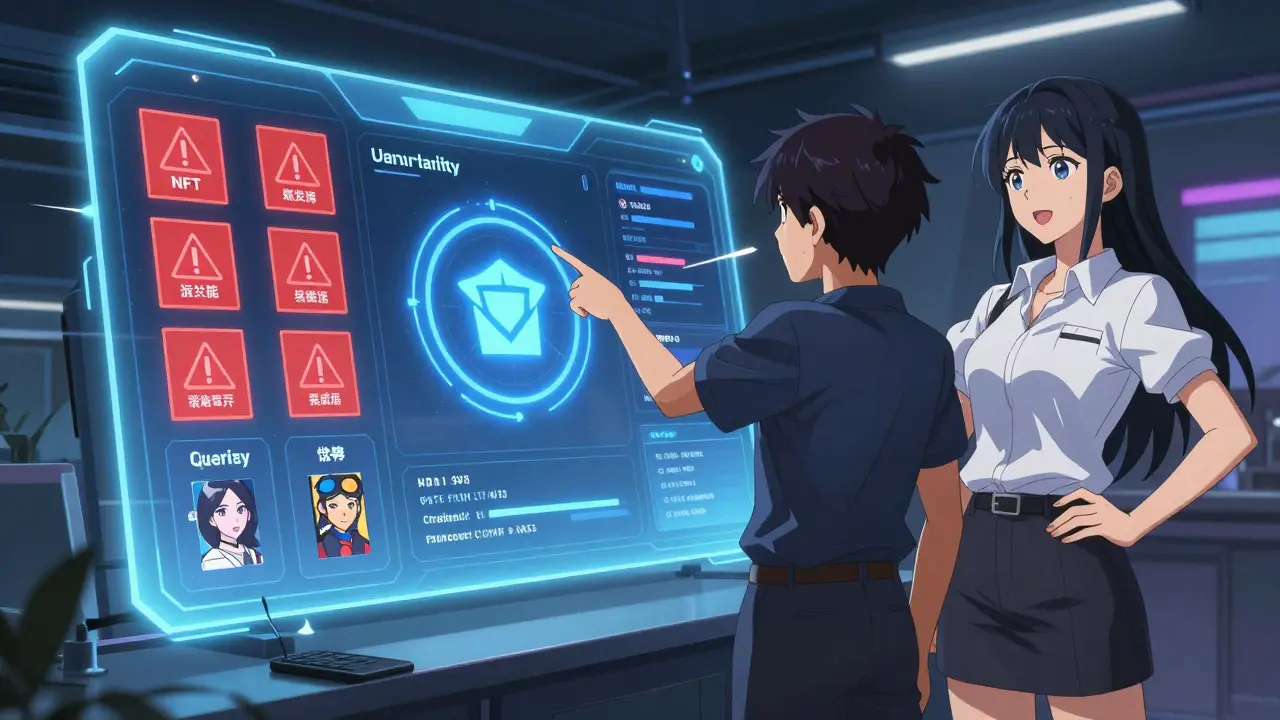
bitsCrunch isn't another meme coin or speculative gamble. It’s a utility token built for a very specific job: helping people spot fraud and understand the real value of NFTs. If you’ve ever bought an NFT and worried you were getting scammed, or wondered if that pixelated ape was truly rare or just a copy, bitsCrunch is designed to answer those questions - using AI, not guesswork.
What exactly does bitsCrunch do?
bitsCrunch runs a decentralized platform that analyzes NFTs and other blockchain assets using artificial intelligence. Think of it like a forensic detective for digital art and collectibles. It doesn’t just show you the price. It digs deeper: Is this NFT a duplicate? Was it minted by a known scammer? Does its rarity score match what the marketplace claims? It checks metadata, ownership history, contract code, and even compares visual traits across thousands of NFTs on different blockchains.
The platform’s main output is clean, reliable data delivered through an API. Developers building NFT marketplaces, wallet apps, or investment tools use this data to protect their users. If you’re buying an NFT on a platform that uses bitsCrunch, you’re seeing the results of its AI analysis - even if you don’t see the name.
How does BCUT, the token, work?
BCUT is the fuel for the bitsCrunch network. You can’t use the platform without it. Here’s how it’s used:
- Payment: Developers pay for API queries using BCUT tokens. The cost is predictable and often tied to stablecoins, so there’s no surprise billing.
- Staking: Users can lock up BCUT tokens to help secure the network. If someone tries to feed false data into the system, their staked tokens can be slashed. This economic penalty keeps the network honest.
- Governance: BCUT holders can vote on upgrades, fee structures, and new features. The more tokens you hold, the more weight your vote carries.
Unlike some crypto projects that create tokens just to raise money, bitsCrunch’s token has clear, daily utility. You need it to use the service, and the service needs it to function securely.
Technical design: Why it’s built differently
bitsCrunch doesn’t run on a single server. Instead, it uses a network of independent nodes - called lite nodes - that each process data locally. This makes the system faster, more reliable, and harder to shut down. If one node goes offline, others keep working.
The AI models are trained on real-world NFT fraud patterns. They’ve learned to spot things like:
- Reused metadata across different NFT collections
- Contract addresses linked to past scams
- Unusual trading patterns that suggest wash trading
- Visual similarities that indicate cloned artwork
And here’s the kicker: it works across multiple blockchains. Whether you’re looking at an Ethereum NFT, a Solana collectible, or an Polygon asset, bitsCrunch’s API gives you the same level of analysis. That’s rare. Most tools only work on one chain.
Market data: Price, supply, and trading
As of January 2026, BCUT trades around $0.0041 USD. That’s down from its initial launch price of $0.14 in early 2024. The token supply is fixed at 1 billion BCUT, and all of them are in circulation. That’s a lot of tokens - which is why the price per unit is so low. It’s not a bug; it’s a design choice. The team wanted to make the token accessible to many users, not just big investors.
Trading volume is modest - around $220,000 in 24 hours - but it’s stable. You can buy BCUT on major exchanges like Binance, Coinbase, and Kraken. Its market cap ranking sits around #1179, which puts it far behind giants like Chainalysis or Elliptic. But those are enterprise-focused companies. bitsCrunch is targeting developers and everyday NFT users.
Why people are still interested
Despite the low price and small market cap, bitsCrunch has strong backing. In December 2024, its token sale on CoinList raised $3.85 million in just 24 minutes. Over 38,000 people from 163 countries signed up. That’s not random speculation - that’s real demand from people who understand what the platform does.
It also got validation from Mastercard’s Start Path program in 2022. Mastercard isn’t just throwing money at crypto projects. They’re looking for tools that can make digital assets safer for mainstream users. bitsCrunch’s AI-powered fraud detection fit that need.
Industry analysts have mixed views. Some predict BCUT could hit $0.19 by 2030 - a 4,600% increase from its 2024 low. Others warn that the low market cap and high supply make it vulnerable to manipulation. The truth? Its value isn’t tied to hype. It’s tied to adoption. If more NFT platforms start using its API, the demand for BCUT will rise. If not, it stays stuck.
Who is this for?
bitsCrunch isn’t for casual traders looking to flip coins. It’s for:
- Developers building NFT marketplaces or wallets who need trustworthy data.
- NFT collectors who want to avoid scams and understand true rarity.
- Investors in blockchain infrastructure who believe NFT security is a growing need.
If you’re just holding BCUT hoping it’ll moon, you’re missing the point. The token only becomes valuable when the platform becomes essential. And that’s still a work in progress.
The big challenge
bitsCrunch is solving a real problem: NFT fraud is everywhere. In 2023 and 2024, millions were lost to fake collections, cloned art, and rigged auctions. But solving a problem doesn’t guarantee success. The blockchain analytics space is crowded. Chainalysis, Elliptic, and Nansen have bigger teams, more funding, and deeper integrations.
bitsCrunch’s advantage? Focus. While others monitor all blockchain activity, bitsCrunch only does NFTs - and does them with AI. That specialization could be its lifeline. If it keeps improving its models and gets adopted by major marketplaces, it could become the go-to tool for NFT safety.
But if developers don’t use its API, or if the AI starts making mistakes, the whole system loses trust. And in crypto, trust is everything.
Final thoughts
bitsCrunch (BCUT) isn’t a get-rich-quick scheme. It’s a tool for a niche but growing need: trustworthy NFT data. The token has real utility, a clear technical design, and early backing from serious players. But its future isn’t written yet. It depends on whether developers choose to build with it - not whether speculators buy it.
If you’re interested in NFTs and tired of getting burned by scams, keep an eye on bitsCrunch. Not because its price might go up, but because it might be the reason you stop losing money to fraud.




Comments (16)
Robert Mills
January 30, 2026 AT 10:16 AMThis is actually useful. Finally someone building real tools, not just memes. 🚀
Devyn Ranere-Carleton
February 1, 2026 AT 00:32 AMwait so bcut is like a nft fraud checker? i thought it was another shitcoin lmao. why is the price so low if its so legit? idk man
Kevin Thomas
February 1, 2026 AT 00:49 AMBro you’re overcomplicating it. It’s not a pump. It’s infrastructure. If you’re holding BCUT hoping to flip it, you’re already wrong. The value is in devs using the API. Period. Stop treating crypto like a casino.
Gurpreet Singh
February 2, 2026 AT 07:36 AMI like how this isn’t trying to be Ethereum or Solana. It’s focused. In India, NFT scams are everywhere - fake art, cloned collections, fake rarity. This could actually help real people. Hope more platforms integrate it.
Rachel Stone
February 3, 2026 AT 08:09 AMso the token price dropped 97% and you call this a success story? cool. sure. 🙃
Ramona Langthaler
February 3, 2026 AT 21:06 PMUS devs are too lazy to build real security tools. This is why crypto stays trash. China and EU have better fraud detection. This is just another american startup trying to look smart while burning cash.
Will Pimblett
February 5, 2026 AT 05:13 AMThe fact that Mastercard backed this says more than any whitepaper. They don’t gamble on hype. They test for real-world use. If this gets adopted by eBay or Etsy’s NFT platform? Game over for scammers.
christal Rodriguez
February 6, 2026 AT 13:45 PMYou think fraud is the problem? Nah. The problem is people think they need to ‘verify’ NFTs at all. Art shouldn’t be quantified. This is capitalism turning pixels into balance sheets.
Tressie Trezza
February 6, 2026 AT 14:32 PMThere’s something beautiful about a project that doesn’t care about the price chart. It’s like a librarian who only wants to help you find the right book - not sell you a copy of it. BCUT feels like that.
Gustavo Gonzalez
February 8, 2026 AT 12:27 PMLMAO 1 billion supply? That’s not accessibility, that’s dilution. And you call it a ‘design choice’? Bro, if your token needs 1B units to be ‘accessible,’ you built the wrong model. This is just a thinly veiled ICO with a fancy API.
Gavin Francis
February 10, 2026 AT 02:55 AMI’ve used the API for my wallet app. It’s legit. Slows down the load time a bit but cuts out 90% of fake listings. My users stopped complaining about scams. Worth the BCUT cost. 👍
Dahlia Nurcahya
February 12, 2026 AT 00:15 AMI used to think NFTs were just digital trading cards. Then I got burned by a cloned Bored Ape. After that, I only buy from platforms using bitsCrunch. It’s not sexy, but it saved me $2k. Grateful.
Christopher Michael
February 12, 2026 AT 04:26 AMWait, so it's not just checking metadata? It's using AI to compare visual traits across blockchains? That's... actually insane. Like, neural nets analyzing pixel patterns? That's like teaching a computer to spot forgeries in the Louvre. This is next-level stuff. I need to check this out.
Elle M
February 13, 2026 AT 21:36 PMLow price = low value. Low market cap = low credibility. You can’t sugarcoat this with ‘utility.’ If it were truly essential, it’d be priced like Chainalysis. This is a vaporware token with a decent pitch.
Brianne Hurley
February 15, 2026 AT 16:26 PMOh wow, another ‘real utility’ crypto. Next you’ll tell me the blockchain is saving puppies. Look, I’ve seen this script a hundred times. ‘We’re not like the others!’ Yeah, and then you dump 80% of your tokens on the first exchange. The only thing this project has in common with trust is the word ‘trust’ in its whitepaper.
Sunil Srivastva
February 16, 2026 AT 22:51 PMI work with a dev team building an NFT marketplace in Mumbai. We integrated bitsCrunch last month. The drop in fraud reports was immediate. Our users are happier. Our support tickets dropped by 60%. BCUT isn’t flashy, but it’s working. If you’re a dev, try the API. It’s cheap and reliable.