

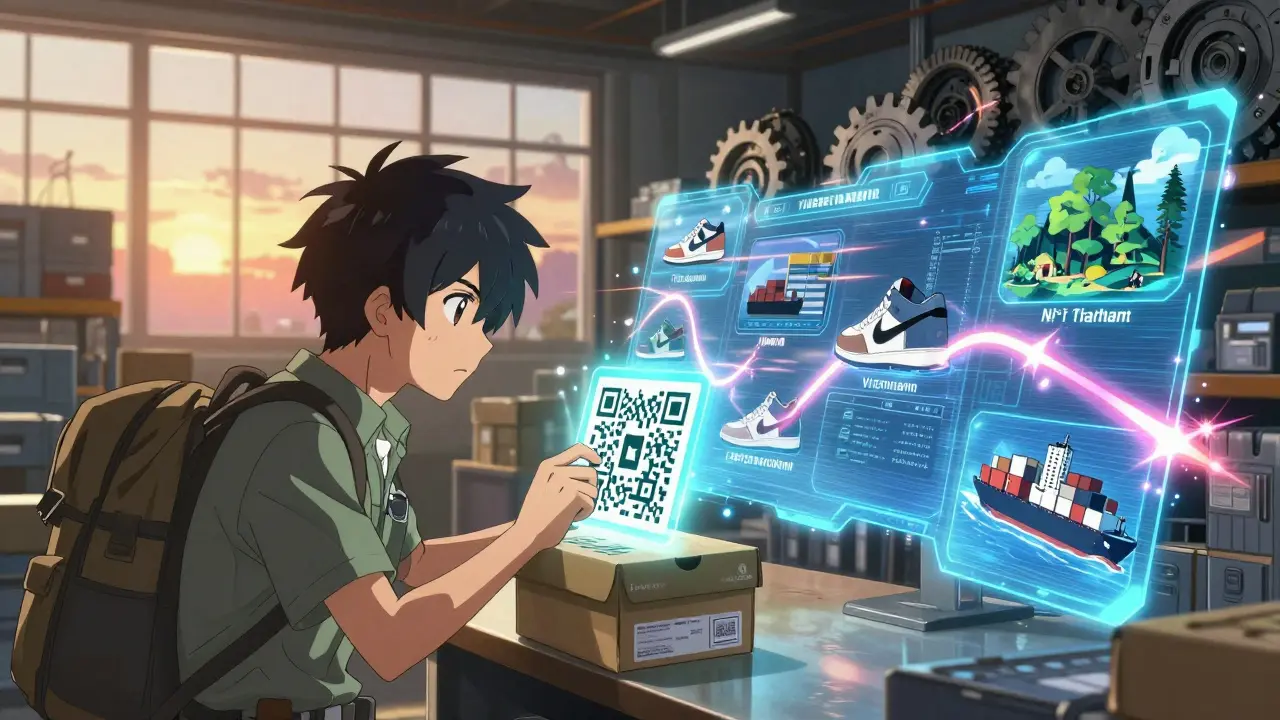
Imagine tracking a pair of sneakers from the rubber plantation in Thailand, through a factory in Vietnam, across the ocean on a cargo ship, past customs in Los Angeles, and finally onto your shelf - all with a single scan. That’s the promise of supply chain NFTs. But in reality, most companies trying to make this work hit wall after wall. It’s not that the idea is broken. It’s that the systems around it weren’t built for this.
What Even Is a Supply Chain NFT?
A supply chain NFT isn’t just a digital certificate. It’s a unique, tamper-proof digital twin of a physical product. Each NFT holds data like where the raw materials came from, who made it, when it was shipped, which warehouse stored it, and even the temperature during transit. Unlike regular blockchain records, NFTs are one-of-a-kind. That means one NFT = one product. No duplicates. No swapping. No fake labels. This isn’t theory. Brands like Nike and LVMH are already using NFTs to prove authenticity for limited-edition shoes and handbags. Retailers scan a QR code, and the customer sees the full journey - not just a marketing claim, but verifiable data. But scaling this beyond luxury goods? That’s where things fall apart.Integration Is a Nightmare
Most supply chains still run on spreadsheets, fax machines, and paper bills of lading. Adding blockchain? It’s like trying to plug a USB-C cable into a 1995 dial-up modem. Companies don’t just need new software - they need to convince dozens of partners to change how they work. A logistics provider in Rotterdam might use one blockchain platform. The manufacturer in Shanghai uses another. The port authority in Singapore doesn’t use any. None of them talk to each other. That’s not a glitch - it’s the norm. Around 30% of companies trying to adopt blockchain in supply chains say integration with existing systems is their biggest hurdle. And that’s before you even get to the fact that many of these partners don’t have IT teams, let alone blockchain developers.Who Pays for It?
Blockchain doesn’t run on magic. It needs servers, developers, training, and ongoing maintenance. But who foots the bill? If a small supplier in Bangladesh has to pay to upload data to a blockchain owned by a German retailer, they’re not going to do it. They’re barely making a profit. The cost of implementation isn’t just technical. It’s political. In a global supply chain, no single company controls the whole chain. So who takes the lead? Who owns the data? Who gets fined if something goes wrong? Without clear rules on cost-sharing and liability, most companies wait for someone else to move first. And that’s why adoption is stuck at 15% - even though 82% of executives believe blockchain will pay off within two years.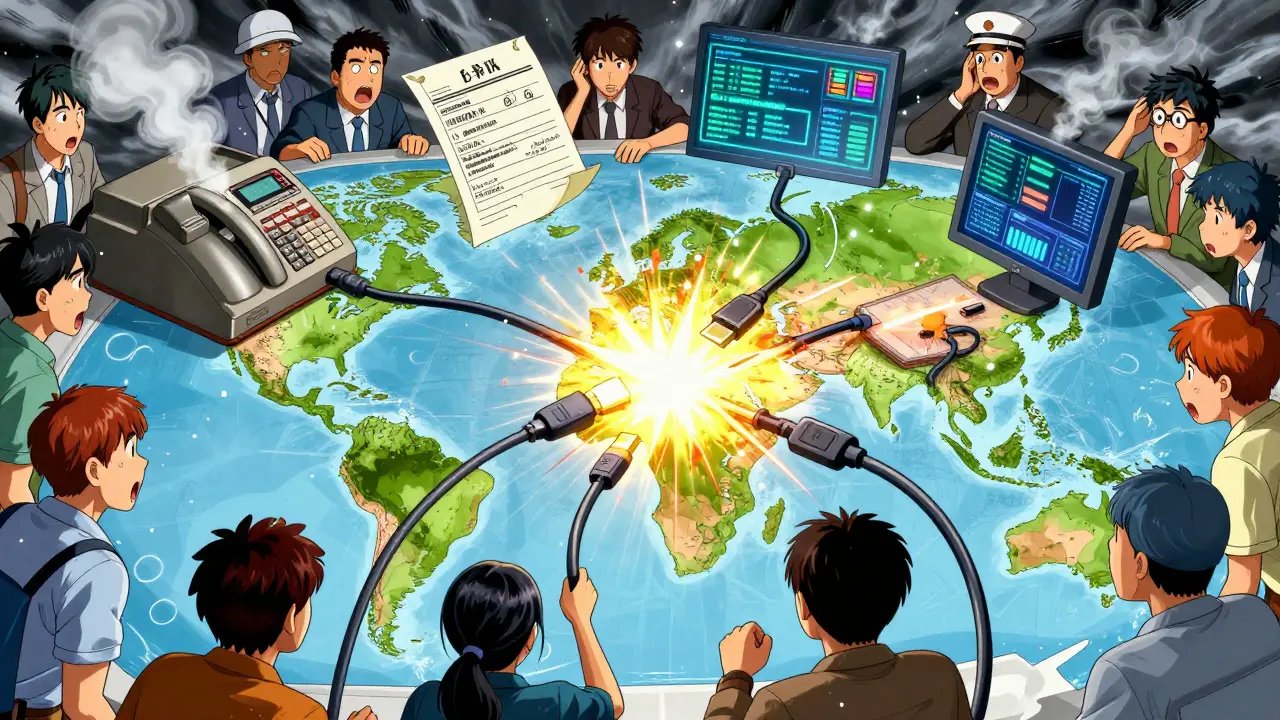
Regulation Is a Wild West
There’s no global rulebook for NFTs in supply chains. The EU has strict digital product passport rules coming in 2026. The U.S. has no federal standard. China regulates blockchain tightly but only for state-approved use cases. And countries in Africa and Southeast Asia? Most haven’t even started drafting laws. This mess makes cross-border trade a legal minefield. A product with an NFT tracking its journey from Mexico to Canada might need to comply with three different data privacy laws, two customs protocols, and one environmental certification standard - all while the NFT itself isn’t legally recognized in half those places. No company wants to risk fines or seizures just to prove their coffee beans were shade-grown.Data Quality Is the Silent Killer
NFTs are only as good as the data put into them. If a factory in Indonesia manually types in the wrong batch number, or a trucker forgets to scan the pallet at the border, the NFT becomes useless. Or worse - misleading. One recycling company in New Zealand tried using NFTs to track plastic waste. They found that 40% of the data uploaded by partner facilities was incomplete or wrong. The NFTs looked perfect - but the truth was buried under bad inputs. Blockchain doesn’t fix bad data. It just makes bad data permanent.People Don’t Trust It - Yet
Even when the tech works, people don’t use it. Workers on the warehouse floor don’t want to learn a new app. Customs officers don’t trust a digital token over a stamped paper document. Retail staff don’t know how to explain it to customers. Change is hard. And in supply chains, change means retraining hundreds, sometimes thousands, of people across continents. Most companies underestimate this. They think if they build the system, people will use it. They don’t realize that the real challenge isn’t technology - it’s culture.
Who’s Doing It Right?
There are exceptions. A small Australian wine producer started using NFTs to track each bottle from vineyard to cellar. They worked with just three partners: the farm, the bottler, and the importer. They kept it simple. No fancy blockchain. Just a single platform everyone agreed on. The result? 95% of customers who scanned the NFT said they trusted the brand more. Sales went up 18% in six months. Another example: a Canadian company using NFTs to track recycled aluminum. Each NFT links to the original source, the energy used in recycling, and the carbon footprint. They got certified by an environmental auditor and now use the NFT as proof for green procurement contracts. That’s the sweet spot: solving a real problem for a clear customer.Why This Matters More Than Ever in 2025
Global supply chains are under more pressure than ever. Raw material shortages hit 94% of companies last year. Shipping delays still cost billions. Consumers demand transparency - 71% say they’ll pay more for products they can trace. NFTs aren’t the only answer. But they’re one of the few tools that can actually prove authenticity at scale. The question isn’t whether they’ll work. It’s whether the industry will fix the broken pieces around them.Where Do We Go From Here?
There’s no magic bullet. But progress is possible if companies focus on three things:- Start small. Pick one product, one partner, one route. Prove value before scaling.
- Choose interoperable tech. Avoid proprietary blockchains. Use open standards like Hyperledger or Ethereum-based solutions that others can join.
- Get regulators involved early. Don’t wait for laws to catch up. Work with trade associations to shape them.
Can NFTs really prevent counterfeit goods in supply chains?
Yes - but only if the NFT is tied to a verifiable physical event. A QR code linked to an NFT that shows a product was made in Italy means nothing if the factory never scanned the item at production. The NFT must be created at a trusted point in the process - like when the product is first sealed or shipped. Without that, it’s just a digital sticker. Real anti-counterfeiting requires physical verification at key checkpoints, not just a blockchain record.
Are NFTs in supply chains just for luxury brands?
No. While luxury brands get the headlines, the biggest opportunities are in high-risk, low-trust areas. Think pharmaceuticals, food safety, recycled materials, and electronics. A hospital needing to verify the origin of surgical tools, or a grocery chain tracking organic produce from farm to shelf - these are the use cases where NFTs add real value. Luxury is just the entry point.
Do I need blockchain expertise to use supply chain NFTs?
Not if you’re a user. But if you’re implementing it, yes - or you need a trusted partner who does. Most platforms now offer plug-and-play solutions that hide the complexity. But you still need someone who understands how to map your supply chain steps to digital events, choose the right blockchain, and train your team. You can’t just buy software and expect it to work.
Why haven’t major retailers like Amazon or Walmart adopted this yet?
They’re watching. But their supply chains are too vast and fragmented. Getting 20,000 suppliers to agree on one system is harder than building the tech. They’re waiting for industry-wide standards to emerge. Until then, they’re testing small pilots - like Walmart’s food traceability project with IBM Food Trust - and scaling only when costs drop and partners join.
Is it worth it for small businesses to try NFTs?
If you’re selling high-value, traceable goods - like handmade jewelry, specialty coffee, or organic textiles - then yes. The cost of entry is lower than ever. Platforms like VeChain and Aura offer affordable SaaS models for small businesses. But if you’re selling low-margin, mass-market products? The ROI won’t justify the effort. Focus on your customers’ trust needs, not the tech trend.
Can NFTs help with sustainability claims?
Absolutely. That’s one of the fastest-growing use cases. Brands are using NFTs to prove carbon footprint, water usage, and ethical sourcing - not just say it. A 2025 study found that products with verified NFT sustainability data saw 34% higher customer loyalty. But beware: if the data is self-reported and unverified, it’s greenwashing. Real impact requires third-party audits tied to the NFT.


Comments (25)
Elvis Lam
December 17, 2025 AT 13:33 PMLet’s cut through the noise: NFTs in supply chains aren’t about tech-they’re about trust. If you can’t verify the physical moment the NFT is minted, it’s just a fancy QR code. Real value comes from tying the digital twin to a verifiable event-like sealing a shipment under camera with a tamper-proof tag. No scan, no NFT. Period.
Most companies fail because they think blockchain solves everything. It doesn’t. It just makes lies permanent. The real win is when a small supplier in Vietnam can prove their cotton was organic before it even left the farm-and get paid a premium because the buyer can see it, not just believe it.
Emma Sherwood
December 18, 2025 AT 11:52 AMBig picture: this isn’t just about tech adoption-it’s about power. Who controls the data? Who gets to decide what’s ‘verified’? Right now, it’s the big brands. The small farmers, the factory workers, the port loaders-they’re not in the room when these systems are designed.
I’ve seen it firsthand. A coffee cooperative in Guatemala got handed a QR code app they didn’t understand, told to ‘just scan it.’ No training. No support. No say. The tech works-but only if we design it *with* people, not *for* them. Otherwise, it’s digital colonialism with a blockchain logo.
Kelsey Stephens
December 19, 2025 AT 05:38 AMI get why people are skeptical. I used to think NFTs were just crypto hype too.
But last year, I helped a local artisan soap maker track her ingredients from fair-trade farms to her workshop. Customers started asking for the NFT scan before buying. One woman cried because she could see the exact field where the lavender was harvested. That’s not tech-that’s connection.
You don’t need a billion-dollar system. You need one honest step. Start there.
Tom Joyner
December 20, 2025 AT 08:56 AMIt’s amusing how the masses think blockchain is the panacea for supply chains. The reality? It’s a glorified spreadsheet with a crypto veneer. The only people benefiting are the consultants charging $500/hour to ‘integrate’ it. The rest? Still using Excel.
And let’s not pretend NFTs prevent counterfeiting. If a factory can fake a certificate, they can fake a QR code. The blockchain doesn’t care.
SeTSUnA Kevin
December 20, 2025 AT 10:19 AMIncorrect premise. NFTs aren’t ‘tamper-proof’ unless the input is. Garbage in, garbage out. The blockchain merely immortalizes error. Real solution? IoT sensors + zero-knowledge proofs. NFTs are the wrong abstraction layer.
Timothy Slazyk
December 21, 2025 AT 18:37 PMHere’s the philosophical truth no one wants to admit: supply chains are human systems wrapped in economic fiction. We pretend they’re about efficiency, but they’re really about control.
NFTs don’t fix broken trust-they expose it. Every time a worker skips a scan, every time a manager falsifies a batch number, every time a retailer ignores the data… that’s not a tech failure. That’s a moral one.
So yes, the tech can work. But only if we stop treating people as obstacles and start treating them as stakeholders. Otherwise, we’re just building a better prison for our own greed.
Bradley Cassidy
December 22, 2025 AT 18:49 PMbro i was at this warehouse in ohio last week and the dude scanning stuff was like ‘yo this thing’s supposed to be a nft but i just click ‘confirm’ and it says ‘verified’ no idea what that means’
like… the tech is cool but if the person on the ground doesn’t get it, it’s just a fancy button that makes the boss happy. we need to stop treating workers like data entry ghosts and start training them like humans. also, why is everyone so obsessed with blockchain? can’t we just use a secure cloud database??
Samantha West
December 23, 2025 AT 21:59 PMOne must consider the epistemological implications of digitizing physical provenance. The NFT, as a semiotic construct, is not the object but a representation thereof-yet in the contemporary capitalist apparatus, representation has been elevated to ontological status. Thus, the very act of tokenizing a sneaker transforms it from commodity to spectacle, reinforcing the alienation inherent in late-stage consumerism. The solution lies not in blockchain, but in recentering material reality over symbolic capital.
Craig Nikonov
December 25, 2025 AT 18:09 PMBig Pharma and the Pentagon are already using this tech. You think Walmart’s waiting for standards? Nah. They’re quietly building their own private chain. The ‘open standards’ talk? Just smoke. The real power players are locking down data before the feds even wake up.
And don’t get me started on the Chinese government using NFTs to track dissidents’ purchases. You think your ‘eco-friendly’ coffee is safe? That NFT knows where you live.
Jesse Messiah
December 27, 2025 AT 06:10 AMHey, just wanted to say-this is actually super cool. I run a tiny handmade candle biz and we started using a simple NFT system last year. Customers love seeing where the soy came from, who poured the wax, even the batch number. It’s not fancy, but it’s real.
And honestly? It’s made my team feel proud. They’re not just workers-they’re part of the story. That’s the magic. Not the tech. The trust.
Rebecca Kotnik
December 27, 2025 AT 19:49 PMWhile the technological infrastructure for supply chain NFTs continues to evolve, the sociotechnical barriers remain profoundly underexamined. The integration of immutable digital ledgers into legacy logistical frameworks necessitates not merely interoperability protocols but a fundamental reconfiguration of organizational epistemologies. The resistance observed is not merely procedural, but ontological: entities accustomed to analog verification mechanisms perceive digital provenance as an epistemic threat to established authority structures. Consequently, the path forward requires not only technical harmonization but also institutional hermeneutics-engaging stakeholders through narrative, not just API documentation.
Furthermore, the regulatory fragmentation across jurisdictions suggests a critical need for transnational normative frameworks, ideally developed via multilateral consensus rather than unilateral corporate initiatives, lest we replicate the inequities of prior digital governance models.
Sammy Tam
December 27, 2025 AT 23:31 PMMy cousin works at a port in LA. He says the biggest complaint isn’t the tech-it’s the paperwork. They still print out 30 pages of customs forms every shipment. Now they’re supposed to scan a QR code and ‘verify’ on a tablet? Most of the crew are 50+ guys who still use flip phones.
They’re not resisting innovation. They’re exhausted. Give them a voice. Train them. Pay them extra. Don’t just drop a new app and call it ‘digital transformation.’ That’s just laziness with a blockchain sticker.
Jonny Cena
December 28, 2025 AT 20:20 PMOne thing I’ve learned working with small manufacturers: they don’t need a blockchain. They need someone to show up and help them. A simple app. A phone call. A person who says, ‘I’ll walk you through this.’
That’s the real innovation. Not the tech. The human touch. The NFT? That’s just the bonus.
Sue Bumgarner
December 28, 2025 AT 23:10 PMUSA invented the modern supply chain. Now we’re letting China and the EU dictate how we track our own goods? No way. We need a U.S.-built blockchain standard. Open source. Made in America. No foreign servers. No EU data rules. If you want to track your sneaker, do it the American way-secure, sovereign, and strong.
Kayla Murphy
December 30, 2025 AT 07:05 AMYOU CAN DO THIS. I BELIEVE IN YOU. THE WORLD NEEDS YOUR TRUST. EVERY SCAN IS A STEP TOWARD A BETTER FUTURE. JUST KEEP GOING. YOU’RE ALREADY WINNING.
Dionne Wilkinson
December 31, 2025 AT 04:35 AMMaybe the problem isn’t the tech. Maybe it’s that we’ve forgotten what ‘trust’ even means. We used to know a farmer by name. We knew where our food came from. Now we just scan a code and hope.
What if we started small? Like, really small. One farm. One store. One customer who just wants to know the truth.
That’s all it takes.
Chevy Guy
December 31, 2025 AT 13:40 PMBlockchain? More like block-scam. The whole thing’s a front for the rich to avoid taxes and track your buying habits. Next thing you know, your NFT sneaker gets flagged as ‘high risk’ because you bought it near a protest zone. They’re not tracking products-they’re tracking YOU. And you’re clicking ‘agree’ like a chump.
Amy Copeland
January 2, 2026 AT 06:13 AMOh wow. A blog post that thinks NFTs are ‘just’ for luxury brands. How quaint. The real innovation is in pharmaceuticals-where counterfeit drugs kill people. But of course, you’d rather talk about sneakers. Because that’s what matters to people who think ‘ethical consumption’ is a lifestyle brand.
Meanwhile, actual lifesaving supply chains are stuck in Excel. Because nobody cares unless it’s a limited-edition hoodie.
Abby Daguindal
January 3, 2026 AT 11:12 AMEveryone’s missing the point. NFTs are a distraction. The real issue is labor exploitation. If your ‘transparent’ supply chain still pays factory workers $2/day, then your NFT is just a PR stunt. You don’t need blockchain-you need a conscience.
Patricia Amarante
January 3, 2026 AT 15:01 PMI work in a warehouse. We tried the NFT thing. We didn’t use it. Too slow. Too many steps. We just stuck with the old scanner. It worked fine. Don’t fix what ain’t broke.
Madhavi Shyam
January 3, 2026 AT 17:19 PMFrom my experience in Mumbai logistics: the bottleneck isn’t blockchain-it’s legacy ERP systems. SAP and Oracle won’t talk to Hyperledger without middleware. And middleware costs $200k. Small vendors can’t afford it. So they just fake the scan. The NFT is just a placebo.
Mark Cook
January 4, 2026 AT 08:35 AMSo you're saying NFTs are the future... but also that people don't trust them? 😂 So we're building a future no one believes in? Cool. I'm out. 🤡
Jack Daniels
January 5, 2026 AT 13:58 PMEvery time I hear ‘NFT’ I think of my ex. Beautiful on the surface. Empty inside. Everyone says it’s revolutionary. But no one can explain why it matters. Just like her. Just like this. Just like everything now.
Donna Goines
January 7, 2026 AT 12:18 PMThey’re using this to track your DNA. The NFT links to your health records. That’s why Walmart’s pushing it. They’re building a biometric database under the guise of ‘product transparency.’ You think your sneaker’s traceable? Wait till they know your blood type from the barcode you scanned.
Elvis Lam
January 9, 2026 AT 06:49 AMAnd that’s why the Australian wine guy got it right. He didn’t try to fix the whole system. He just made one bottle tell one true story. And people believed it because it felt real. Not because it was fancy. Because it was honest.
That’s the model. Not the tech. The truth.