


When your bank won’t let you send money abroad, when your government blocks crypto apps, and when your local currency is falling fast - what do you do? For millions of people in countries like Nigeria, Vietnam, Bangladesh, and Iran, the answer isn’t waiting for permission. It’s finding a way. And that way is cryptocurrency.
Why banks won’t help - and what that forces people to do
In Nigeria, the Central Bank banned banks from handling crypto transactions in 2021. In Bangladesh, trading crypto is illegal under money laundering laws. In China, all crypto exchanges are shut down, and financial institutions can’t touch digital assets. In Vietnam, you can be fined over $8,000 just for buying Bitcoin. These aren’t theoretical rules. They’re enforced with arrests, frozen accounts, and blocked websites. But here’s the thing: people still trade. In 2024, Nigeria ranked fourth globally in crypto adoption, even though its central bank tried to stop it. Vietnam had over 5 million crypto users. Iran and North Korea saw massive spikes in Tor browser use. Why? Because crypto isn’t just an investment - it’s a lifeline. For people dealing with inflation, capital controls, or political instability, crypto is how they preserve value, send money home, or even buy food.The tools they use: VPNs, P2P, and no-KYC exchanges
Most people don’t log into Binance or Coinbase directly. Those platforms block users from restricted countries. So they use alternatives. First, VPNs. NordVPN reported a 342% jump in users from Nigeria between 2023 and 2024. ExpressVPN and Surfshark are just as popular. These tools hide your location, making it look like you’re in the U.S., Germany, or Singapore - places where crypto is legal. But it’s not foolproof. Governments in China and Iran sometimes block known VPN servers. Users have to keep switching providers, which costs money and time. Next, peer-to-peer (P2P) platforms. This is where most of the action happens. On Paxful and LocalBitcoins, you don’t need a bank account. You buy Bitcoin by paying someone in cash, via mobile money, or even by sending gift cards. A Nigerian user might buy $500 in Bitcoin by transferring airtime credit to a seller on Paxful. A Vietnamese trader might pay a middleman in local currency through a bank transfer - and get Bitcoin in return. Paxful alone had 1.2 million active users from restricted countries in early 2025. Then there are no-KYC decentralized exchanges like Uniswap, PancakeSwap, and Bisq. These platforms don’t ask for your ID, passport, or selfie. You connect your wallet - like Trust Wallet or MetaMask - and trade directly on the blockchain. But there’s a catch: low liquidity. Bisq averages just $1.2 million in daily trades. Coinbase does $14.7 billion. That means if you want to move $10,000, you might have to wait hours or pay a big premium.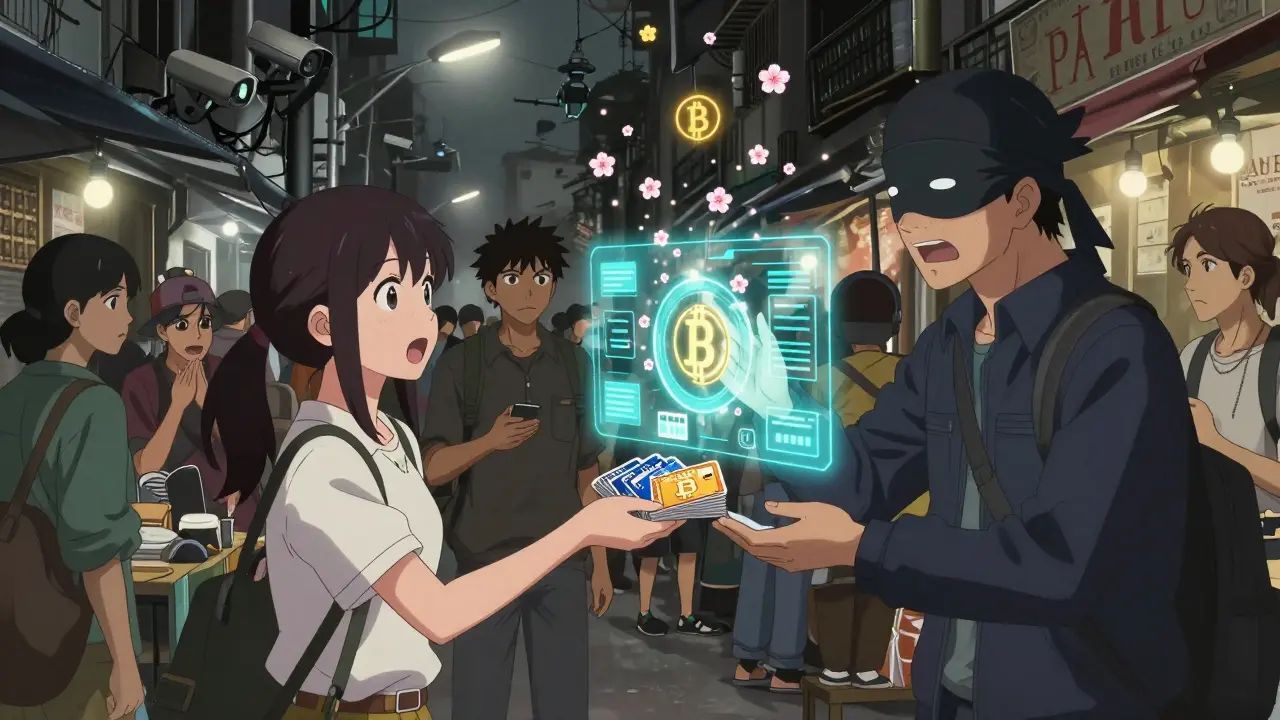
Gift cards, hawala, and digital workarounds
Some users bypass banks entirely by turning everyday items into crypto. Gift cards are huge. You buy a $100 Amazon or iTunes card with naira, dong, or taka - then list it on Paxful or Bitrefill. Someone else buys it with Bitcoin. You get crypto. They get a gift card. Chainalysis found $427 million in gift card-based crypto trades from restricted countries in 2024. In the Middle East and parts of Africa, people use hawala - an old-school, informal money transfer system. Instead of sending cash, you give money to a local agent. They call their counterpart in Dubai, where crypto exchanges are legal under VARA regulations. The counterpart sends Bitcoin to your wallet. No bank involved. Over $30 billion flowed through these networks in 2023-2024. In Latin America, apps like Bitcoin Beach Wallet let users trade Bitcoin directly from their phones. No ID. No bank. But transactions take 10 minutes to confirm - not seconds like with PayPal. Still, for people without access to traditional finance, it’s better than nothing.The hidden costs: scams, delays, and frozen accounts
It’s not all smooth sailing. A 2025 survey of 1,247 users from restricted countries found that 63% used a VPN, but 47% had their service cut off during government internet shutdowns. In Bangladesh, over 87 accounts were frozen in January 2025 alone - locking up $412,000 in crypto. On Trustpilot, Chinese users give Paxful a 2.1/5 rating, complaining about 72-hour delays and account bans when they use a Chinese phone number. Scams are rampant. Because no-KYC exchanges don’t verify users, fraudsters create fake trading pairs, impersonate sellers, or drain wallets with phishing links. Professor David Yermack from NYU found that 67% of users in restricted countries have suffered at least one security incident. Twelve percent lost significant money. Even when you do everything right, support is nearly nonexistent. Only 37% of no-KYC exchanges offer multilingual customer service. If you’re stuck with a frozen wallet and speak only Vietnamese or Farsi, you’re on your own. Average response time for non-English queries? 58 hours.
How to get started - if you’re in a restricted country
If you’re reading this because you’re in a country where crypto is blocked, here’s what actually works, based on real user guides from Iran, Nigeria, and Vietnam:- Download a reliable VPN - NordVPN or ExpressVPN cost around $12/month. Test it before you start.
- Create a non-custodial wallet - Trust Wallet or MetaMask. Write down your 12-word recovery phrase. On paper. Not on your phone.
- Buy your first crypto through P2P. Use Paxful or Binance P2P. Look for sellers with high ratings and fast payment methods like mobile money or bank transfer.
- Transfer that crypto to a decentralized exchange like Uniswap or PancakeSwap. Trade it for other coins if needed.
- Withdraw to a privacy wallet if you want anonymity. Monero (XMR) or Zcash (ZEC) are better for hiding transactions, but they’re harder to buy and less liquid.
- Set up recurring access. Maybe you buy gift cards monthly. Or find a trusted P2P trader you can use again.
- Join a local community. Telegram channels like “Crypto Without Borders” have 147,000 members and country-specific guides.
The bigger picture: crypto as resistance
This isn’t just about trading. It’s about survival. In Nigeria, where inflation hit 33% in 2024, people use crypto to protect their savings. In Venezuela, Bitcoin is used to pay for medicine. In Iran, families send remittances through crypto to avoid currency controls. The Chainalysis Global Adoption Index shows that despite bans, crypto use keeps growing in these places. Even regulators are catching on. In January 2025, OKX blocked users from Algeria, Bangladesh, and Nepal. But instead of stopping crypto use, it pushed people toward decentralized platforms. Uniswap v4 saw an 187% spike in users from those countries. The U.S. is now pushing rules that would require KYC on all transactions over $300 - a move that could break the P2P model many rely on. But history shows that when governments try to shut down access, people find new ways. The future won’t be about banning crypto. It’ll be about who controls the tools to use it. And right now, the users in restricted countries are winning that battle - one P2P trade, one VPN, one gift card at a time.Can I use Binance if my country bans crypto?
Yes - but only through Binance P2P. The main exchange blocks direct access in restricted countries. But Binance P2P lets you buy and sell crypto directly with other users using local payment methods like bank transfers, mobile money, or gift cards. Over $8.7 billion in P2P trades happened from restricted countries in Q1 2025. Just be careful: accounts can be frozen if you use a local phone number or bank account.
Are no-KYC exchanges safe?
They’re private, but not always safe. No-KYC exchanges like Bisq or Uniswap don’t verify your identity, which protects you from government tracking. But they also don’t protect you from scammers. There’s no customer support, no chargebacks, and no way to recover funds if you send crypto to the wrong address. Only trade with reputable sellers, use small amounts at first, and never share your wallet’s private key.
What’s the easiest way to buy crypto in Nigeria or Bangladesh?
For most people, it’s P2P using mobile money or bank transfer. In Nigeria, services like Chipper Cash and Opay are used to send money to P2P sellers on Paxful or Binance. In Bangladesh, users often pay through bKash or Nagad. You’ll pay a 1-5% premium over the market price, but it’s faster and more reliable than trying to use a bank. Look for sellers with over 1,000 trades and 98%+ positive feedback.
Do I need a VPN to access crypto exchanges?
Mostly yes. If your government blocks crypto websites, a VPN is your only way to access centralized exchanges or even P2P platforms. Without one, you’ll get a connection error. But not all VPNs work - some are blocked by national firewalls. NordVPN, ExpressVPN, and Surfshark are the most reliable. Test them before you start trading. Also, avoid free VPNs - they often sell your data or have slow speeds.
Why are gift cards used for crypto in restricted countries?
Gift cards are easy to buy with local cash and don’t require a bank account. You can buy a $50 Amazon gift card at a local store, then list it on Paxful or Bitrefill for Bitcoin. Someone else buys it with crypto, and you get your Bitcoin instantly. This method bypasses banks entirely. Chainalysis recorded $427 million in gift card-based crypto trades from restricted countries in 2024 - making it one of the most popular workarounds.
Is crypto trading legal in these countries?
In most of these countries, it’s technically illegal - but enforcement is inconsistent. In Bangladesh, crypto trading is banned under the Money Laundering Prevention Act. In China, it’s a criminal offense. But millions still trade. Governments focus on shutting down large exchanges, not individual users. Still, you risk fines, account freezes, or even arrest if caught. Use discretion. Never advertise your activity. Use privacy tools. And never keep large amounts on exchanges.







Comments (14)
carol johnson
January 26, 2026 AT 14:47 PMOMG this is literally the most important thing I've read all year 🥹 I mean, who even needs banks anymore?? Crypto is the future, and these people are living it. I'm crying. 🌍💸
Paru Somashekar
January 28, 2026 AT 10:08 AMThe resilience of individuals in restricted economies is truly commendable. Utilizing P2P platforms and non-custodial wallets demonstrates a profound understanding of financial sovereignty. One must, however, exercise extreme caution regarding wallet security and transaction verification.
Steve Fennell
January 28, 2026 AT 17:48 PMThis is a powerful reminder that technology doesn't discriminate-it empowers those who dare to use it. Kudos to the everyday heroes using VPNs and gift cards to protect their livelihoods. You're not just trading crypto-you're reclaiming dignity. 🙏
Heather Crane
January 29, 2026 AT 00:18 AMI just want to say-this is beautiful. 🌈 People are creating their own financial systems despite oppressive laws. It's not just about Bitcoin-it's about freedom. And yes, it's messy, risky, and imperfect... but so was the civil rights movement. And look where that got us!
Nathan Drake
January 30, 2026 AT 20:40 PMIt's fascinating how human ingenuity thrives under constraint. The state tries to control money, but money-real value-is always a social agreement. When institutions fail, people revert to decentralized trust networks. This isn't crypto adoption. This is civilization adapting.
Kevin Pivko
January 31, 2026 AT 23:48 PMLet’s be real-this is just a glorified way to launder money and scam old ladies. 67% have been scammed? And you call this progress? 🤡 The only thing growing here is the number of people getting robbed. Stop romanticizing chaos.
Nadia Silva
February 1, 2026 AT 20:32 PMI'm Canadian. We have nice banks. Why would anyone risk their life for crypto? This is just chaos dressed up as innovation. The West solved this with regulation. Why can't they?
Roshmi Chatterjee
February 2, 2026 AT 16:18 PMThis is so inspiring! I’m from India and I’ve seen how hard it is to send money home. I used P2P to help my cousin in Nepal last year. It took 3 days, but it worked. No bank ever did that for us. Keep going, everyone!
Deepu Verma
February 4, 2026 AT 08:50 AMI’ve been using Binance P2P for 2 years now. Started with $20, now I’m sending $500/month to my family. The key? Stick to sellers with 1000+ trades. Never use free VPNs. And always write your seed phrase on paper-twice. One copy in the safe, one in the envelope with your grandma’s letters.
MICHELLE REICHARD
February 5, 2026 AT 00:22 AMHonestly? This whole thing is a psyop. The CIA funds these P2P platforms to destabilize sovereign nations. You think Nigerians are doing this for inflation? No. They’re being manipulated into a blockchain-based dollar trap. Wake up.
tim ang
February 6, 2026 AT 17:27 PMyo i just wanna say-this post changed my life. i used to think crypto was just for bros in vegas. now i see it’s for moms in Lagos buying rice. i just bought my first 0.001 BTC on paxful. thank you. 🙌 (also i typoed like 3 times but you get it)
Julene Soria Marqués
February 6, 2026 AT 17:52 PMWait, so you’re telling me people are using gift cards to buy Bitcoin… and you’re not even tracking who’s doing it? That’s literally a money laundering paradise. Why isn’t the FBI shutting this down? This is wild. And kinda terrifying.
Bonnie Sands
February 8, 2026 AT 07:11 AMI’ve been following this since 2021. I know what’s really happening. The Fed is using this to track everyone. Every P2P trade, every VPN connection-it’s all feeding into a global surveillance grid. They want you to think it’s freedom. It’s not. It’s a trap. Don’t fall for it.
MOHAN KUMAR
February 8, 2026 AT 14:59 PMThis is nonsense. In India, we have UPI. Fast, safe, legal. Why risk jail for crypto? These people are fools. Banks are bad? Fine. But crypto? Worse. You lose money, get hacked, and still can’t eat.