


Most people looking for a place to trade crypto on Polygon end up at SushiSwap or QuickSwap. They’re big, they have deep liquidity, and everyone knows them. But if you’ve stumbled across Firebird Finance, you’re probably wondering why anyone would choose this smaller platform over the giants.
The short answer? You don’t use Firebird Finance just to swap tokens. You use it because it tries to solve the most annoying part of decentralized finance (DeFi): the friction between trading and earning yield. It’s not your standard automated market maker (AMM). It’s a hybrid platform that bundles swapping, yield aggregation, and vaults into one interface. But with a Total Value Locked (TVL) of around $4.79 million, it sits firmly in the mid-to-small tier of Polygon protocols. That raises serious questions about safety, liquidity, and whether the rewards are actually worth the smart contract risk.
In this review, we’ll break down exactly what Firebird Finance does, how its HOPE token works, and whether it’s a viable tool for your portfolio in 2026-or if you should stick to the bigger exchanges.
What Exactly Is Firebird Finance?
At its core, Firebird Finance is a decentralized finance (DeFi) protocol built primarily on the Polygon network, with secondary support for Binance Smart Chain (BSC). Unlike traditional exchanges where you simply buy low and sell high, Firebird positions itself as a three-in-one ecosystem. It combines an exchange, a yield aggregator, and a vault system.
Think of it this way: On a standard DEX like Uniswap, you provide liquidity to earn fees, but your rewards sit there until you manually harvest them. On Firebird, the platform automates much of this process. Its core features include:
- Standard Swaps: An AMM interface for trading tokens on Polygon.
- OneSwap: A specialized stablecoin AMM designed to minimize slippage when trading assets like USDC, USDT, and DAI.
- Vaults: Auto-compounding strategies where you deposit tokens, and the protocol automatically reinvests your earnings to maximize compound interest.
- Farms-as-a-Service: A unique feature allowing other projects to launch their own yield farms on Firebird’s infrastructure quickly.
This structure suggests Firebird targets users who want more than just execution speed. It targets users who want optimization. However, "optimization" in DeFi often comes with higher complexity-and higher risk.
The Liquidity Problem: TVL Context Matters
When reviewing any decentralized exchange, liquidity is king. Without enough money locked in the pools, you face two major issues: high slippage (your trade moves the price against you) and impermanent loss risks that aren't offset by trading volume.
Here is where Firebird Finance struggles to compete with the heavyweights. As of early 2026 data, Firebird Finance holds approximately $4.79 million in Total Value Locked (TVL).
| Platform | Estimated TVL | Primary Focus | Risk Profile |
|---|---|---|---|
| SushiSwap | $5.04 Billion+ | General Trading & Governance | Lower (Established) |
| QuickSwap | $100 Million+ | Native Polygon Ecosystem | Medium |
| Firebird Finance | $4.79 Million | Yield Optimization & Vaults | Higher (Niche/Newer) |
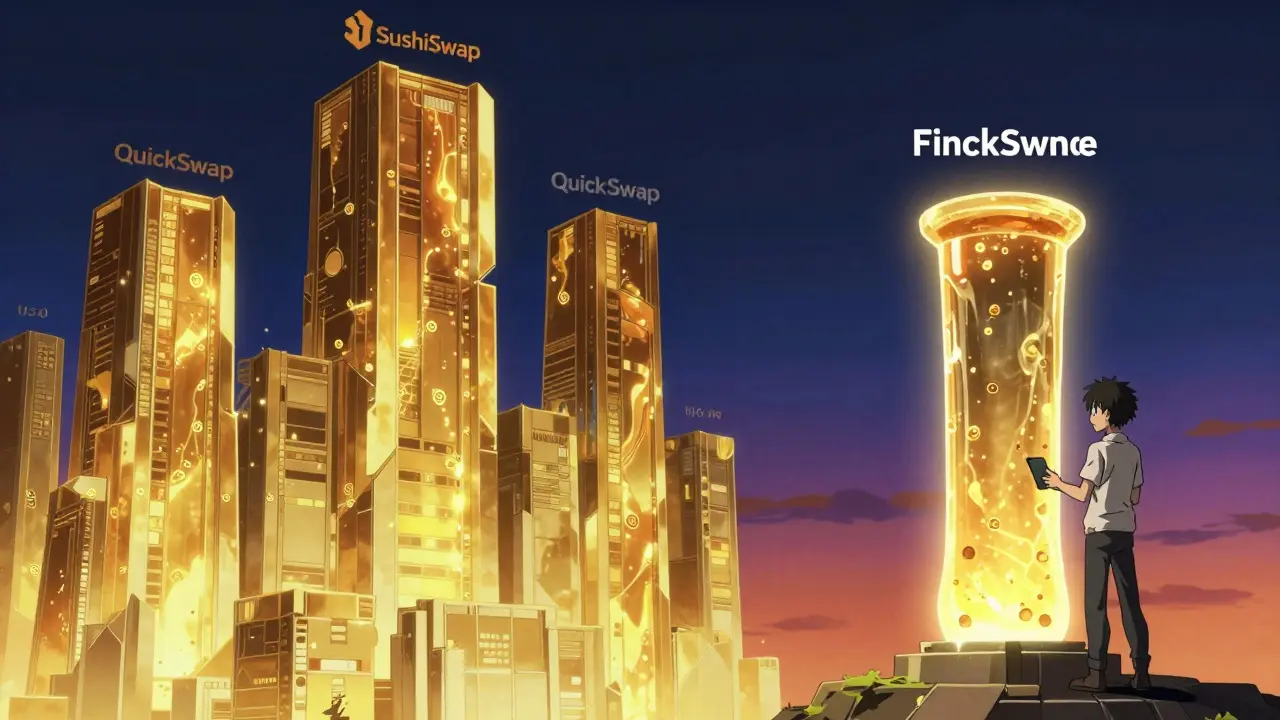
To put that in perspective, SushiSwap has over a thousand times more liquidity. What does this mean for you? If you try to swap $10,000 worth of tokens on Firebird, you might move the market significantly, resulting in a worse rate than you’d get on SushiSwap. For small trades-say, under $500-the difference might be negligible. For larger positions, the lack of depth is a real constraint.
Furthermore, lower TVL often correlates with fewer auditors scrutinizing the code and less capital available to cover potential exploits. While Firebird may have undergone audits (standard practice), the sheer size of the protocol means it hasn't been battle-tested by billions in user funds the way larger competitors have.
Understanding the HOPE Token and Incentives
Every DeFi protocol needs an incentive mechanism to attract liquidity providers. For Firebird, that incentive is the HOPE token. The protocol uses HOPE to reward users who stake their assets in vaults or provide liquidity to pools.
However, the HOPE token presents some red flags for cautious investors. Data aggregators like CoinCodex note that there isn't enough historical trading data to generate reliable price predictions for HOPE. This usually indicates one of two things:
- The token is very new and hasn't established a consistent trading pattern yet.
- The token has low liquidity on centralized exchanges, meaning it’s hard to sell without crashing the price.
Firebird also offers "locked staking" for HOPE holders. This is a common tactic in DeFi to reduce selling pressure. By locking your tokens for 3 months, 6 months, or a year, you earn higher yields. But ask yourself: Why do they need to lock your tokens? Usually, it’s because the team wants to prevent a mass exodus of sellers that could devalue the token. If you’re using Firebird solely for the utility of its swaps and vaults, the HOPE token is secondary. If you’re investing *in* HOPE expecting it to moon, understand that you’re buying into a highly speculative asset with limited market history.
Features Deep Dive: OneSwap and Farms-as-a-Service
If you’re going to risk your capital on a smaller DEX, you want unique features that justify the risk. Firebird has two standout offerings.
OneSwap for Stablecoins
Trading stablecoins shouldn’t cost you much in slippage. If you swap USDC for USDT, you expect a 1:1 ratio. On many generic AMMs, if the pool is unbalanced, you might lose 0.5% or 1% in slippage. Firebird’s OneSwap is designed specifically for these pairs. By concentrating liquidity only around the peg, it aims to offer near-zero slippage for stablecoin traders. If you frequently rotate between stablecoins to chase yield, this feature alone might make Firebird useful as a supplementary tool.
Farms-as-a-Service
This is a B2B (business-to-business) feature rather than a direct consumer benefit, but it impacts the ecosystem. Firebird allows other crypto projects to launch yield farms on its platform within minutes. This democratizes access to farming infrastructure. For the average user, this means you might find newer, exotic tokens listed on Firebird before they hit major exchanges. Early access can mean higher APYs, but it also means higher risk of rug pulls or failed projects. Always do your own due diligence (DYOR) on any farm offering triple-digit returns.
User Experience and Technical Barriers
Let’s be honest: Firebird Finance is not built for beginners. The interface assumes you already know what a wallet connection is, how to approve transactions, and what gas fees look like on Polygon.
Using the platform requires several steps that add friction:
- Bridging Assets: You need to bridge ETH or USDC from Ethereum mainnet to Polygon first. If you’re on Binance Smart Chain, you need to bridge there. Firebird doesn’t handle cross-chain bridging natively in a seamless way; you rely on third-party bridges.
- Approvals: Every time you interact with a new token in a vault or farm, you must sign an approval transaction. These cost small amounts of MATIC (Polygon’s native token) but can be confusing for new users.
- Vault Complexity: Understanding auto-compounding requires grasping concepts like internal rebalancing frequencies and performance fees. If you don’t understand how the vault calculates your APY versus APR, you might overestimate your earnings.
Documentation quality appears moderate. While the dashboard is clean, detailed guides on risk management or advanced vault strategies are sparse compared to giants like Aave or Compound. If you get stuck, there’s no customer support hotline-you’re relying on community Discord channels or Telegram groups, which can be slow or filled with bots.

Risks You Can’t Ignore
No DeFi review is complete without discussing what could go wrong. With Firebird Finance, the risks fall into three categories:
- Smart Contract Risk: All DeFi platforms live or die by their code. If there’s a bug in Firebird’s vault contracts, hackers could drain funds. While audits help, they don’t guarantee security. Smaller protocols are often easier targets because they have less capital to hire top-tier security firms continuously.
- Liquidity Risk: With only $4.79M TVL, sudden large withdrawals can destabilize pools. If a whale decides to exit a vault, the remaining users might suffer significant losses due to price impact.
- Token Volatility Risk: If you’re earning yield in HOPE tokens, and the price of HOPE drops by 50%, your "yield" is irrelevant. You’ve lost principal value. Always calculate your net profit in USD terms, not just token counts.
Additionally, regulatory uncertainty looms over all DeFi. While Polygon is a robust layer-2 solution, changes in US or EU regulations regarding decentralized exchanges could impact accessibility or legality depending on your jurisdiction.
Who Should Use Firebird Finance?
Based on its current state, Firebird Finance isn’t for everyone. Here’s a breakdown of who fits the profile:
- Advanced Yield Farmers: If you understand auto-compounding, impermanent loss, and can monitor multiple chains, Firebird’s vaults might offer slightly better optimized yields than generic LP positions on larger DEXs.
- Stablecoin Rotators: Users who frequently switch between USDC, USDT, and DAI might appreciate the low-slippage OneSwap feature.
- Early Adopters: Those willing to take on higher risk for potentially higher rewards from new token listings via the Farms-as-a-Service model.
Conversely, you should avoid Firebird Finance if:
- You are new to crypto and DeFi.
- You plan to trade large volumes (over $1,000 per transaction).
- You prioritize security and established track records over marginal yield gains.
- You don’t have MATIC in your wallet for gas fees.
Final Verdict: Niche Tool, Not Mainstream Exchange
Firebird Finance fills a specific gap in the Polygon ecosystem. It’s not trying to be the next Uniswap. Instead, it’s aiming to be a sophisticated yield optimizer for those who already know how to navigate DeFi. The integration of swaps, vaults, and specialized stablecoin trading is clever. The "farms-as-a-service" angle gives it a unique edge for project developers.
However, the low TVL is a glaring issue. In the world of DeFi, liquidity equals trust. Until Firebird attracts significantly more capital, it will remain a niche player. The HOPE token’s lack of historical data adds another layer of speculation. Use Firebird for small allocations, experiment with its vaults, and leverage OneSwap for stablecoin swaps. But keep your main portfolio on platforms with deeper liquidity and longer audit histories.
Remember, in DeFi, if a yield looks too good to be true, check the liquidity behind it. Firebird offers interesting tools, but it demands respect for the risks involved.
Is Firebird Finance safe to use in 2026?
Like all DeFi platforms, Firebird Finance carries inherent smart contract risks. While it operates on the secure Polygon network, its smaller Total Value Locked (TVL) of ~$4.79 million means it has less battle-testing than larger competitors like SushiSwap. It is considered safer for small transactions but risky for large capital deployments. Always verify current audit status before depositing funds.
What is the HOPE token used for?
The HOPE token is the native governance and reward token of Firebird Finance. Users earn HOPE by providing liquidity to pools or staking assets in vaults. It can also be locked in staking contracts to earn additional incentives. However, it currently lacks significant historical trading data, making it a highly speculative asset.
How does Firebird Finance compare to SushiSwap?
SushiSwap is a massive, general-purpose DEX with over $5 billion in TVL, offering deep liquidity and lower slippage for large trades. Firebird Finance is a niche platform focused on yield optimization, auto-compounding vaults, and specialized stablecoin swaps (OneSwap). Choose SushiSwap for reliability and volume; choose Firebird for experimental yield strategies and stablecoin efficiency.
Can I use Firebird Finance on Ethereum Mainnet?
No, Firebird Finance is primarily built on Polygon (a Layer-2 scaling solution for Ethereum) and Binance Smart Chain (BSC). To use it, you must bridge your assets from Ethereum Mainnet to Polygon first. This involves paying gas fees on Ethereum and waiting for the bridge transaction to confirm.
What is "Farms-as-a-Service" on Firebird?
This is a feature that allows external crypto projects to easily create their own yield farming campaigns on the Firebird platform. For users, this means access to new token listings and potentially high-yield opportunities early in a project's lifecycle. However, these new farms carry higher risk as the underlying projects may be unproven.







Comments (19)
Kumaran sowkarpet
June 12, 2026 AT 13:37 PMhey guys, just wanted to say that while big DEXs are safe, small ones like this have potential if u do ur research. in india we love taking calculated risks for higher returns :)
Mauricio Contreras Loredo
June 12, 2026 AT 19:32 PMoh wow, another review telling us not to put our life savings into a protocol with less liquidity than my checking account. groundbreaking stuff right there. thanks for the heads up on the rug pull waiting to happen.
sreeja boora
June 14, 2026 AT 13:15 PMThe article clearly states that Firebird Finance is risky due to low TVL. It is imperative that investors understand the difference between established protocols and speculative ventures. Do not be foolish with your capital.
Grace Newman
June 14, 2026 AT 15:04 PMI suspect the authors of these reviews are paid by SushiSwap to keep users away from innovative platforms. The lack of historical data for HOPE is a deliberate obfuscation tactic used by centralized exchanges to maintain their monopoly on information. Wake up people.
Annemarie Fitzgerald
June 15, 2026 AT 13:33 PMits all about the narrative really. why do we trust billions locked in one place when it could all vanish? maybe the chaos of small pools is more honest. i dont know, just thinking out loud here lol
Abby Sivertsen
June 16, 2026 AT 08:26 AMi get the risk but sometimes you gotta try new things. i use firebird for stablecoin swaps because the slippage is actually better for small amounts. its not for everyone tho.
Benjamin Eisen
June 17, 2026 AT 09:33 AMgreat point about the slippage. i wasnt aware that oneswap was optimized for stables. might give it a shot with some spare change. thanks for sharing your experience!
Kenneth Riley
June 17, 2026 AT 21:36 PMyou people are so naive. smart contract risk is real and with $4m tvl they are sitting ducks. hackers target the weak links first. stop pretending this is safe just because its on polygon.
ravi mahla
June 18, 2026 AT 05:26 AMhaha yeah sure Kenneth, act like you know everything. meanwhile im farming yields on smaller chains and making bank while you worry about hypothetical hacks. live a little bro.
Mark Brunschwiler
June 20, 2026 AT 05:05 AMthe void stares back at you when you stake in obscure vaults. i feel the emptiness every time i check my portfolio. is it yield or is it just fear? nobody knows. i am lost in the blockchain abyss.
Sonya O'Brien
June 20, 2026 AT 06:16 AMWhile I appreciate the detailed breakdown of the features, I think it's important to consider that many users simply don't have the technical expertise to navigate these complex interfaces, which leads to unnecessary losses for beginners who are trying to learn how decentralized finance works in practice today.
Filbert Reeves
June 21, 2026 AT 05:48 AMthey always say DYOR but really they want you to fail. the whole system is rigged against the little guy. i bet the team is dumping HOPE tokens right now while telling you to lock yours up. classic pump and dump scheme disguised as innovation.
Amit Thakur
June 22, 2026 AT 04:41 AMListen up! If you cannot handle the volatility of DeFi then stay away. We need aggressive alpha seekers here not scaredy cats. Firebird offers high APY for those brave enough to deploy capital efficiently across fragmented liquidity pools.
Eric Scheinberg
June 22, 2026 AT 14:26 PMIt is evident that the platform serves a niche audience. One must evaluate the trade-off between yield optimization and security rigorously.
pankaj chawla
June 22, 2026 AT 14:57 PMI agree with the assessment. It is good for testing strategies but definitely not for main holdings. Let's support Indian devs building on Polygon though.
Jessica Lane
June 24, 2026 AT 02:37 AMThis is a very thorough analysis. I am curious about the long-term sustainability of the HOPE token incentives. Will the team provide more clarity on the tokenomics roadmap soon?
Charles Pawlikowski
June 24, 2026 AT 19:00 PMtypical crypto scam vibes. why would anyone trust a random project over established names? stick to the basics folks. no need to be fancy with your money :)
Andrea Burd
June 25, 2026 AT 22:08 PMboring article. obviously its risky. who needs a 2000 word essay to tell them that? next time write something interesting or dont bother posting at all.
Akeem Whittaker
June 27, 2026 AT 12:10 PMFor those interested in the technical side, look at the audit reports. They are public. If you cant read code or audits, you should probably stick to centralized exchanges until you educate yourself properly.