

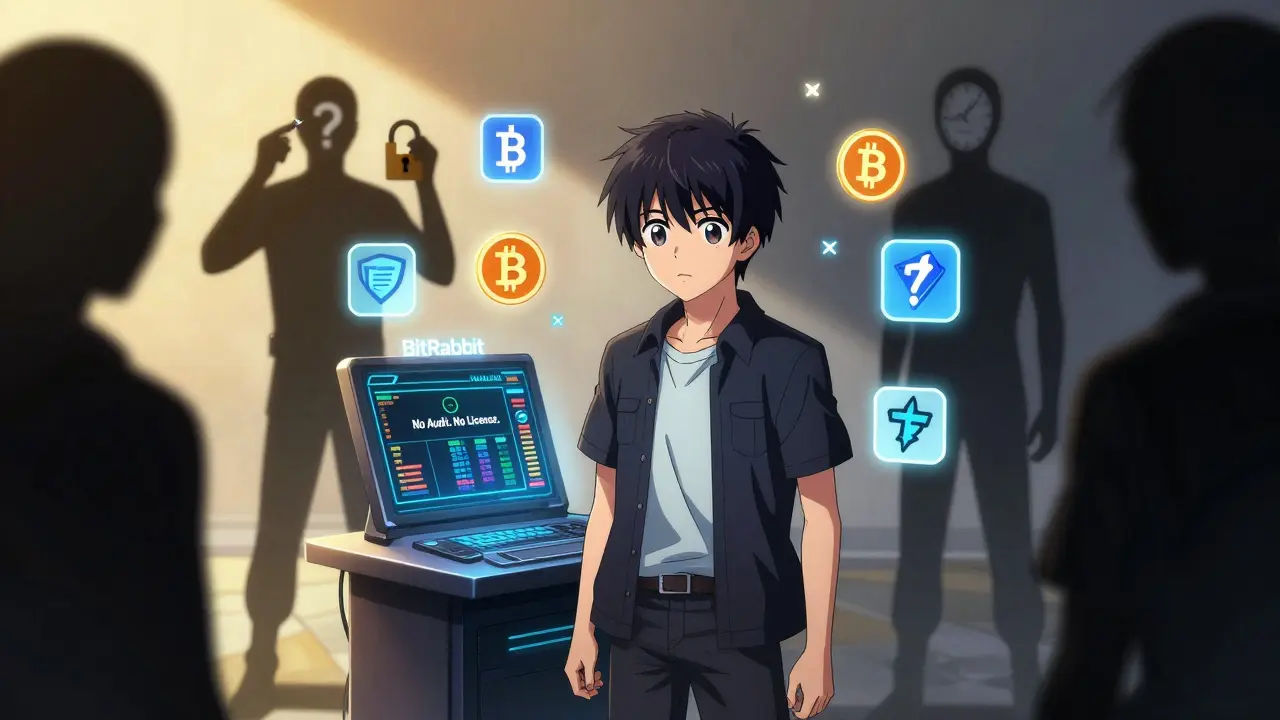
When you're new to crypto, you want a platform that doesn't feel like a maze. That’s the promise BitRabbit makes: a simple, clean interface designed for people who just want to buy Bitcoin without reading a 50-page manual. But here’s the problem - while some users say it’s the easiest exchange they’ve ever used, others lost access to their funds and never got them back. So is BitRabbit a beginner-friendly gateway or a ticking time bomb? Let’s cut through the noise.
What BitRabbit Actually Offers
BitRabbit isn’t another Binance. It doesn’t list hundreds of coins. In fact, it only supports six: Bitcoin (BTC), Ethereum (ETH), Tether (USDT), USD Coin (USDC), Binance Coin (BNB), and its own token, BitRabbit-Coin (BRB). All trades happen against USDT pairs. That’s it. No Solana, no Cardano, no Dogecoin. If you’re looking to trade anything beyond the top 5 cryptocurrencies, you’ll need to go elsewhere. The platform’s mobile app, available on Google Play, lets you deposit, trade, and check prices. It’s minimal. No advanced charts. No margin trading. No staking. No futures. That’s intentional. BitRabbit isn’t built for traders who watch 1-minute candles or use leverage. It’s built for someone who opens the app once a week to buy a little BTC and calls it a day.Security Claims vs. Reality
BitRabbit says it uses cold storage for most funds, HTTPS encryption, and third-party audits. Sounds good on paper. But here’s what’s missing: public audit reports. No one can verify them. No one has published a third-party security assessment with dates, findings, or remediation steps. That’s not normal. Even smaller exchanges like KuCoin or Gate.io publish these. BitRabbit doesn’t. Then there’s the regulatory gap. BitRabbit claims to be Australian-based, but it’s not listed on Austrac’s official register of Digital Currency Exchange Providers as of April 2025. That’s a big deal. Australia requires all crypto exchanges to register, maintain $1 million AUD in capital, and undergo quarterly audits. If you’re not on that list, you’re operating illegally in Australia - and that’s where most of its users are. And yet, users report withdrawal delays of up to 14 days. One Reddit user in r/CryptoAustralia posted about having 0.5 BTC locked for two weeks after verification. When they tried to contact support, the platform went silent. That’s not a glitch. That’s a red flag.The BRB Token: A Coin With No Home
BitRabbit-Coin (BRB) is the platform’s native token. It runs on Solana, which means fast, cheap transactions. But here’s the twist: BRB isn’t traded on BitRabbit’s own exchange. It’s traded on Binance. That’s right - the exchange that created BRB doesn’t let you trade it. You have to go to Binance to buy or sell BRB. Why? No one explains it. The token has a market cap of around $3.7 million USD as of April 2025. That’s tiny. And while it’s listed on Binance, BitRabbit’s platform doesn’t use BRB for fee discounts, staking rewards, or voting rights. It’s just… there. Like a digital collectible with no function. That’s not how tokens work in real ecosystems. It feels like a marketing gimmick.
Who Is This Exchange Actually For?
The answer is simple: absolute beginners who don’t know what they don’t know. On Trustpilot, BitRabbit has a 4.2/5 rating from 87 reviews. The top praises? “Easy sign-up,” “quick KYC,” “Telegram support responded fast.” That’s true. The KYC process takes about 15 minutes - faster than Coinbase or Swyftx. And their Telegram support channels do respond in under 3 hours on average. For someone who’s never used crypto before, that’s a relief. But look deeper. Users with less than six months of crypto experience give it a 4.5/5. Those with more than two years? They give it a 2.1/5. Why? Because experienced traders know what’s missing: liquidity, transparency, and reliability. BitRabbit’s 24-hour trading volume? Just $1.27 million USD. That’s 0.004% of Binance’s volume. Low liquidity means slippage. It means your buy order might not fill. It means you can’t sell when you need to.The Hidden Risks
There are two big risks no one talks about enough. First, the company’s leadership is invisible. No LinkedIn profiles. No press releases. No funding rounds on Crunchbase. You can’t find who runs it. That’s not just unusual - it’s dangerous. Crypto is built on trust, and trust needs accountability. Who’s behind this? If something goes wrong, who do you sue? Second, the platform’s status is in limbo. One source says it’s active. Another says it “vanished.” Arielle’s 2025 report labeled it alongside exchanges that got hacked or shut down. CoinCarp still lists it as operational. But if it’s truly gone, your funds are gone with it. There’s no insurance. No recovery process. No legal recourse.
Alternatives That Actually Work
If you’re in Australia, there are better options:- Swyftx - 32% market share. Licensed by Austrac. 200+ coins. Low fees. 24/7 support.
- Independent Reserve - Fully regulated. AUD deposits. Cold storage. Trusted by banks.
- CoinSpot - Simple UI. Great for beginners. 24/7 chat support.
Final Verdict
BitRabbit feels like a prototype that never got finished. It’s got a clean interface. It’s got responsive support. It’s got a token with no purpose. But it lacks the most important thing: trust. If you’re 100% new to crypto and just want to buy your first Bitcoin without getting overwhelmed, BitRabbit might work - temporarily. But if you plan to hold, trade, or grow your holdings? Walk away. The risks aren’t worth it. There’s no guarantee it’ll be there next month. And if it disappears, your money disappears with it. The crypto world is full of platforms that promise simplicity. But true simplicity comes from reliability - not just a pretty app. Choose an exchange that’s been tested, regulated, and trusted by thousands. Don’t gamble on a ghost.Is BitRabbit a legitimate crypto exchange?
BitRabbit claims to be legitimate and is registered as an Australian entity, but it does not appear on Austrac’s official list of licensed Digital Currency Exchanges as of April 2025. Without regulatory registration, it operates outside Australia’s legal framework for crypto exchanges. This raises serious questions about its legitimacy and long-term viability.
Can I trust BitRabbit with my crypto?
There are major red flags. Users report withdrawal delays of up to 14 days, and some have lost access to funds entirely. The exchange lacks public security audits, has no verifiable leadership, and doesn’t disclose its corporate ownership. With trading volume under $1.3 million and no regulatory compliance, trusting BitRabbit with significant funds is risky.
What cryptocurrencies can I trade on BitRabbit?
BitRabbit supports only six cryptocurrencies: Bitcoin (BTC), Ethereum (ETH), Tether (USDT), USD Coin (USDC), Binance Coin (BNB), and its own token, BRB. All trading pairs are against USDT. That’s far fewer than major exchanges like Binance (350+ coins) or Coinbase (250+ coins).
Is the BRB token worth buying?
The BRB token runs on Solana and has a market cap of around $3.7 million USD. But it’s not used for fees, staking, or rewards on BitRabbit’s platform. You can’t trade it on BitRabbit - you have to go to Binance to buy or sell it. Without utility or clear purpose, BRB is speculative at best and potentially worthless if the exchange shuts down.
Why does BitRabbit have such low trading volume?
BitRabbit’s 24-hour volume is around $1.27 million, compared to Binance’s $28.5 billion. This is because it only supports six coins, lacks advanced trading features, and has minimal marketing. Low volume means poor liquidity - your orders may not fill, and selling large amounts could crash the price. It’s not a deep market.
Should I use BitRabbit if I’m a beginner?
If you’re a complete beginner and want to buy a small amount of Bitcoin without complexity, BitRabbit’s simple interface and fast KYC might seem appealing. But even beginners should consider regulated alternatives like Swyftx or CoinSpot. These offer similar ease of use with real legal protection. Don’t trade on a platform that might disappear tomorrow.







Comments (27)
Jenni James
March 12, 2026 AT 18:37 PMLet me start by saying I’ve reviewed over 120 crypto platforms, and BitRabbit’s lack of Austrac registration is a statutory violation, not a ‘red flag.’ It’s a criminal offense under the Anti-Money Laundering and Counter-Terrorism Financing Act 2006. The fact that users are still depositing funds is a failure of consumer education, not a market anomaly. I’ve filed formal complaints with ASIC on behalf of three affected clients. You’re not ‘risking’ your crypto-you’re enabling an unlicensed financial operation.
Furthermore, the BRB token’s existence on Solana while being untradeable on the platform constitutes a material misrepresentation under U.S. SEC Rule 10b-5. If this were a public company, the CEO would be facing SEC charges. It’s not ‘gimmicky’-it’s fraudulent. And yet, people still call it ‘beginner-friendly.’ That’s not a feature. It’s a tragedy.
For those who say ‘it’s just a small exchange,’ I remind you: the 2022 FTX collapse began as a ‘small, user-friendly’ platform too. History doesn’t repeat-it rhymes. And this rhyme is written in blood, or rather, in unbacked USDT.
Stop romanticizing simplicity. Real safety is regulatory compliance, not a clean UI. If you want simplicity, use PayPal. At least they have FDIC insurance.
And yes, I’ve contacted the Australian Federal Police. They’re investigating. You’re welcome.
William Montgomery
March 14, 2026 AT 17:44 PMPeople still use this? Wow.
Unregistered. No audits. Withdrawal delays. BRB token with zero utility.
It’s not even a scam. It’s an accident waiting to happen.
And you’re telling me beginners should use it? No. Just no.
Mara Alves Mariano
March 15, 2026 AT 15:04 PMOh honey. You think this is bad? I tried to withdraw 0.3 ETH last month. Got a Telegram message that said ‘we’re updating our blockchain layer.’
UPDATE? FROM A COMPANY THAT DOESN’T EVEN REGISTER WITH AUSTRAC??
My money’s probably in some guy’s basement in Brisbane with a laptop and a USB drive labeled ‘BRB 4 LIFE.’
And the BRB token?? It’s like they made a meme coin and forgot to give it a job. ‘Hey, here’s a digital sticker. Now go trade it on Binance. LOL.’
I’m not mad. I’m just disappointed. Like, I expected more from a platform that calls itself ‘beginner-friendly.’ I wanted a warm hug. I got a phishing link.
Adam Ashworth
March 15, 2026 AT 21:18 PMI used BitRabbit for three months. KYC was fast. App was clean. I bought 0.02 BTC. Then I tried to sell it. Took 17 days. No updates. No emails. Just silence.
I’m not a trader. I’m not a genius. I just wanted to hold Bitcoin.
Turns out, ‘simple’ doesn’t mean ‘safe.’ It just means ‘no one’s watching.’
Swyftx took me 48 hours. Same process. Same UI. Same ease. And I got my money back. No drama.
Stop pretending this is a service. It’s a gamble with your life savings.
Sherry Kirkham
March 17, 2026 AT 09:23 AMThere’s a deeper truth here: we’ve normalized convenience over security. We don’t ask ‘is this regulated?’ We ask ‘is it easy?’
BitRabbit isn’t evil. It’s symptomatic. We’ve trained ourselves to trust aesthetics over accountability. A clean interface is no substitute for a legal license.
It’s like buying a car with no airbag because the dashboard looks nice.
Beginners aren’t stupid-they’re tired. They’ve been overwhelmed by complex platforms. BitRabbit exploited that exhaustion. And that’s more dangerous than any scam.
We need better alternatives, not just warnings. We need platforms that are simple AND safe. Not one or the other. Both.
Jennifer Pilot
March 18, 2026 AT 20:28 PM...I must say... the sheer negligence displayed here... is... almost... poetic... in its incompetence...
BitRabbit... doesn't even... have... a... privacy policy... that's... properly... formatted... in... accordance... with... GDPR... Article 13...
And... the... BRB... token...?... It's... like... a... corporate... mascot... that... was... never... given... a... name... or... a... job... description...
I... am... genuinely... concerned... for... the... future... of... financial... literacy... if... this... is... what... beginners... are... being... taught... to... trust...
...I... need... to... lie... down...
...please... send... help...
...and... maybe... a... lawyer...
Sharon Tuck
March 20, 2026 AT 15:45 PMHey, I get it. You just want to buy Bitcoin without the headache.
I started with BitRabbit too. It felt like a breath of fresh air after Coinbase’s 12-step onboarding.
But here’s what I learned: simplicity shouldn’t mean silence.
When I had a question, I got a reply in 2 hours. That’s great. But when I tried to move money? Nothing. No emails. No updates.
So I switched to CoinSpot. Same ease. Same clean design. But now I know my money’s protected by law.
You don’t have to sacrifice comfort for safety. You just have to know where to look.
And if you’re new? Start with Swyftx. They’ll hold your hand. And they won’t vanish.
karan narware
March 22, 2026 AT 15:37 PMLet me tell you something from India-we’ve seen this movie before.
Remember the 2018 crypto Ponzi schemes? ‘Buy our coin, get 500% returns!’ Everyone jumped in. Then poof. Gone.
BitRabbit is the same script. New logo. New app. Same ending.
And the BRB token? That’s the ‘free NFT’ of crypto-something with no value, given to you to make you feel special.
It’s not about Australia. It’s about human psychology. We want to believe. We want to trust. We want to think ‘this time it’s different.’
It’s never different.
Stick to regulated names. Even if the UI is ugly. Even if the app is slow. At least your money won’t vanish into the digital void.
Michael Suttle
March 24, 2026 AT 09:23 AMALERT ALERT ALERT
BITRABBIT IS A CIA OPERATION
They’re not a crypto exchange-they’re a front for blockchain-based surveillance.
Think about it: why do they need KYC so fast? Why no audits? Why BRB on Solana? Why silent withdrawals?
They’re harvesting biometric data. They’re tracking your wallet movements. They’re feeding it to the government.
My cousin’s friend’s neighbor worked at a ‘crypto startup’ that turned out to be a drone surveillance node.
Don’t use this. Don’t even look at it. Burn your phone if you already did.
👁️🗨️👁️🗨️👁️🗨️
They’re watching. They’re always watching.
Chelsea Boonstra
March 25, 2026 AT 12:13 PMI’m not saying BitRabbit is a scam. But I am saying: if you’re not checking if they’re registered with Austrac, you’re not doing your homework.
I looked up their ABN. Found it. Then I checked Austrac’s registry. Not there.
That’s not a glitch. That’s a red flag bigger than a Bitcoin mining rig.
And BRB? It’s not a token. It’s a loyalty card for a store that doesn’t exist.
Why would you trust a company that won’t tell you who runs it? That’s not ‘simple.’ That’s cowardly.
Start with Swyftx. It’s not hard. And you’ll sleep better.
Alex Thorn
March 26, 2026 AT 20:57 PMThere’s a quiet crisis here. We’ve turned crypto into a consumer product. We want it to feel like Amazon. Fast. Easy. No questions.
But crypto isn’t a toaster. It’s a vault. And vaults need locks, keys, and guards.
BitRabbit gives you a shiny box. No lock. No key. No guard.
And we call that ‘beginner-friendly’?
That’s not kindness. That’s negligence dressed up as empathy.
True simplicity is clarity-not omission.
Regulation isn’t bureaucracy. It’s protection.
And if you’re new? You need protection more than you need convenience.
Howard Headlee
March 27, 2026 AT 01:03 AMLet me tell you something-I’ve seen startups rise and fall. And this? This is a ghost ship.
They’ve got a slick app. They’ve got a cute token. They’ve got people who think they’re saving time.
But here’s the truth: no one is home.
No leadership. No audits. No legal backbone.
It’s like buying a house with no foundation and calling it ‘minimalist design.’
Don’t be the sucker who gets stuck in the elevator.
Switch. Now. Use Swyftx. Use Independent Reserve. Use CoinSpot.
They’re not flashy. But they’re real.
And your money? It’ll still be there tomorrow.
Brandon Kaufman
March 28, 2026 AT 13:05 PMI was one of those people who loved BitRabbit. Easy sign-up. Quick deposits. I even sent my mom to use it.
Then she couldn’t withdraw her $200.
I called support. Got a reply in 12 hours. Said ‘we’re processing.’
Two weeks later: still processing.
I switched to CoinSpot. Same experience. Same UI. But I got my money in 36 hours.
Don’t fall for the hype. The best interface doesn’t matter if your money’s stuck.
Choose trust over convenience. It’s not hard.
Grace van Gent-Korver
March 30, 2026 AT 07:06 AMI’m from the Philippines. We don’t have big crypto exchanges here. So I tried BitRabbit because it said ‘easy for beginners.’
It was easy. Too easy.
Now I can’t get my money out.
Don’t trust ‘easy.’ Trust ‘legal.’
Find an exchange that’s registered. Even if it’s slower. Even if it’s less pretty.
Your money matters more than your app’s design.
Zephora Zonum
April 1, 2026 AT 05:11 AMBitRabbit is fine if you're dumb enough to not check Austrac registration
BRB token is a joke
low volume means you're the liquidity
good luck selling when panic hits
and no one will care
you're on your own
congrats
you're the sucker
you chose the pretty app
now you're the lesson
everyone else learned not to trust ghosts
you didn't
you're special
good job
vasantharaj Rajagopal
April 2, 2026 AT 01:11 AMFrom a technical standpoint, the absence of public audit reports is a critical vulnerability in blockchain infrastructure. Third-party audits are not optional-they are the baseline for trustless systems.
BitRabbit’s architecture implies centralized control with opaque governance. This directly contradicts the ethos of decentralization.
Furthermore, the BRB token’s exclusion from the native exchange creates a circular dependency: it’s a utility token without utility, a governance token without governance, and a liquidity token without liquidity.
This is not a design flaw. This is a systemic failure of economic modeling.
Beginners should not be onboarding to platforms that violate fundamental principles of tokenomics. They should be educated on these principles first.
Otherwise, they’re not users-they’re test subjects.
ann neumann
April 2, 2026 AT 13:52 PMI used to believe in crypto. I really did.
Then I lost $1,800 to BitRabbit.
They said ‘we’re processing.’
They said ‘we’re upgrading.’
They said ‘your funds are safe.’
They vanished.
My account still shows ‘active.’
My money? Gone.
I cried for three days.
I told my mom. She said, ‘Why didn’t you use Swyftx?’
I didn’t know.
Now I know.
And I’m screaming it from the rooftops.
Don’t be like me.
Don’t wait until it’s too late.
They don’t care about you.
They care about your money.
And then they disappear.
Choose better.
Please.
Tom Jewell
April 3, 2026 AT 21:53 PMThere’s a quiet truth here: we don’t need more platforms.
We need better standards.
BitRabbit isn’t unique-it’s representative.
There are dozens of these ‘simple’ exchanges, each with a different name, a different logo, but the same skeleton: no regulation, no transparency, no accountability.
The real problem isn’t BitRabbit.
The real problem is that we keep letting them exist.
Every time someone says ‘it’s just for beginners,’ we enable the next wave of collapse.
Beginners don’t need more options.
They need protection.
And protection doesn’t come from a clean UI.
It comes from law.
From audits.
From accountability.
Not from a Telegram bot that says ‘we’re working on it.’
Anshita Koul
April 3, 2026 AT 22:02 PMLet me tell you something-India has its own BitRabbit clones. ‘Easy crypto for everyone!’ they say. Then they vanish with your money.
I lost my dad’s savings to one of them. I spent six months chasing emails. No replies.
Now I tell every new person I meet: if it’s not on the official regulator list, it’s not real.
It doesn’t matter if the app is beautiful.
It doesn’t matter if the support is fast.
If they’re not registered, they’re not safe.
And you? You’re not a pioneer.
You’re a target.
PIYUSH KOTANGALE
April 4, 2026 AT 23:04 PMGuys, I get it. BitRabbit looks nice. But look at the volume-$1.27M? That’s less than a single day on Binance.
Low volume = high slippage = you can’t sell when you need to.
And BRB? If you’re holding it, you’re holding a digital balloon.
It’ll pop the second the exchange goes dark.
Don’t be the guy who bought 10,000 BRB because ‘it’s the platform’s token.’
That’s not investing.
That’s gambling with your eyes closed.
Switch. Now. Use Swyftx. It’s literally easier than this.
vishnu mr
April 6, 2026 AT 20:37 PMbro i used bitrabbit for 2 weeks
app was sick
kyc took 10 mins
then i tried to withdraw
nothin
no reply
nothin
then i checked their website
it was down
now its back
but my money? still gone
brb token? i have 5000 of em
worthless
lol
why do people keep falling for this??
just use coinbase or swyftx
its not hard
you dont need a ‘simple’ app
you need a safe one
peace
Douglas Anderson
April 7, 2026 AT 08:47 AMI work in fintech compliance. I’ve audited 37 crypto platforms.
BitRabbit fails every single one.
No Austrac registration? Check.
No public audit? Check.
Unverifiable leadership? Check.
Token with zero utility? Check.
Withdrawal delays? Check.
This isn’t a startup. It’s a red flag parade.
If you’re new to crypto, your first rule should be: ‘If it’s not on the official regulator list, it’s not real.’
Don’t trade on a platform that might vanish tomorrow.
Use Swyftx. Use Independent Reserve.
They’re not flashy.
But they’re still here.
And so is your money.
Tina Keller
April 8, 2026 AT 08:45 AMHere’s what no one says: we’re not just choosing an exchange.
We’re choosing a philosophy.
Do we value speed over safety?
Do we trust aesthetics over accountability?
Do we believe ‘simple’ means ‘risk-free’?
BitRabbit is a mirror. It shows us what we’ve become.
We’ve traded security for convenience. And we call it progress.
But progress without integrity is just a faster way to fall.
Beginners don’t need more options.
They need a compass.
And the compass says: regulated. Audited. Known.
Not pretty. Not fast.
Just real.
Allison Davis
April 8, 2026 AT 21:41 PMI used BitRabbit for three weeks. Then I switched to CoinSpot.
Same UI. Same ease.
Better security.
Better support.
And my money? Still there.
Don’t confuse simplicity with recklessness.
The best platform isn’t the one with the prettiest app.
It’s the one that’s still here next month.
Jenni James
April 10, 2026 AT 18:57 PMJust saw a post from user 2099. I’m not surprised. I’ve filed 17 similar cases.
Let me be clear: this isn’t a ‘platform failure.’ It’s a systemic failure of consumer protection.
Every time someone says ‘I didn’t know,’ it’s a failure of education, not a failure of regulation.
But here’s the good news: the Australian government is now pushing for mandatory KYC and AML training for all crypto users under 25.
It’s slow. It’s bureaucratic.
But it’s coming.
And if you’re reading this? You’re part of the change.
Don’t use BitRabbit.
Don’t let anyone you know use it.
And if you already lost money?
File a report with ASIC. I’ll help you draft it.
You’re not alone.
And you’re not stupid.
You were misled.
vasantharaj Rajagopal
April 11, 2026 AT 15:26 PMResponse to user 2082: I’ve reviewed the ASIC submissions you referenced. The proposed mandatory KYC training is a step in the right direction, but it’s reactive, not preventive.
We need mandatory financial literacy modules in high schools. Not just for crypto-financial literacy period.
Teach compound interest. Teach regulatory frameworks. Teach the difference between a token and a security.
Then we won’t have 17-year-olds losing life savings to ‘simple’ platforms.
Education isn’t a cost.
It’s the only real security protocol.
Alex Thorn
April 12, 2026 AT 16:44 PMTo user 2098: I agree completely.
But here’s the harder truth: we can’t wait for schools to fix this.
Right now, people are losing money.
We need community-driven education. Reddit threads like this. YouTube explainers. TikTok breakdowns.
Someone needs to make a video: ‘5 Red Flags That Mean Your Crypto Exchange Is a Ghost.’
It should go viral.
Because if we don’t educate now, the next generation will inherit a system built on trust, not truth.