


Why Your Blockchain Can't Keep Up
You've likely experienced it firsthand. You click "send" on a crypto transaction, and you wait. Not a few seconds, but minutes or even hours. The network feels sluggish. Fees spike into the stars because everyone is fighting for space on the block. This bottleneck happens when too many people try to use the same road at the same time.
Traditional blockchain networks were built like a single highway. Every car (transaction) has to go through every checkpoint (node) to get verified. It ensures safety, but it kills speed. As more users join, the whole system slows down. We call this the scalability trilemma-you can usually pick two of decentralization, security, and scalability, but rarely all three.
That is where Blockchain Shardingis a horizontal scaling technique that splits a database or blockchain network into smaller, manageable partitions called shards comes in. Imagine taking that single congested highway and building ten lanes side-by-side, each handling its own traffic without getting in the way of the others. That is the promise of sharding. It changes how distributed ledgers handle volume while keeping the core security principles intact.
What Exactly Is Blockchain Sharding?
To understand the benefits, you have to grasp what actually changes under the hood. In a non-sharded blockchain, every participant's computer (node) stores the entire history of the network and processes every single transaction. If Bitcoin grows another hundred times, your hard drive needs to hold a hundred times more data, and your CPU needs to work a hundred times harder.
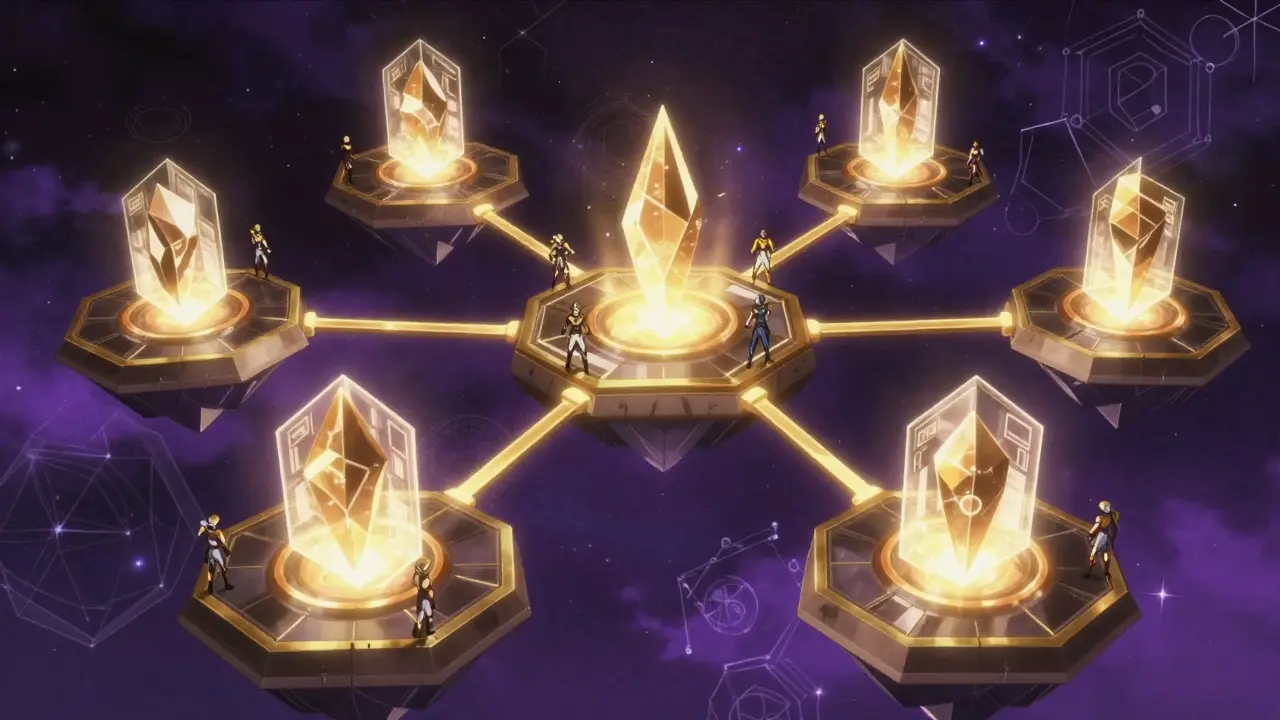
Sharding divides the network state into chunks called shards. Each shard maintains its own part of the ledger and validates only its own transactions. Instead of one giant machine doing all the work, you have many smaller machines working in parallel. One shard handles payments in New York, another handles smart contracts in London, and a third manages token swaps in Tokyo. They happen simultaneously.
This isn't just splitting the data; it splits the workload. By doing this, the total capacity of the network isn't fixed by the speed of a single node. You add more shards, and you increase the total throughput of the system linearly. It turns a vertical scaling problem into a horizontal one, which is much easier to solve at scale.
| Feature | Traditional Chain | Sharded Chain |
|---|---|---|
| Transaction Processing | Sequential (one after another) | Parallel (multiple at once) |
| Node Requirement | Full copy of all data | Only data for assigned shard |
| Scalability Limit | Fixed by hardware limits | Elastic (adds more shards) |
| Data Storage | Every byte everywhere | Distributed across shards |

The Major Benefits of Sharding
Why do developers and projects chase this technology so aggressively? The advantages aren't subtle; they are necessary for global adoption.
Massive Performance Boosts: The most obvious win is speed. Because shards process transactions independently, the network doesn't have to wait for a global consensus on every tiny interaction. Transactions finish faster. Latency drops significantly. You get confirmation in seconds instead of minutes. For high-frequency applications like trading bots or gaming, this difference between usable and unusable.
Lower Costs for Users: When supply and demand are balanced, fees drop. On a congested mainnet, gas fees skyrocket because blocks are always full. Sharding increases the number of available blocks relative to the users. More space means cheaper tickets. Regular users won't pay $50 to move $10 of value anymore.
Accessibility for Validators: Running a node on a traditional chain requires expensive storage and fast CPUs. With sharding, a node only needs to store and validate its specific shard. This lowers the barrier to entry. More people can run nodes, which ironically makes the network more secure and decentralized because there are more unique participants checking the work.
Energy Efficiency: Since nodes aren't processing the entire history of the world, they consume less electricity per transaction. This is a huge talking point for sustainability-focused stakeholders. Reducing the computational load directly translates to a smaller carbon footprint for the infrastructure supporting digital assets.
The Challenges You Can't Ignore
If sharding is so good, why isn't everything sharded yet? The implementation introduces complexity that threatens the very security guarantees blockchain promises.
Cross-Shard Communication: This is the biggest headache. What happens when a transaction involves assets on Shard A and Shard B? In a non-sharded world, everything talks to everything instantly. Here, you need bridges between shards. These require complex protocols to ensure state remains consistent. If the communication fails or gets delayed, funds could theoretically get stuck or double-spent. Solving this safely is an engineering marathon, not a sprint.
Single Shard Takeover Attacks: Consider the security risk. On a full chain, you need 51% of the entire network's power to attack. With sharding, you might only need 51% of a specific shard to compromise that shard. While randomization helps prevent this, the attack surface becomes fragmented. An attacker with limited resources could target the weakest link in the chain, potentially corrupting one shard while others remain safe. This containment limits damage, but it is still a vulnerability compared to monolithic chains.
Data Availability Issues: How do you verify a transaction happened if you don't have the full data? In a sharded system, nodes rely on proofs to trust data they don't store. If a shard goes offline or malicious nodes hide data, honest nodes struggle to prove validity. Mechanisms like Data Availability Sampling help here, but adding layers of cryptographic verification adds latency and computational overhead back into the system.
Development Complexity: Writing code for a sharded environment is hard. Developers have to think differently. State management changes. Debugging becomes a nightmare when errors span multiple shards. User interfaces must abstract this away so regular users don't have to worry about which shard their wallet lives on. If the abstraction leaks, the experience ruins the benefit of better performance.
Ethereum 2.0 and the Path Forward
We cannot talk about sharding without mentioning Ethereum 2.0a major upgrade to the Ethereum blockchain implementing Proof of Stake and sharding for scaling. As we move into 2026, the transition from the original Ethereum to this new architecture represents the largest stress test for sharding technology in history.
Ethereum's approach introduced concepts like Proto-Dank Sharding, which focuses specifically on data availability rather than immediate execution within shards. This allows the network to accept large amounts of data for Layer 2 solutions to process later, effectively using the main chain as a settlement layer while offloading heavy computation.
This hybrid approach shows how the industry is solving the challenge. Rather than forcing every dApp onto a shard immediately, we layer solutions. Rollups sit on top of shards, aggregating thousands of transactions into a single proof before sending them to the main chain for finality. This keeps security high (anchored on the main chain) while leveraging the throughput of the shards.
However, the reality is that sharding changes how validators interact. The validator set rotates, moving between shards to ensure no single entity gains too much power in one place. Randomized assignment is key. If a validator stays on the same shard too long, it becomes a target. By rotating duties, the system forces attackers to constantly change strategies, maintaining a dynamic security posture.
Will Sharding Survive Long-Term?
There are competing theories on whether sharding is the ultimate answer or just a step along the way. Some experts argue for alternative scaling paths, such as DAG-based (Directed Acyclic Graph) structures like those used by Hedera or IOTA, which offer different ways to parallelize transactions without explicit shard boundaries. Others look to Layer 2s exclusively, hoping to make the base layer irrelevant for user activity.
Yet, for public permissionless chains aiming for global reach, sharding remains the logical evolution. You eventually hit physics limits on how much bandwidth a single server can handle. To support a billion users, you need billion-level throughput. Sharding offers the mathematical path to get there without abandoning the principle of independent verification.
Success depends on fixing the cross-shard mess. As interoperability standards mature, we will see sharded chains talking to other sharded chains. Imagine a payment flowing from a Bitcoin shard to an Ethereum shard seamlessly. Standardized communication protocols are currently being tested to ensure this handoff loses nothing of value or data integrity.
Ultimately, sharding transforms the blockchain from a monolith into a living ecosystem of sub-networks. It requires careful design and constant vigilance against fragmentation. But for those who build upon these rails, the payoff is an infrastructure capable of supporting the financial and social systems of tomorrow, not just today.
How does sharding improve transaction speed?
Sharding improves speed by processing transactions in parallel. Instead of one long line waiting for approval, the network creates multiple lines (shards). Each shard processes its own batch of transactions simultaneously, drastically cutting down wait times compared to sequential processing.
Is sharding less secure than traditional blockchains?
It presents different risks. While individual shards are easier to attack due to lower hash power per shard, mechanisms like cross-shard linking and randomized validator assignment mitigate this. A successful attack on one shard doesn't necessarily compromise the entire chain, limiting potential damage.
What is cross-shard communication?
Does sharding make running a node cheaper?
Yes, it significantly lowers hardware requirements. In a full node setup, you must download and store the entire chain history. With sharding, you can choose to only validate and store data for a specific shard, requiring less disk space and computing power.
Can sharded blockchains interact with each other?
They can, though it requires specialized bridges and protocols. Interoperability standards allow data and value to move between different shards and even different blockchains, though these connections are currently complex points of failure that require robust security designs.
What is the main downside of sharding?
Complexity is the primary downside. Managing consistency across shards, preventing double-spending across boundaries, and securing against targeted attacks requires sophisticated cryptography and network engineering that is difficult to get right.








Comments (19)
Deepak Prusty
April 3, 2026 AT 06:57 AMThe implementation of Proto-Dank Sharding represents a critical evolution for network capacity limits. Most developers underestimate the computational overhead required for Data Availability Sampling. Randomized validator sets are necessary to prevent targeted attacks on specific partitions effectively. Security remains the primary concern even when throughput increases significantly. We cannot compromise integrity for the sake of speed alone. Nodes must remain capable of verifying proofs efficiently. This architecture demands rigorous testing before mainnet deployment occurs. Legacy systems will struggle to integrate with new sharded protocols. Interoperability standards are currently insufficient for robust cross-chain movement.
Brooke Herold
April 4, 2026 AT 00:28 AMI appreciate the detailed breakdown of node requirements here. It really highlights the barrier reduction for smaller participants joining the ecosystem. Decentralization benefits from this accessibility greatly.
sekhar reddy
April 6, 2026 AT 00:26 AMThis technology is going to be HUGE!!! Everyone talking about fees is missing the bigger picture on scalability. We need massive parallel processing power NOW!!! The current congestion is unbearable!!! Why are people still arguing about monolithic chains???!
Suzanne Robitaille
April 7, 2026 AT 02:02 AMThere is a philosophical tension between efficiency and absolute security guarantees. We trade some redundancy for throughput which feels risky. Trust assumptions change fundamentally in this model.
June Coleman
April 8, 2026 AT 12:41 PMhonestly its nice to see progress but dont expect things to work perfectly yet. always a lot of hidden issues waiting to pop up
Taylor Meadows
April 9, 2026 AT 20:49 PMYou are clearly ignoring the vulnerability surface expansion. Single point failures become distributed vulnerabilities instead. This is why you cannot trust such a system with high value assets.
Emily 2231
April 10, 2026 AT 02:40 AMthe elites are pushing this to control more data. watch out for the bridges. they fail when you need them most
Arlen Medina
April 11, 2026 AT 02:23 AMAmerican infrastructure leads this industry and we should dominate the node market. Foreign validators pose a risk to our economic sovereignty. Sharding helps scale US based tech faster.
Alexandra Lance
April 12, 2026 AT 20:02 PMOh please! You guys take yourselves way too seriously 🙄. Sharding is just marketing hype wrapped in crypto jargon 🤡. Real innovation doesnt need this many layers 😴. Wake up! 💀
Hugo Lopez
April 12, 2026 AT 20:28 PMI disagree! It opens up amazing opportunities for L2 rollups 👌. Security stays anchored on the beacon chain ✅. Progress is happening step by step 🚀. We need to support the builders 💪.
Lauren Gilbert
April 13, 2026 AT 20:15 PMThe way we handle data availability matters immensely for security. If nodes cannot verify transactions locally trust breaks down. We often forget that decentralization requires verification power. Sharding attempts to solve throughput without losing this power. Yet the cross shard communication remains a fragile point. Attacks could target specific shards if randomization fails. We need better mechanisms to protect these partitions from takeover. Economic incentives play a huge role in keeping validators honest. Staking requirements must align with security needs perfectly. Any weakness here gets exploited by bad actors quickly. We also see developer friction during implementation phases now. Smart contracts behave differently across shard boundaries obviously. Gas optimization changes when state moves between different zones. Users end up waiting longer than promised during peak times sometimes. We must balance performance gains against system complexity overhead carefully.
Sonya Bowen
April 15, 2026 AT 20:01 PMThat summary captures the nuance perfectly. Balancing load and security is indeed the core challenge. Keep monitoring the testnet metrics for proof.
Carol Prates
April 17, 2026 AT 19:54 PMTotal disaster waiting to happen in my opinion.
Patty Levino
April 19, 2026 AT 16:27 PMI understand your frustration but there are safeguards in place. The community is working hard on fixes. Patience helps here.
Carmelita Gonzales
April 20, 2026 AT 00:40 AMgood info here thanks
Nicholas Whooley
April 21, 2026 AT 08:33 AMWe should all view these developments with optimism for the future. Technology matures slowly and surely. Confidence in the process is vital for success.
Joshua Aldrich
April 21, 2026 AT 23:23 PMI recieve a lot of confuson about sharding from peers. Teh math is complex but the concept is simple. Parallel processing wins here. Just need to fix bugs fast.
alex rodea
April 22, 2026 AT 09:01 AMKeep it simple for the users please. High fees hurt adoption badly. Speed is what matters most now.
Susan Wright
April 22, 2026 AT 14:25 PMWe finally got a solution that scales horizontally without breaking security entirely.